
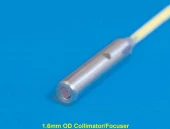
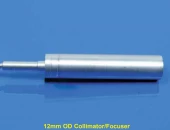
Description
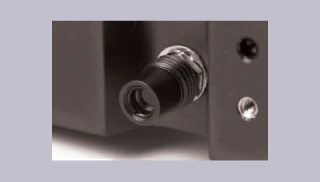
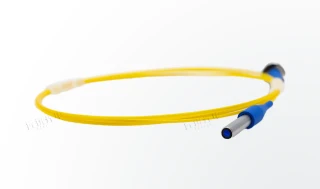
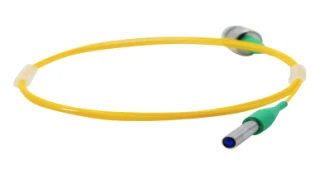
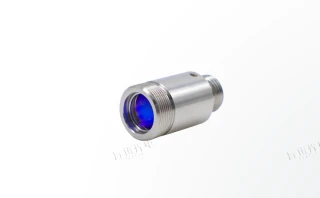
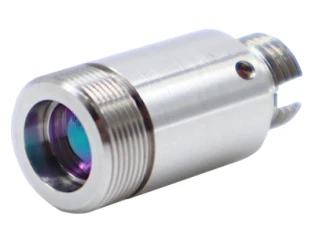
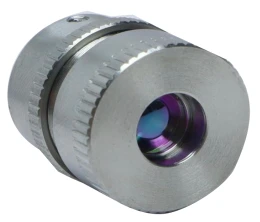
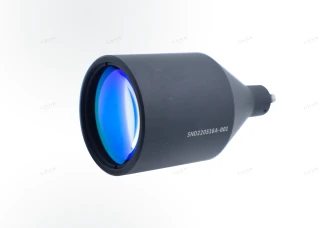
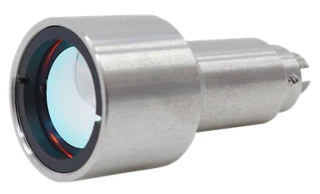
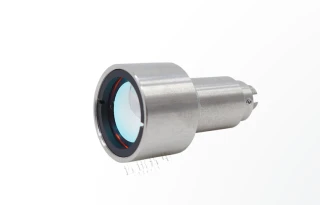
High-Performance Pigtail Style Fiber Collimators and Focusers
These pigtail style fiber collimators and focusers are precision‑engineered optical assemblies designed to transform light exiting an optical fiber into a well‑defined collimated beam, or to focus an incoming beam to a tightly controlled spot size. Built around diffraction‑limited optics and low backreflection terminations, they provide a robust, low-loss interface between fiber and free space, making them an essential building block in advanced photonics packaging and test setups.
Covering a very broad wavelength range from approximately 180 nm in the deep ultraviolet through 2000 nm in the near infrared, these devices support a wide array of laser and broadband sources commonly used in telecommunications, biomedical imaging, test and measurement, and industrial laser systems. The optical design leverages high‑quality GRIN, aspheric, achromatic, plano‑convex, and biconvex lenses to achieve diffraction‑limited performance across the specified spectrum. As a result, beam diameters from about 0.2 mm up to 22 mm and focused spot sizes as small as a few microns can be realized, depending on the chosen configuration and fiber type.
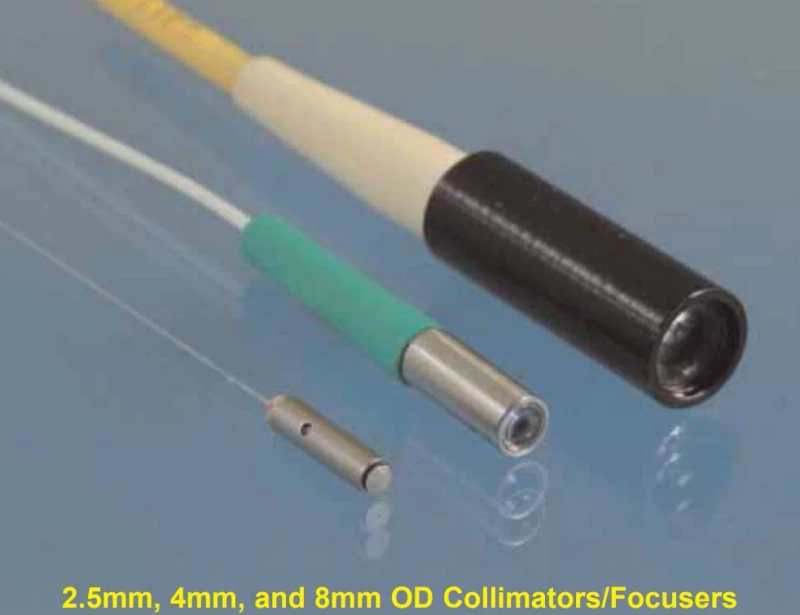
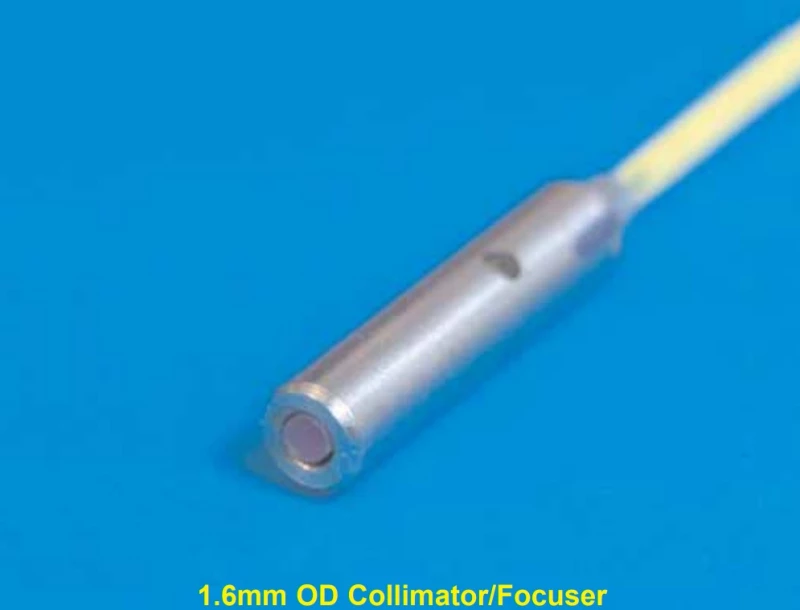
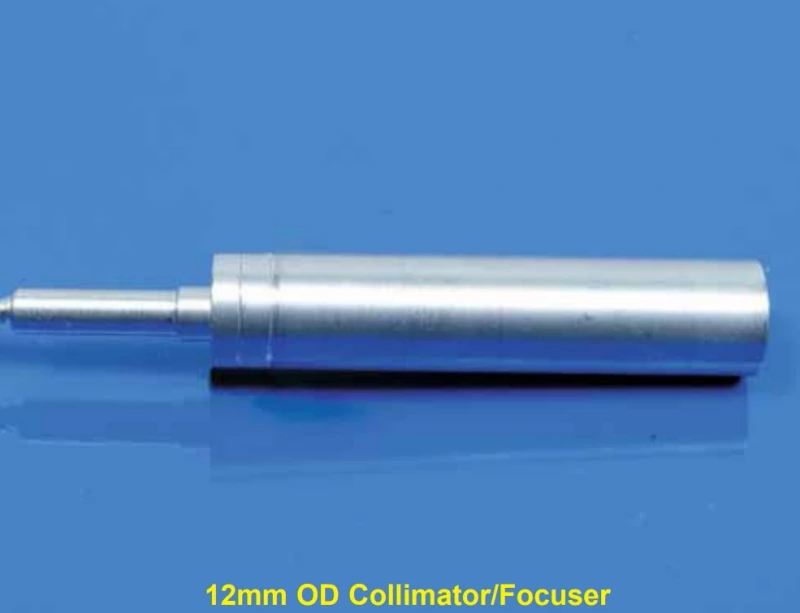
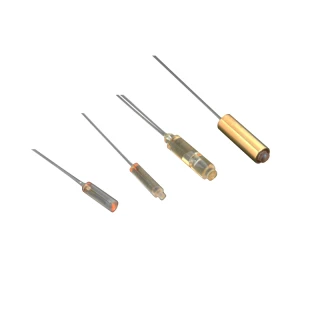
In pigtail style collimators and focusers, the fiber is permanently aligned and fixed relative to the lens inside a compact metal housing, eliminating the need for the user to perform delicate fiber‑to‑lens alignment. This construction not only simplifies integration, but also ensures excellent long‑term stability under mechanical and thermal stress. Typical designs are offered in outer diameters of approximately 1.6 mm, 2.5 mm, 4 mm, 8 mm, and 12 mm, providing mechanical compatibility with a wide range of mounts and optomechanical assemblies used in labs and OEM systems worldwide. Rugged strain‑relief boots protect the fiber pigtail and improve durability during handling and repeated mating.
From a system performance perspective, these collimators and focusers are optimized for low insertion loss and exceptionally low backreflection, which is particularly important when working with sensitive laser sources and interferometric measurements. In typical configurations, insertion loss can be as low as about 0.3 dB for short separations and remains under approximately 0.6 dB even at separations on the order of tens of millimeters. Multiple return loss (backreflection) levels are available, such as −35 dB, −40 dB, −50 dB, and −60 dB, allowing the user to match device performance to the coherence and feedback tolerance of the light source. For polarization‑sensitive applications, polarization‑maintaining (PM) versions with polarization extinction ratios around 20, 25, or 30 dB help preserve the input polarization state through the fiber‑to‑free‑space interface.
A key advantage of these pigtail style collimators and focusers is their compatibility with different fiber types and operational regimes. They are available in singlemode, multimode, and polarization‑maintaining variants, enabling optimized performance for coherent communication systems, high‑power delivery, sensing, and imaging. Singlemode versions are preferred when a clean Gaussian beam profile and minimal wavefront distortion are required, such as in coherent detection or interferometry. Multimode versions support higher optical power levels and larger core diameters, which are often used in illumination, pumping, or power‑delivery applications. PM versions are designed for systems where polarization integrity directly impacts measurement accuracy or system throughput, including coherent detection, quantum optics, and advanced spectroscopy.
The underlying beam characteristics follow well‑established Gaussian beam optics relationships between the fiber core diameter, numerical aperture, and lens focal length. For collimation, the resulting beam diameter is roughly proportional to the focal length and the fiber numerical aperture, while the divergence angle scales with the ratio of the fiber core size to the focal length. In focusing configurations, the lens equation connects object and image distances, and the focused spot size is directly related to the fiber core and magnification. Because fiber manufacturers can define numerical aperture in different ways (for example at 50 percent, 13.5 percent, 5 percent, or 1 percent intensity levels), care is taken to use consistent 1/e² definitions when predicting beam diameters and divergence, which leads to more accurate system‑level modeling and easier comparison between designs from different vendors.
Pigtail Style Collimators and Focusers
Specifications
| Center Wavelength: | 300 nm |
|---|---|
| Bandwidth: | 1820 nm |
| Wavelength Range: | 180 nm – 2000 nm |
| Backreflection Options: | -35, -40, -50, -60 dB |
| Polarization Extinction Ratio Options: | 20, 25, 30 dB |
| Beam Diameter Range: | 0.2 to 22 mm |
| Minimum Spot Size: | <5 µm |
| Wavefront Distortion: | λ/4 to λ/10 |
| Insertion Loss (60 Mm Separation): | ≤0.6 dB |
| Insertion Loss (10 Mm Separation): | ≤0.3 dB |
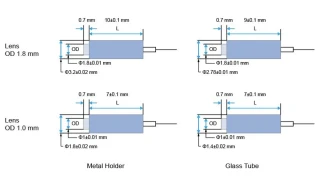
| Outer Diameter Options: | 1.6 mm, 2.5 mm, 4 mm, 8 mm, 12 mm |
| Jacket Outer Diameter (option 1): | Ø0.9 mm |
| Jacket Outer Diameter (option 2): | Ø3 mm |
| Housing Diameter (example): | Ø7.95/7.98 mm |
Got questions about specs? Use the inquiry form to ask.
 Download Data Sheet

Features
- High-Power Fiber Collimators & Focusers (Pigtail Style) – Engineered for demanding laser and photonics applications, supporting high optical power levels while maintaining stable beam quality.
- Wide Wavelength Coverage: 180 nm – 2000 nm – UV, visible, and IR compatible, enabling use with a broad range of light sources including laser diodes, supercontinuum sources, LEDs, and IR lasers.
- Low Insertion Loss – Optimized fiber–lens alignment and precision polishing deliver insertion loss as low as ≤0.3 dB (10 mm separation) and ≤0.6 dB (60 mm separation), maximizing overall system efficiency.
- Ultra-Low Backreflection – Available backreflection levels of -35, -40, -50, and -60 dB reduce feedback into lasers and sensitive components, improving source stability and measurement accuracy.
- Diffraction-Limited Optics – High-quality optical design ensures diffraction-limited performance for clean, well-defined beams and minimal aberrations, ideal for precision coupling and imaging.
- Flexible Beam Diameters & Spot Sizes – Supports collimated beam diameters from 0.2 mm to 22 mm and focused spot sizes down to <5 μm, enabling tight focusing for high-resolution and high-intensity applications.
- Multiple Lens Types Available – Choose from GRIN, aspheric, achromatic, plano-convex, and biconvex lenses to optimize performance for specific wavelength ranges, numerical apertures, and application needs.
- Supports Singlemode, Multimode, and Polarization-Maintaining Fibers – Configurable for SM, MM, and PM fibers, including polarization extinction ratios of 20, 25, or 30 dB, ensuring compatibility with a wide variety of fiber-based systems.
- Optimized Wavefront Quality – Wavefront distortion as low as λ/4 to λ/10 helps preserve beam profile and phase front, critical for interferometry, coherent detection, and high-precision metrology.
- Matched Collimator–Focuser Pairs – Can be used in pairs for efficient free-space coupling into and out of optical components such as WDMs, splitters, modulators, and integrated optics devices.
- Rugged, Compact Mechanical Design – Robust pigtail-style construction with small outer diameters (e.g., 1.6 mm, 2.5 mm, 4 mm, 8 mm, and 12 mm options) and strain‑relief boots for reliable integration into dense optical packages and instruments.
- Easy Integration into Fiber Optic Packaging – Ideal for fiber optic device packaging, including WDMs, splitters, integrated optics, acousto-optic modulators, photodiodes, and optical sensors.
- Excellent for Coupling Applications – Designed for efficient source-to-fiber and fiber-to-detector coupling, improving signal levels in systems such as test setups, optical transmitters, and receiver modules.
- OCT and Imaging Ready – Small achievable spot sizes and low wavefront error make these collimators/focusers well-suited for optical coherence tomography (OCT), biomedical imaging, and scanning applications.
- Supports Precise Beam Engineering – Beam diameter (BD) and divergence angle (DA) are predictable and controllable using BD = 2 × f × NA and DA = a / f, simplifying optical design and alignment.
- Versatile Jacket and Connector Options – Available with standard fiber jackets (e.g., 0.9 mm and 3 mm) and compatible with common connector styles for quick integration into existing fiber networks and benchtop setups.
- Cost-Effective Performance – Combines low cost with premium optical performance, providing a competitive solution for OEMs and system integrators requiring scalable, high-volume deployment.
- Ideal for R&D and OEM Systems – Suitable for laboratory experiments as well as OEM integration in telecom, industrial, medical, and sensing systems where stable, repeatable free-space–fiber coupling is essential.
Applications
- Fiber optic device packaging and assembly – Precision collimation and focusing for integrating WDMs, splitters, couplers, circulators, isolators, VOAs, and integrated optical components into fiber‑based modules.
- Source‑to‑fiber coupling – Efficiently couple free‑space laser sources (laser diodes, DPSS lasers, tunable lasers, supercontinuum sources) into singlemode, multimode, or PM fibers over 180–2000 nm.
- Fiber‑to‑detector coupling – Focus light from fiber pigtails onto photodiodes, APDs, PMTs, InGaAs detectors, cameras, and array detectors with micrometer‑scale spot sizes.
- OCT (Optical Coherence Tomography) systems – Collimation and focusing in sample and reference arms, fiber‑based interferometers, catheter probes, and endoscopic OCT imaging heads.
- Free‑space to fiber interfaces in test & measurement – Fiber pigtail collimators/focusers for optical benches, alignment stations, optical power meters, spectrum analyzers, and network analyzers.
- Fiber pigtailed laser diode modules – Integrating laser diodes and superluminescent diodes (SLDs) into robust fiber‑coupled modules with high coupling efficiency and low backreflection.
- Fiber pigtailed detector and receiver modules – Creating compact receiver heads and fiber‑coupled detector modules for telecom, datacom, and sensing applications.
- Beam shaping and mode conditioning – Adjusting beam diameter, NA, and wavefront quality using GRIN, aspheric, achromatic, plano‑convex, and biconvex lens options for diffraction‑limited performance.
- Polarization‑sensitive systems – Use with PM fibers and controlled polarization extinction ratios in interferometers, coherent detection, and quantum optics experiments.
- Telecom and datacom optical links – Free‑space coupling between fibers and components in DWDM, CWDM, ROADM, and high‑bit‑rate transmission systems.
- Integrated optics and photonic chip coupling – Fiber‑to‑chip and chip‑to‑fiber coupling for silicon photonics, InP, LiNbO₃, and PLC waveguides in both R&D and production environments.
- Fiber‑based interferometry – Michelson, Mach–Zehnder, and Fabry–Pérot interferometers for metrology, vibration analysis, displacement sensing, and coherence measurements.
- Laser beam delivery systems – Delivering well‑defined collimated or focused beams from fibers to workpieces in micromachining, scribing, trimming, and precision laser processing setups.
- Medical and biomedical optics – Fiber‑based illumination and collection for endoscopy, minimally invasive surgery, photoacoustic imaging, confocal and multiphoton microscopy interfaces.
- Industrial sensing and monitoring – Fiber‑coupled probes for process control, position sensing, thickness measurement, and machine‑vision illumination.
- Spectroscopy and hyperspectral systems – Coupling fibers to spectrometers and monochromators; launching and collecting light in Raman, fluorescence, absorption, and reflectance setups.
- LIDAR and range‑finding – Fiber‑based transmit/receive optics with controlled beam diameters for TOF, frequency‑modulated, and coherent LIDAR systems.
- Free‑space optical communications – Collimating and focusing beams for short‑range FSO links, indoor optical wireless, and line‑of‑sight fiber–free‑space–fiber connections.
- Optical alignment and metrology tools – Reference collimated beams for alignment of optical components, system calibration, and verification of optical axis and focus positions.
- Laser scanning and imaging systems – Use as input/output optics for galvo scanners, polygon scanners, and 2D/3D imaging systems requiring stable, well‑defined beam profiles.
- Microscopy coupling – Fiber‑coupled excitation and collection in confocal, fluorescence, and multiphoton microscopes, including scanning fiber endoscopes and probe‑based imaging.
- High‑power fiber delivery – Robust collimators for high‑power fiber lasers and amplifiers in material processing, marking, and welding where high damage threshold and low loss are critical.
- Research & development in photonics – General‑purpose collimation/focusing modules for laboratories working on new laser sources, nonlinear optics, optical clocks, and quantum communications.
- Educational and training setups – Teaching tools in university optics and photonics labs to demonstrate fiber coupling, Gaussian beam propagation, and numerical aperture concepts.
Frequently Asked Questions
What are pigtail-style fiber collimators and focusers and how are they used?
What wavelength range do these collimators and focusers support and are they suitable for high-power lasers?
How do I choose the correct beam diameter or focused spot size for my application?
What is the difference between collimators and focusers, and can they be used as matched pairs?
What are the fiber options (singlemode, multimode, polarization maintaining) and how do they affect performance?
How low are the insertion loss and backreflection, and why are they important for my system?
What mechanical sizes are available and how do I integrate these collimators into my setup?
Got more questions? Use the inquiry form to ask the supplier directly.
Similar Products

Your inquiry has been received.
Create an account by adding a password
Why create an account?
- Auto-complete inquiry forms
- View and manage all your past messages
- Save products to your favorites
- Close your account anytime — no hassle