
Motorized Stages for Precision Positioning




Frequently Asked Questions
What is a motorized stage and how does it differ from a manual translation stage?
A motorized stage is a precision positioning platform driven by an electric actuator—typically a stepper motor, DC servo, piezo, or linear motor—rather than by hand-adjusted micrometers. Compared with manual stages, motorized stages provide programmable motion profiles, closed-loop positioning (with encoders), higher repeatability, and automated integration into experimental or production workflows via motion controllers and software APIs.
How do stepper, servo, and piezo-driven motorized stages work, and when is each type used?
Stepper-driven stages use discrete motor steps (often with microstepping) to achieve moderate speed and sub-micron to a few micron resolution, making them suitable for general-purpose positioning where open-loop control may be acceptable. Servo stages use DC or brushless motors with encoder feedback to achieve higher speeds, dynamic response, and true closed-loop positioning, preferred in scanning or high-throughput systems. Piezo-driven stages use piezoelectric actuators for nanometer-level resolution, very short strokes, and fast response, ideal for fine focus, interferometry, and vibration-sensitive applications.
What are the main sub-types of motorized stages (e.g., linear, rotation, XY, Z, goniometer) and their typical use cases?
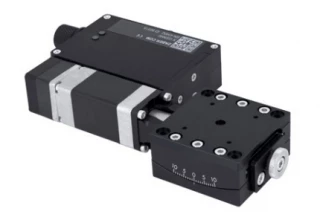
Linear motorized stages provide one-dimensional translation and are used for beam alignment, sample scanning, and focusing over a defined travel range. Rotary stages provide angular positioning around a single axis for tasks such as polarizer rotation, sample orientation, or spectrometer component alignment. XY and XYZ stacks combine multiple linear axes, while Z and vertical-lift stages handle focus and height control; motorized goniometers provide tilting about a point for angular alignment of optics, crystals, or detectors relative to a beam.
Which key specifications should I consider when selecting a motorized stage for a photonics setup?
Critical parameters include travel range, load capacity (static and dynamic), minimum incremental motion (step size), resolution, accuracy, bidirectional repeatability, and straightness/flatness of motion. You should also evaluate speed, acceleration, backlash, stiffness, resonant frequency, and the type of feedback (linear encoder vs. rotary encoder vs. open loop), as these directly affect beam pointing stability and measurement precision. Environmental factors such as vacuum compatibility, outgassing, and thermal stability may be important in laser and optical experiments.
How do I compare different motorized stages for beam alignment, sample positioning, or scanning applications?
For beam alignment, prioritize angular stability, minimal pitch/yaw, and high repeatability over long travels, often with low profile and high stiffness to reduce drift. For sample positioning and scanning, compare stages by their usable scan speed, trajectory smoothness, encoder resolution, and runout/straightness, as well as how well their controller integrates with your DAQ or imaging software. Also assess cable management, mounting hole patterns, and compatibility with existing optical tables, rails, or cage systems to avoid mechanical adapters that can introduce flexure.
What factors influence lead time, customization, and pricing for motorized stages?
Lead time and price are driven by actuator type (piezo and linear motor systems typically cost more and may have longer lead times), encoder technology, travel length, precision grade, and environmental options such as vacuum or cleanroom preparation. Customization—such as special mounting interfaces, non-standard travel, higher-load bearings, or integrated limit/home sensors and cabling—adds engineering time and usually extends delivery schedules. OEM volumes can reduce per-unit pricing, but initial NRE (non-recurring engineering) charges may apply for custom designs.
Motorized Stages for Photonics and R&D
Motorized Stages provide controlled linear or rotary motion for alignment, positioning, and scanning tasks in optics, photonics, and scientific instrumentation. On FindLight you can compare motorized stages across travel range, load capacity, resolution, accuracy, repeatability, and environmental compatibility to match your application requirements.
Key Types of Motorized Stages
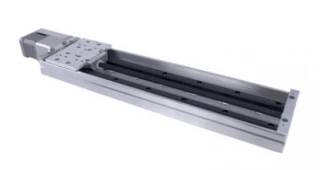
Linear Motorized Stages offer single-axis translation for beam alignment, sample positioning, or focal adjustment. They differ by drive technology (ball screw, linear motor, piezo), encoder type, maximum speed, and guidance (crossed-roller, recirculating bearing, air bearing).
Custom Vacuum Compatible Motorized Stages are designed for high or ultra-high vacuum environments. They use vacuum-rated lubricants, low outgassing materials, and appropriate feedthroughs while maintaining precise motion and position feedback under vacuum.
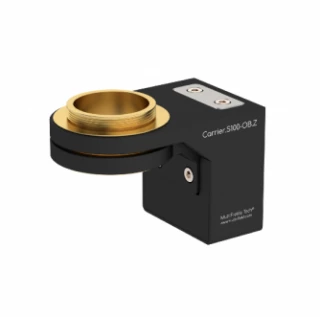
Rotary Motorized Stages provide controlled angular positioning for optics mounts, wafers, filters, or fixtures. Selection parameters include aperture size, angular range, torque, wobble, eccentricity, and bidirectional repeatability.
Vertical Motorized Stages support Z-axis motion against gravity for focusing, sample lifts, or objective positioning. Critical factors are load capacity, counterbalance or lift mechanism, straightness of travel, and position stability under varying loads.
Motorized Goniometers allow precise tilting about a defined center of rotation. They are used for crystal alignment, incidence-angle tuning, and metrology. Consider angular resolution, travel range, and the distance between pivot and mounting surface.
Gantry Systems combine multiple motorized stages into multi-axis platforms for large-area scanning, inspection, or precision assembly. Evaluate stiffness, orthogonality, dynamic performance, and cable management.
Motorized Stage Accessories include controllers, cables, adapter plates, and brackets that integrate Motorized Stages into complete motion systems.
Buyer Guidance on FindLight
When sourcing motorized stages, compare datasheets for encoder resolution, accuracy, repeatability, backlash, speed, and load ratings, as well as motor type and controller interface (USB, Ethernet, RS-232, or fieldbus). Confirm mounting patterns, aperture size, and compatibility with your existing opto-mechanical hardware.
Use FindLight to browse all motorized stages, filter by key specifications, and contact multiple suppliers for technical questions or customization. You can request quotes directly from vendors without registration, streamlining procurement for both laboratory setups and OEM systems.