
Precision Optical Tables and Isolation Platforms


Frequently Asked Questions
What is an optical table and how does it differ from a simple laboratory workbench?
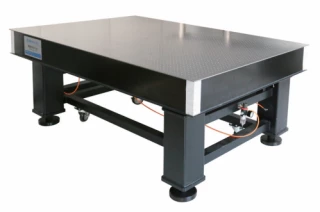
An optical table is a vibration-isolated, precision-engineered platform with a flat, stiff top used to mount and align optical components with high positional stability. Unlike simple workbenches, optical tables typically feature a steel honeycomb or similar core, a grid of threaded holes (often M6 or 1/4-20), and are paired with passive or active isolation systems to suppress mechanical vibrations over a wide frequency range.
How do vibration isolation systems in optical tables work?
Most optical tables use pneumatic (air-spring) isolators or active electronic isolators between the table top and the floor to attenuate vibrations. Pneumatic isolators act as low-pass mechanical filters with a natural resonance (often around 1–3 Hz) and high attenuation at higher frequencies, while active systems add sensors and actuators to sense motion and apply counteracting forces, improving isolation at low frequencies and under changing load conditions.
What are the main sub-types of optical table platforms and their typical use cases?
Common sub-types include optical breadboards, full optical tables, and table systems with integrated frames. Breadboards are thinner, lighter plates for benchtop setups or smaller experiments, while full tables are thicker, larger, and designed for high-stability laser and interferometry setups; integrated frames provide an engineered structure with leveling, isolation, and sometimes overhead structures for mounting accessories or enclosures.
Which technical specifications are most important when selecting an optical table?
Key parameters include table thickness, core construction (e.g., steel honeycomb cell size), static and dynamic stiffness, damping performance, and the vibration transmissibility curve of the isolation system. You should also consider material and surface finish (e.g., stainless steel vs. aluminum), hole pattern and spacing, load capacity, and flatness over the working area relative to your alignment tolerances.
How can I compare the vibration performance of different optical tables?
Compare manufacturer-provided compliance or mobility plots, which show table surface deflection versus excitation frequency, and transmissibility curves for the isolators, which indicate vibration attenuation vs. frequency. Also review damping time for a known impulse, resonant frequency peaks and their Q-factors, and ensure all data are specified under similar conditions (table size, loading, support points) for a meaningful comparison.
What factors influence lead time and pricing for optical tables, and what customization options are typical?
Lead times and pricing are driven by table size and thickness, isolation type (rigid, passive pneumatic, or active), material choice, and any non-standard hole patterns or surface treatments. Typical custom options include custom dimensions, special grid patterns or thread types, through-holes or cutouts for beam paths, reinforced sections for heavy equipment, and integration with custom frames, enclosures, or lift mechanisms.
What Are Optical Tables?
Optical Tables provide a rigid, low-vibration platform for building and aligning optical setups, from basic beam paths to complex interferometers. Their honeycomb or ribbed cores, combined with damped skins and precision-drilled hole patterns, minimize deflection and resonance so that alignment remains stable over time.
Breadboards and Optical Table Tops
Breadboards and table tops are the primary structural elements within the Optical Tables category. Breadboards are typically smaller plates used on existing lab benches or isolation systems, while full-size table tops support larger beamlines and multi-module experiments. Key specifications include thickness, flatness, surface finish, and core construction (steel honeycomb vs solid or composite cores).
- Thread pattern and spacing: Commonly M6 or 1/4-20 on 25 mm or 1 in grids; ensure compatibility with your opto-mechanical mounts.
- Damping performance: Internal damping treatments and tuned resonances reduce ringing from mechanical shocks.
- Magnetic vs non-magnetic: Select non-magnetic Optical Tables for sensitive magneto-optic or high-field experiments.
Vibration Isolation and Active Vibration Isolation
Vibration Isolation systems decouple optical tables from floor-borne disturbances. Passive systems (air legs, elastomer mounts) provide isolation above their natural frequency and are often sufficient for general R&D and laser alignment.
Active Vibration Isolation adds sensors and actuators to detect and cancel motion in multiple axes. These platforms are suited for high-resolution interferometry, microscopy, and ultra-stable laser cavities, where sub-micron stability over a broad frequency range is required.
Buyer Guidance on FindLight
When comparing Optical Tables on FindLight, evaluate load capacity, static deflection, top-plate material, and resonant frequency relative to your lab environment and equipment mass. For vibration isolation stages, compare payload range, isolation bandwidth, and settling time, as well as the interface to your chosen table top or breadboard.
Use the subcategory filters for Breadboards and Table Tops, Vibration Isolation, and Active Vibration Isolation to narrow down options. You can request quotes directly from multiple manufacturers for all optical tables listed on FindLight, obtain pricing and lead times, and communicate technical requirements without registration.