
Fiber Lasers for Research, OEM, and Industrial Use
Frequently Asked Questions
What is a fiber laser and how does it differ from other solid-state lasers?
A fiber laser is a solid-state laser where the gain medium is a rare-earth-doped optical fiber (typically Yb, Er, Tm, or Ho) pumped by laser diodes. Unlike bulk solid-state lasers that use crystal or glass rods, fiber lasers guide light in a waveguide geometry, enabling long interaction lengths, high optical gain, efficient heat dissipation, and excellent beam quality with inherently monolithic alignment-free construction.
How does light generation and amplification occur inside a fiber laser?
In a fiber laser, pump diodes inject light into the cladding or core of a doped fiber, exciting the rare-earth ions to higher energy levels. Stimulated emission in the fiber core amplifies the signal wavelength, which is confined by total internal reflection; cavity feedback is provided by fiber Bragg gratings or other integrated resonator components, producing CW or pulsed output depending on the cavity design and modulation scheme.
What are the main types of fiber lasers and their typical use cases?
Key types include CW single-mode Yb-doped fiber lasers for cutting, welding, and marking in the 1 µm band, and high-power multimode versions for bulk materials processing. Ultrafast fiber lasers (mode-locked, ps/fs) are used for micro-machining and nonlinear optics, while Er- and Tm-doped fiber lasers in the 1.5–2 µm range are favored for telecom testing, medical applications, and eye-safer LiDAR. There are also fiber MOPAs (master oscillator power amplifiers) that combine a low-power seed with multi-stage amplification for high-peak-power pulsed operation.
Which key specifications should I evaluate when selecting a fiber laser for my application?
Critical parameters include output wavelength, average power, beam quality (M²), and delivery fiber type/core size, which together determine processing capability and focusability. For pulsed systems, pulse duration, pulse energy, repetition rate, and peak power are essential, along with temporal pulse shape and available modulation formats (Q-switched, mode-locked, MOPA). You should also review stability specs (power and pointing stability), polarization state (PM vs non-PM), and allowable back-reflection if you are working with reflective targets.
How do I compare fiber lasers in terms of integration and system-level compatibility?
Compare electrical interface (supply voltage, power consumption, control protocol such as analog, TTL, RS-232, Ethernet, or CAN) and available monitoring signals to ensure compatibility with your motion or PLC system. Mechanically, check form factor, cooling method (air-cooled vs water-cooled), environmental ratings, and output connector (e.g., QBH, QCS, SMA, FC/APC) for compatibility with your optics or processing head. Also assess safety features (interlocks, key switch, shutter), built-in diagnostics, and supported standards (e.g., IEC 60825) for integration into your safety architecture.
What factors influence lead time, customization options, and pricing for fiber lasers?
Lead time is typically driven by configuration complexity, required qualifications (e.g., burn-in, MIL/space testing), and availability of pump diodes and specialty fibers; common configurations may ship within a few weeks, while highly customized systems can require several months. Pricing is strongly affected by output power, pulse performance (ultrafast or high-peak-power), beam quality, and any custom fiber delivery, packaging, or electronic control options. Customization often includes wavelength selection via specific dopants and Bragg gratings, tailored pulse parameters, custom connectors, and OEM modules instead of turnkey systems.
Overview of Fiber Lasers
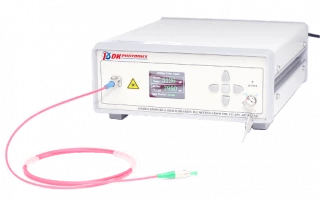
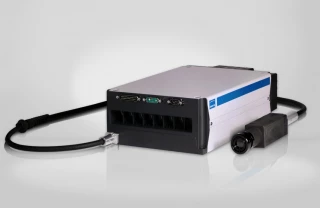
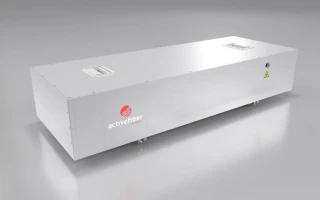
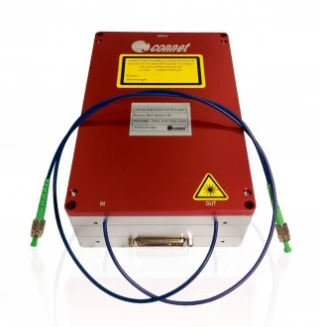
Fiber Lasers are solid-state light sources in which the gain medium is a doped optical fiber, typically ytterbium, erbium, thulium, or holmium. Pump diodes inject energy into the fiber core, where stimulated emission generates a diffraction-limited, robust output beam. Thanks to efficient heat dissipation and an inherently waveguided geometry, fiber lasers support compact, alignment-free layouts, long lifetimes, and high optical efficiency.
On FindLight, you can source Fiber Lasers for precision materials processing, telecom and LIDAR development, nonlinear optics, metrology, and general laboratory use. Products span low-power single-frequency units up to high-power multi-kilowatt systems.
Key Types of Fiber Lasers and Related Sources
CW Fiber Lasers provide continuous output for applications such as cutting, welding, soldering, pumping OPOs, optical trapping, and interferometry. Core parameters include output power, wavelength, beam quality (M²), spectral linewidth, and stability.
Pulsed Fiber Lasers generate microsecond to nanosecond pulses for marking, drilling, micromachining, and range finding. When comparing models, review pulse energy, peak power, repetition rate, pulse duration, and triggering options.
Ultrafast Fiber Lasers produce picosecond and femtosecond pulses for nonlinear spectroscopy, frequency comb generation, multi-photon microscopy, and precision microfabrication. Evaluate pulse width, timing jitter, average power, and pulse dispersion management.
Fiber Amplifiers boost seed sources from narrow-linewidth or ultrafast Fiber Lasers. Important specifications include small-signal gain, saturation power, noise figure, polarization handling, and gain bandwidth.
Broadband & Supercontinuum Sources use nonlinear broadening in fiber to create wide spectral bandwidths for spectroscopy, OCT, and component characterization. Assess spectral coverage, spectral power density, and temporal properties.
Fiber Optics & Laser Accessories include delivery fibers, collimators, isolators, combiners, connectors, and protection modules needed to integrate Fiber Lasers into your setup safely and efficiently.
Buyer Guidance on FindLight
When selecting Fiber Lasers, compare wavelength, average power, pulse regime (CW, pulsed, ultrafast), beam quality, polarization, cooling requirements, and electrical interfaces. Also consider form factor, rack or benchtop integration, and available monitoring and control software.
Use FindLight to filter Fiber Lasers by specification, review datasheets, and benchmark multiple models side by side. You can contact manufacturers directly and request quotes without registration, streamlining component selection for both R&D experiments and OEM system design.