
Optical Filters for Research, Imaging & Laser Applications


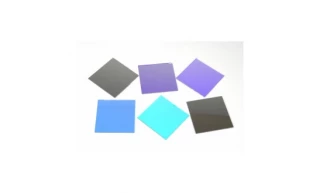

Frequently Asked Questions
What are optical filters and how do they function in photonic systems?
Optical filters are components that selectively transmit, reflect, or absorb light as a function of wavelength, polarization, or angle of incidence. They are used to isolate spectral bands, block unwanted light, or shape emission/illumination profiles in systems such as fluorescence microscopes, laser setups, and imaging sensors. Their behavior is defined by a transmission spectrum, typically measured at a specified angle and for a given polarization state.
What is the difference between absorptive and interference (dichroic) filters?
Absorptive filters use dyed glass or plastic substrates that attenuate specific wavelength bands via absorption, converting unwanted light into heat; they usually have broad transition regions and are less sensitive to incidence angle. Interference filters use thin-film dielectric coatings that create constructive and destructive interference, enabling steep spectral edges, high peak transmission, and deep blocking (high OD). Interference filters are more angle-sensitive and polarization-dependent, but provide tighter spectral control and higher performance for precision applications.
What are common sub-types of optical filters and their typical use cases?
Key sub-types include bandpass filters (transmit a defined wavelength band), longpass/shortpass filters (cut-on or cut-off at a specific edge), notch filters (reject a narrow band while passing surrounding wavelengths), and neutral density (ND) filters (attenuate uniformly over a broad spectrum). Dichroic beam-splitting filters reflect one spectral band while transmitting another, often used in fluorescence and multi-color imaging. Polarizing filters selectively transmit one polarization state and are used for contrast enhancement, glare reduction, and polarization-based measurements.
Which technical specifications are most important when selecting an optical filter?
Critical parameters include central wavelength (CWL) or cut-on/cut-off wavelength, full width at half maximum (FWHM) for bandpass filters, peak transmission, and optical density (OD) in the blocking regions. You should also consider surface quality (e.g., 20-10 scratch-dig), substrate material and thickness, damage threshold for high-power lasers, angle of incidence, and environmental durability (e.g., MIL or ISO coating stability). For imaging systems, wavefront distortion and coating uniformity across the clear aperture are also important.
How do I compare filters for a specific laser or detector application?
Match the filter’s passband or notch band precisely to the laser wavelength or detector sensitivity curve, accounting for expected angle of incidence and temperature shifts that can move the effective CWL. For laser-line applications, look for very narrow FWHM, high peak transmission at the laser wavelength, and high OD blocking at nearby spontaneous emission lines. For detector protection or fluorescence imaging, compare blocking levels (OD vs. wavelength), out-of-band leakage, and any induced wavefront error that might affect image quality.
What factors influence lead time, customization options, and pricing for optical filters?
Lead time and price are driven by filter complexity (e.g., narrowband interference vs. simple absorptive glass), coating design (number of layers), substrate size and shape, and required tolerances on CWL, FWHM, and flatness. Custom options may include non-standard wavelengths, custom bandwidths, specific AOI designs, custom apertures or mounts, anti-reflection coatings on additional surfaces, and laser damage threshold optimization. Small-quantity, highly customized thin-film filters generally have longer lead times and higher unit costs than catalog glass or standard coated parts.
Optical Filters are passive components used to selectively transmit, reflect, or attenuate specific wavelength bands in a light path. In light transport systems, Filters shape the spectral content, intensity, and direction of beams for imaging, sensing, spectroscopy, and laser processing. On FindLight you can evaluate and source a broad range of Filters from multiple manufacturers without registration.
Key Types of Filters Available
Bandpass Filters transmit a defined wavelength band while blocking shorter and longer wavelengths. They are common in fluorescence imaging, machine vision, and laser line isolation.
Color Glass Filters use absorptive glass compositions to tailor spectral response. These Filters provide stable, broad-band shaping of visible and near-IR spectra and are often used in illumination and photography systems.
Neutral Density Filters (ND) provide spectrally flat attenuation, reducing beam intensity without significantly changing spectral distribution. They are essential for laser power adjustment and detector linearity control.
Shortpass Filters transmit wavelengths below a specified cutoff and block longer wavelengths, useful for isolating blue/UV bands or rejecting IR background.
Longpass Filters do the opposite, transmitting wavelengths above a cutoff. These Filters are frequently used for fluorescence emission collection and stray-light suppression.
Notch Filters reject a narrow spectral band while transmitting on both sides of the notch. They are ideal for laser line suppression in Raman spectroscopy and other analytical instruments.
Dichroic Filters (beam-splitter coatings) reflect one spectral band while transmitting another, enabling wavelength multiplexing and beam routing in compact optical assemblies.
Buyer Guidance on FindLight
When selecting Filters for your application, compare center or cutoff wavelength, bandwidth, edge steepness, optical density (OD), transmission, substrate material, clear aperture, and damage threshold for laser use. Verify angle of incidence requirements, polarization sensitivity, and coating durability, especially for high-power or outdoor systems.
Use FindLight to browse and filter the available optical Filters by wavelength range, spectral type (bandpass, longpass, shortpass, notch, dichroic, neutral density, color glass), and mechanical format. Access detailed datasheets, compare specifications across suppliers, and request quotes directly from manufacturers. All quote requests for Filters can be made without registration, streamlining sourcing for procurement engineers and R&D teams.