
Manual Stages for Precision Motion Control


Frequently Asked Questions
What is a manual stage and how does it work in a motion control setup?
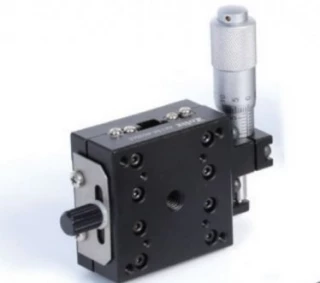
A manual stage is a mechanical positioning device that provides precise linear or rotary motion controlled directly by the user via micrometers, thumbscrews, or fine adjustment knobs. Motion is typically guided by crossed-roller bearings, ball bearings, or dovetail slides, while the actuator converts rotational input into linear travel through a lead screw or micrometer thread. They are used wherever low-speed, high-resolution alignment is needed without motors or controllers.
What are the common types of manual stages and their primary use cases?
Common types include linear translation stages (single-axis motion), XY or XYZ stages (stacked multi-axis motion), rotation stages (angular adjustment around a central axis), and goniometers (tilt stages for angular positioning about an off-center pivot). Linear stages are used for focusing, beam alignment, and sample positioning, while rotation and goniometer stages are used for angular alignment of optics, samples, and sensors. Z-translation or lift stages provide vertical motion, often combined with XY for 3D positioning in microscopy and photonics experiments.
What key technical terms should I know when working with manual stages (travel, resolution, straightness, etc.)?
Travel range is the maximum usable linear or angular displacement of the stage, while resolution is the smallest incremental movement achievable, typically defined by the micrometer or screw pitch (e.g., 0.5 mm/rev with 50 divisions → 10 µm per division). Straightness and flatness specify how much the moving platform deviates from an ideal straight line or plane, often in micrometers over the full travel, and pitch/yaw/roll errors quantify unwanted angular motions. Load capacity and moment capacity define how much weight or torque the stage can support without excessive deflection or binding.
Which parameters matter most when selecting a manual stage for optical alignment?
For optical alignment, key parameters include travel range, minimum achievable step size (resolution), and repeatability, as these govern how precisely you can position and return to a given point. Straightness, angular error (pitch/yaw/roll), and stiffness are critical to maintain beam pointing stability, especially over long optical paths. You should also consider mounting interface (hole patterns, thread types), material/finish (for thermal stability and vacuum compatibility), and compatibility with existing posts, rails, or breadboards.
How should I compare different manual stages in terms of load, bearings, and actuators?
Compare load and moment capacities against your actual payload, including optics, fixtures, and any off-center masses, and ensure a safety margin to limit deflection. Bearing type strongly affects performance: crossed-roller bearings offer high stiffness and low friction for precision alignment; ball bearings provide smoother motion at moderate precision; dovetail slides are robust and compact but have higher friction and lower straightness. Actuator choice (standard screw, differential micrometer, fine-pitch micrometer) will dictate resolution, backlash behavior, and feel during adjustment.
What are typical lead times and customization options for manual stages, and what drives pricing?
Standard manual stages are often available from stock to a few weeks, while customized hole patterns, special travel ranges, vacuum-compatible versions, or non-magnetic materials can extend lead times to several weeks or more. Pricing is driven by bearing type and precision class (straightness, flatness, repeatability specs), travel length, and actuator complexity (e.g., differential or encoded micrometers). Additional costs may arise from custom machining, specialized coatings, or integration into multi-axis assemblies.
Overview of Manual Stages
Manual Stages are mechanical positioning devices used to finely adjust the position or angle of components in optical, photonics, and scientific setups. They rely on micrometer drives, fine-pitch screws, or differential adjusters to translate small hand adjustments into precise linear or rotary motion. Manual Stages are essential where repeatable positioning is required but motorized automation is not necessary or practical.
Key Types of Manual Stages
Linear Stages provide translation along a single axis for tasks such as aligning lenses, mirrors, or fiber couplers. Key parameters include travel range, load capacity, resolution, straightness, and pitch/yaw errors. Many linear Manual Stages use crossed-roller bearings or dovetail slides, which differ in stiffness, smoothness, and load performance.
Rotary Stages enable manual rotation around a central axis, typically for angular positioning of optical mounts, prisms, or samples. When evaluating rotary Manual Stages, review rotation range (e.g., 360° continuous or limited arcs), graduation accuracy, wobble, runout, and the type of locking mechanism.
Goniometer Stages provide precise angular tilt about a point in space, often located above the stage surface. These Manual Stages are used for setting incidence angles in spectroscopy, crystal alignment, or beam steering. Important specs include center-of-rotation height, angular travel, resolution, and angular deviation from the ideal pivot.
Vertical Manual Stages (Z-stages or lift stages) offer motion along the vertical axis to change focus position, sample height, or working distance. Selection criteria include load capacity versus counterbalance or spring design, vertical runout, parallelism, and sensitivity to off-center loading.
Buyer Guidance on FindLight
When selecting Manual Stages on FindLight, compare specifications such as travel range, resolution, repeatability, load capacity, mounting pattern, and bearing type to match your experimental or integration needs. Use the platform to review datasheets for Linear Stages, Rotary Stages, Goniometer Stages, and Vertical Manual Stages across multiple manufacturers.
You can request quotes for any listed Manual Stages directly from suppliers, ask technical questions, and evaluate delivery terms without registration. This allows procurement engineers and R&D teams to rapidly shortlist Manual Stages that meet mechanical, optical, and budget constraints while maintaining full technical transparency.