
Laser Scanning and Ranging Solutions

Frequently Asked Questions
What is LiDAR technology and how does it work?
LiDAR (Light Detection and Ranging) technology uses laser light to measure distances and create 3D models of objects and environments. A LiDAR device emits a laser beam and measures the time it takes for the beam to bounce back from objects in its path. By collecting and analyzing this data, LiDAR devices can create highly accurate 3D models of objects and environments.
What are the main advantages of using LiDAR technology?
The main advantages of using LiDAR technology include high accuracy, speed, and the ability to capture detailed 3D data of objects and environments. LiDAR technology is widely used in various industries, including surveying, mapping, environmental monitoring, and autonomous vehicles.
What is a laser scanner and how is it different from LiDAR?
A laser scanner is a device that uses laser technology to measure distances and create 3D models of objects and environments. While LiDAR also uses laser technology, it typically refers to devices that use a scanning laser beam to generate 3D data. Laser scanners, on the other hand, use a fixed laser beam that scans across an object or environment to capture 3D data.
What are some common applications of laser scanning and ranging technology?
Laser scanning and ranging technology is commonly used in a variety of industries, including surveying, mapping, environmental monitoring, and construction. It can be used to create detailed 3D
What is the difference between 2D and 3D laser scanning?
2D laser scanning captures data along a single plane, creating a 2D image. 3D laser scanning captures data along multiple planes to create a 3D image. 3D laser scanning is typically more accurate and detailed than 2D laser scanning.
What is the range of laser scanning and ranging devices?
The range of laser scanning and ranging devices can vary widely depending on the device and its intended use. Some devices are capable of measuring distances up to several hundred meters, while others are designed for short-range scanning and imaging.
What types of lasers are used in laser scanning and ranging devices?
A variety of lasers can be used in laser scanning and ranging devices, including diode lasers, fiber lasers, and solid-state lasers. The type of laser used will depend on the specific application and requirements of the device.
What is the accuracy of laser scanning and ranging devices?
The accuracy of laser scanning and ranging devices can vary widely depending on the device and its intended use. High-end devices are capable of sub-millimeter accuracy, while lower-end devices may have accuracy in the range of several millimeters.
Overview of Laser Scanning and Ranging
Laser Scanning and Ranging systems use coherent or incoherent light sources to measure distance, map surfaces, and detect objects with high spatial resolution. By emitting laser pulses or continuous beams and analyzing the returned signal, these devices provide accurate range data for automation, surveying, robotics, safety, and scientific experiments.
On FindLight you can source a variety of Laser Scanning and Ranging products, including LiDAR units, laser scanners and rangefinders, and compact distance sensors tailored for integration into OEM systems.
Key Types of Laser Scanning and Ranging Devices
LiDAR (Light Detection and Ranging) systems typically employ pulsed lasers with time-of-flight (ToF) detection to build 2D or 3D point clouds. They differ by wavelength (commonly 905 nm or 1550 nm), scan architecture (mechanical, solid-state, MEMS), field of view, scan rate, and maximum range. LiDAR is widely used in autonomous navigation, SLAM, terrain mapping, and volume measurement.
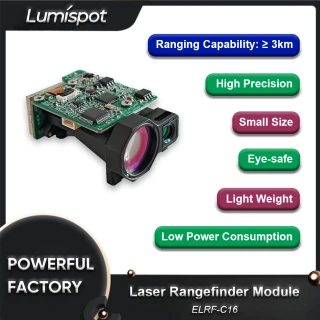
Scanners and Rangefinders in the Laser Scanning and Ranging domain usually provide single-point or line scanning distances. They may use ToF, phase-shift, or triangulation methods. Key parameters include working range, spot size, update frequency, beam divergence, and accuracy over temperature and target reflectivity.
Distance Sensors are often compact modules designed for close to mid-range measurement and OEM embedding. They are used in position feedback, level sensing, alignment, and process control. Variants include triangulation sensors for short ranges and ToF modules for longer distances with simple electrical interfaces.
Buyer Guidance for Laser Scanning and Ranging
When selecting Laser Scanning and Ranging equipment, compare:
- Measurement range and accuracy: ensure sufficient margin for your target distances and required tolerances.
- Wavelength and eye safety class: match to ambient lighting, material reflectivity, and regulatory constraints (e.g., IEC 60825).
- Scanning geometry: 1D, 2D, or 3D coverage, field of view, and scan speed versus your motion profile.
- Interface and integration: communication protocols (Ethernet, CAN, serial, digital I/O), power requirements, size, and mounting options.
- Environmental robustness: IP rating, operating temperature, vibration resistance, and contamination tolerance.
Use FindLight to compare detailed specifications across multiple Laser Scanning and Ranging products, then request quotes or technical information directly from manufacturers. No registration is required to contact suppliers, streamlining evaluation and procurement for your imaging and vision projects.