
Precision Optics Manufacturing and Finishing Tools
Frequently Asked Questions
What are precision optics and how do they differ from standard optical components?
Precision optics are optical components manufactured with tight tolerances on surface figure, roughness, homogeneity, and dimensional accuracy to enable controlled manipulation of light in demanding systems. Compared with standard optics, they typically feature λ/10 or better surface flatness, sub-angstrom surface roughness, strict centration tolerances, and accurately specified coatings, supporting high-resolution imaging, metrology, and laser applications.
Which key optical parameters define the performance of precision lenses, mirrors, and windows?
Critical parameters include surface figure (e.g., λ/4, λ/10 PV), surface roughness (e.g., <1 nm Ra for low scatter), wavefront error, and transmitted/reflective wavefront distortion. Additional metrics such as scratch–dig, parallelism, wedge, refractive index tolerance, and coating specifications (R/T %, bandwidth, AOI, polarization behavior, and damage threshold) determine suitability for a given wavelength range and system f-number.
What are the main sub-types of precision optics and how do they differ functionally?
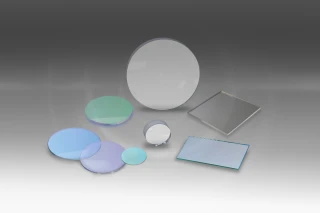
Common sub-types include precision lenses (spherical, aspheric, cylindrical), mirrors (flat, spherical, off-axis parabolic), windows, prisms, beamsplitters, and filters. Aspheric lenses correct spherical aberration in fast systems, cylindrical optics shape beams in one axis, off-axis parabolas provide aberration-free focusing of collimated beams, and precision prisms control beam steering, image rotation, and dispersion with tight angle tolerances.
Which specifications are most important when selecting precision optics for high-power laser systems?
For high-power lasers, key parameters are bulk material quality (inclusions, bubbles), absorption at the operating wavelength, AR/HR coating design, and laser-induced damage threshold (LIDT) under specified pulse duration and repetition rate. Surface quality (scratch–dig), surface roughness, and edge quality also matter to minimize scattering and prevent damage initiation, while thermal properties (dn/dT, thermal conductivity) influence performance under high average power.
How should I compare precision optics for imaging or metrology applications?
For imaging and metrology, prioritize transmitted/reflective wavefront error, surface figure and irregularity, homogeneity of the substrate, and tight dimensional and centration tolerances to preserve system MTF and minimize aberrations. You should also assess coating spectral performance (bandpass, out-of-band rejection), angle-of-incidence sensitivity, and environmental stability (temperature and humidity cycling) to ensure consistent, calibration-grade performance.
What lead times, customization options, and cost drivers are typical for precision optics?
Standard catalog precision optics often ship in days to a few weeks, while custom geometries, materials, or coatings can require 6 to 12 weeks or more depending on complexity and lot size. Major cost drivers include substrate material (e.g., CaF₂ vs. BK7 vs. fused silica), surface figure tolerance, aperture size, coating complexity, and required metrology documentation (interferograms, environmental tests), with tight tolerances and specialized coatings increasing both price and lead time.
Precision Optics Manufacturing Overview
Precision Optics production relies on tightly controlled grinding and polishing processes to achieve the required surface figure, roughness, and dimensional tolerances. On FindLight you can source specialized tooling and consumables used to manufacture lenses and other precision optics components for imaging, laser delivery, and metrology systems.
This category focuses on equipment and materials that support sub-micron surface quality, repeatable geometry, and consistent batch-to-batch performance across common optical substrates such as BK7, fused silica, CaF2, and various IR crystals and ceramics.
Lens Polishing Equipment and Tools
Lens polishing solutions for precision optics typically include pitch or polyurethane laps, sub-aperture tools, and automated or semi-automated polishers. These systems are used after fine grinding to correct form error and reduce surface roughness to λ/10 or better, depending on application. When evaluating lens polishing tools, consider part diameter range, compatible radii of curvature, tool compliance, spindle speed range, pressure control, and coolant or slurry delivery.
Optical Grinding Solutions
Grinding tools for precision optics remove bulk material and establish the initial radius, thickness, and edge geometry. Available products span diamond cup wheels, ring tools, and dedicated curve generators or CNC grinding machines. Key specifications include grit size, bond type, maximum workpiece diameter, axis configuration, positioning accuracy, and coolant integration. Proper grinding selection directly impacts subsequent polishing time and achievable surface figure.
Polishing Compounds and Slurries
Polishing compounds for precision optics are formulated to balance removal rate with surface quality while avoiding sub-surface damage. Offerings on FindLight include cerium oxide, alumina, and colloidal silica abrasives in various particle size distributions. Buyers should review median particle size, solids concentration, pH, compatibility with specific glass or crystal types, and slurry stability for recirculating systems.
Buyer Guidance on FindLight
When sourcing tooling and materials for precision optics, compare detailed datasheets across lens polishing, grinding, and polishing compounds to ensure process compatibility. Review surface roughness targets, flatness or radius tolerances, machine footprint, utilities, and integration with existing metrology. You can request quotes directly from multiple suppliers, specify required tolerances and part volumes, and discuss custom configurations. No registration is required to send quote requests, enabling rapid evaluation of alternatives for your precision optics manufacturing line.