
Beamsplitters for Precision Optical Systems

Frequently Asked Questions
What are optical beamsplitters used for?
Optical beamsplitters are used in a wide range of scientific, industrial, and medical applications to divide a beam of light into two or more paths. They are used for polarization control, spectral filtering, laser beam steering, interferometry, and microscopy.
What are the different types of optical beamsplitters available?
There are different types of optical beamsplitters available, including polarizing beamsplitters, non-polarizing beamsplitters, cube beamsplitters, plate beamsplitters, and thin-film beamsplitters. Each type of beamsplitter is designed to split light in a specific way and is suited for different applications.
How do I choose the right optical beamsplitter for my application?
To choose the right optical beamsplitter for your application, you should consider factors such as the type of light you are using, the polarization of the light, and the wavelength range you need to work with. You should also consider the size and shape of the beamsplitter and whether you need a custom or off-the-shelf solution. At FindLight.net, we offer a comprehensive search and filtering system that makes it easy to find the perfect beamsplitter for your project.
Can I get a custom optical beamsplitter?
Yes, many of our suppliers and manufacturers offer custom optical beamsplitters. You can specify the type of beamsplitter you need, the size and shape of the beamsplitter, and any other specifications required for your application. You can contact the supplier or manufacturer directly through FindLight.net to discuss your custom requirements.
What kind of optical beamsplitters are available for use with lasers?
There are several types of optical beamsplitters available for use with lasers, including polarizing and non-polarizing beamsplitters, cube beamsplitters, and thin-film beamsplitters. These beamsplitters are designed to handle the high power and intensity of laser light and are available in various wavelength ranges.
How do I clean my optical beamsplitter?
To clean your optical beamsplitter, use a soft, lint-free cloth or tissue to gently wipe the surface of the beamsplitter. Do not use abrasive materials or solvents, as these can damage the coating on the beamsplitter. If necessary, you can use a small amount of isopropyl alcohol on the cloth or tissue. Be sure to handle the beamsplitter carefully and avoid touching the surface with your fingers.
Overview of Beamsplitters
Beamsplitters are optical components that divide an incident beam into transmitted and reflected parts with a defined ratio, polarization state, and spectral response. In laser and imaging systems, beamsplitters enable power sampling, beam combining, interferometry, routing to diagnostics, and feedback control. On FindLight, you can source a wide range of beamsplitters optimized for distinct wavelength ranges, power levels, and angular configurations.
Key Types of Beamsplitters
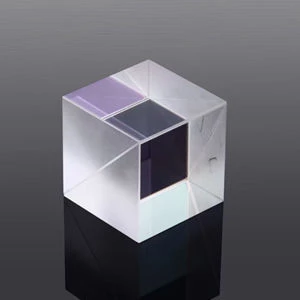
Cube Beamsplitters consist of two right-angle prisms cemented or optically contacted together with a beamsplitting coating on the internal interface. These beamsplitters provide robust mechanical alignment, good angular tolerance, and reduced ghost reflections, making them suitable for lab setups, interferometers, and ruggedized assemblies.
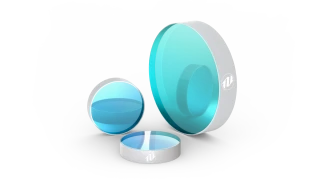
Plate Beamsplitters are flat substrates with a partial reflective coating on one surface and an AR coating on the other. These beamsplitters are compact and cost-effective, but introduce a secondary reflected beam from the rear surface and a slight beam offset. They are common in imaging paths and moderate-power laser routing.
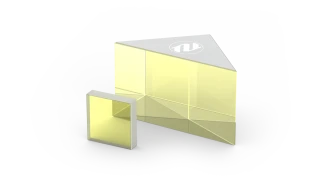
Fresnel Beamsplitters employ uncoated dielectric interfaces or micro-structured surfaces to achieve polarization-dependent splitting via Fresnel reflection. These beamsplitters are often used as polarizing elements, diagnostic splitters, or when minimal absorption and broad bandwidth are required.
Output Couplers function as specialized beamsplitters within laser resonators. They transmit a defined fraction of intracavity power as usable output while reflecting the remainder to sustain lasing. Output couplers are specified by reflectance/transmittance at the laser wavelength, substrate material, radius of curvature, and damage threshold.
Buyer Guidance for Selecting Beamsplitters
- Wavelength range: Match beamsplitters to your laser or broadband source (UV, visible, NIR, MIR).
- Split ratio and polarization: Select 50:50, 30:70, or custom ratios; consider non-polarizing vs. polarizing beamsplitters for sensitive measurements.
- Damage threshold: Verify CW and pulsed power handling for high-intensity beams and resonator output couplers.
- Geometry and mounting: Choose cube beamsplitters for stable alignment, plate beamsplitters for compact paths, and Fresnel beamsplitters for polarization control.
- Surface quality and flatness: Important for interferometry and high-precision imaging.
On FindLight, you can filter beamsplitters by subcategory, wavelength, coating, and mechanical format. Compare detailed specifications across vendors and request quotes directly from suppliers. No registration is required to view pricing requests or initiate technical discussions, enabling fast evaluation and procurement of suitable beamsplitters for your optical system.