
Prisms for Precision Light Transport

Frequently Asked Questions
What is an optical prism and how does it work in photonics applications?
An optical prism is a transparent component with flat, polished surfaces that refract, reflect, or disperse light based on Snell’s law and total internal reflection (TIR). By controlling geometry (apex angles, face orientation) and material dispersion, prisms can deviate, invert, rotate, or spectrally separate incident beams with high angular precision.
What are the main types of prisms and their typical uses?
Common prism types include right-angle prisms for 90° beam deviation or 180° retroreflection, equilateral dispersion prisms for spectral separation, and penta prisms for fixed 90° deviation independent of small alignment errors. Dove and Pechan prisms are used for image rotation, while wedge and anamorphic prisms adjust beam pointing or aspect ratio, respectively.
How do dispersion and total internal reflection influence prism performance?
Dispersion, characterized by refractive index versus wavelength (e.g., Abbe number, Sellmeier coefficients), determines how strongly a prism separates different wavelengths and how much chromatic deviation occurs. Total internal reflection, governed by the critical angle of the material, enables loss‑low internal reflections without coatings, but requires appropriate incidence angles and limits the useful angular field.
Which key specifications should I consider when selecting a prism for my system?
Critical specs include material (e.g., N-BK7, fused silica, CaF2) for bandwidth and transmission, size and clear aperture, wedge or apex angle tolerances, and surface quality (scratch-dig, flatness, and surface irregularity). You should also check angular deviation tolerance, transmitted wavefront error, coating type (AR, HR, beamsplitter), and the specified wavelength range to ensure compatibility with your laser or detector.
How do I compare different prism options for beam steering or beam shaping tasks?
For beam steering, compare angular deviation accuracy, beam deviation stability over wavelength, and sensitivity to misalignment, especially for penta or roof prisms versus single right-angle prisms. For beam shaping or anamorphic applications, evaluate magnification ratio, chromatic effects, input polarization dependence, and the combined wavefront error introduced by the prism pair or assembly.
What factors affect lead time, pricing, and customization options for prisms?
Lead time and price are driven by material type and availability, custom geometry (nonstandard angles, large apertures), tight tolerances on angle and flatness, and surface quality grades. Custom coatings, cemented assemblies, precision mounting, and volume orders typically increase both cost and manufacturing time, while standard catalog prisms in common glasses are usually available faster at lower unit cost.
Overview of Prisms
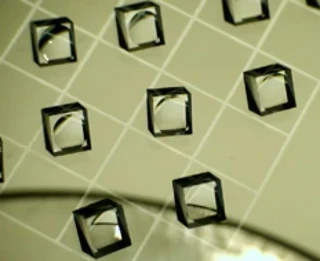
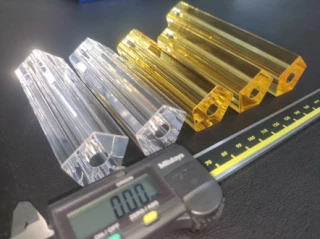
Prisms are solid optical components that refract, reflect, or disperse light to redirect or condition optical beams. In light transport systems they are used for beam steering, image rotation, path folding, dispersion, and retroreflection. On FindLight you can compare prisms from multiple suppliers, review specifications, and request quotes without registration.
Key Types of Prisms Available
Anamorphic prisms use a pair of wedge-shaped elements to reshape elliptical laser beams, typically adjusting aspect ratio to better match circular fibers or apertures.
Dispersing prisms (e.g., equilateral or Pellin–Broca) separate polychromatic light into constituent wavelengths, essential for spectroscopy and wavelength selection.
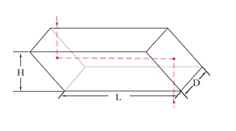
Dove prisms rotate images and are commonly used in interferometers and beam-rotation assemblies, often with collimated input along the prism axis.
Penta prisms provide a stable 90° deviation independent of small angular misalignments, useful for alignment and metrology setups.
Porro prisms invert and revert images while folding the optical path, widely used in binoculars and compact imaging systems.
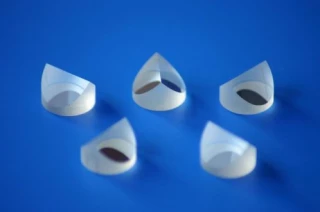
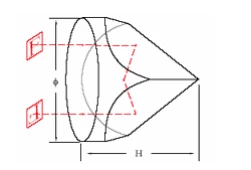
Retroreflectors (corner cubes) return incident beams parallel to the input direction, enabling precise distance metrology and alignment feedback.
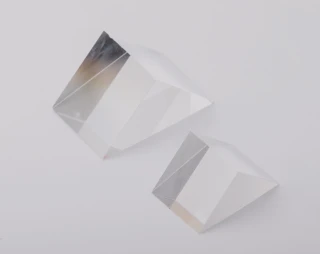
Right-angle prisms are versatile for 90° beam deviation, total internal reflection folding, or substituting mirror pairs in compact optical layouts.
Wedge prisms provide small, controllable angular deviation for beam steering, scanning, or low-order aberration correction.
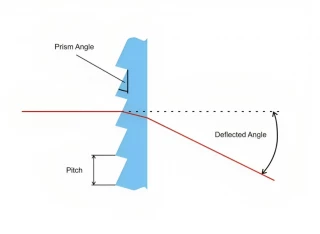
Fresnel prisms approximate a prism using a thin, stepped profile, reducing weight and thickness for large-aperture or wearable systems.
Buyer Guidance for Selecting Prisms
When evaluating prisms, compare substrate material (e.g., N-BK7, UV fused silica, CaF₂), wavelength range, AR coatings, clear aperture, surface quality, and dimensional tolerances. For laser applications, verify damage threshold and transmitted wavefront error. For imaging or metrology, pay attention to angle tolerance, beam deviation accuracy, and image orientation effects.
Use FindLight to filter prisms by sub-type, material, and spectral region, then request quotes directly from suppliers. No registration is required, enabling rapid comparison of technical specifications, pricing, and lead times across all available prisms in this category.