
Opto-Mechanics for Precision Light Transport
Explore Opto-Mechanics for accurate light transport on FindLight. Compare apertures, optical mounts, posts and post holders, optical tables, and optomechanical kits from multiple suppliers to build and stabilize your optical setups.



Frequently Asked Questions
What products fall under Opto-Mechanics "umbrella"?
The main types of Opto-Mechanics include optical mounts, optical tables, post and post holders, translation stages, rotation stages, and kinematic mounts.
What are optical mounts?
Optical mounts are devices used to hold and adjust optical components, such as lenses and mirrors, in a stable and precise manner. They come in a variety of configurations, including kinematic mounts, gimbal mounts, and flexure mounts.
What is a kinematic mount?
A kinematic mount is a type of optical mount that uses three point contact to hold and adjust optical components. They provide high stability and precision, and are commonly used in applications where thermal expansion and vibration are a concern.
What is an optical table and why is it important for my experiments?
An optical table is a vibration isolation platform that is designed to provide a stable and isolated surface for optical experiments. It is important because it minimizes vibrations and disturbances that can affect your measurements.
What are the differences between kinematic and gimbal mounts?
Kinematic mounts provide three points of contact, ensuring that the mounted optic maintains a fixed position. Gimbal mounts, on the other hand, allow for two degrees of freedom, which means that the mounted optic can be tilted and rotated.
What is an optical breadboard?
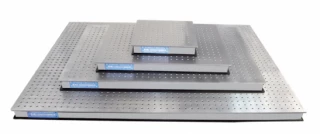
An optical breadboard is a flat, rigid platform used to mount optical components for experiments. It is typically made from aluminum or steel and has regularly spaced mounting holes for attaching various opto-mechanical components.
Opto-Mechanics for Light Transport Systems
Opto-Mechanics on FindLight covers the mechanical hardware required to build, align, and stabilize light transport paths in optical experiments and photonics systems. These components interface with lasers, lenses, mirrors, and detectors to ensure stable positioning, repeatable alignment, and low drift over time.
Key Opto-Mechanics Subcategories
Apertures in this Opto-Mechanics category define and condition beams, provide stray light control, and limit numerical aperture. You will find fixed and adjustable apertures, iris diaphragms, and precision pinholes used in beam shaping, spatial filtering, and imaging setups.
Optical mounts provide the kinematic and rigid supports for mirrors, lenses, prisms, and filters. Available models include tip-tilt mirror mounts, lens mounts with retaining rings, and cage-compatible holders. Typical specifications to compare are angular resolution, range of adjustment, clear aperture, mechanical stability, and compatibility with standard post and cage systems.
Posts and post holders form the basic structural elements of Opto-Mechanics assemblies. They support optical mounts and apertures at defined heights relative to optical tables. Consider post diameter, length, threading (metric or imperial), and clamping mechanism, as well as material properties such as thermal expansion and magnetic behavior.
Optical tables and breadboards provide vibration-damped reference surfaces with precision hole patterns for mounting other Opto-Mechanics components. Compare surface flatness, damping performance, core construction, grid spacing, and thread type to match lab space, load requirements, and vibration sensitivity of your setup.
Optomechanical kits bundle commonly used posts, post holders, clamps, and mounts into modular sets. These are useful for R&D labs building flexible Opto-Mechanics test stations, educational benches, or rapid prototyping rigs where reconfiguration is frequent.
Buyer Guidance on FindLight
When selecting Opto-Mechanics hardware, match mechanical tolerances and stability levels to the beam size, alignment sensitivity, and environmental conditions of your system. For high-precision interferometry or long path lengths, prioritize low drift mounts, high-stiffness posts, and well-damped optical tables. For general-purpose alignment, standard-grade components may be sufficient and more cost-effective.
Use FindLight to compare detailed specifications across multiple suppliers, including material, load capacity, adjustment resolution, mounting interface, and compatibility with existing hardware standards. You can request quotes directly from vendors and inquire about custom Opto-Mechanics solutions without registration, streamlining procurement for both engineering and R&D teams.