
Hologram Manufacturing Tools and Systems

Frequently Asked Questions
What is hologram manufacturing and how does it differ from conventional optical component fabrication?
Hologram manufacturing is the process of recording and replicating three-dimensional interference patterns formed by coherent light (typically lasers) on a photosensitive medium, rather than shaping bulk optics to control light by refraction or reflection. Instead of lenses or mirrors, the hologram itself encodes both phase and amplitude information of the wavefront, enabling 3D image reconstruction or complex beam shaping when illuminated under specified conditions.
How is a hologram physically recorded and what are the typical recording materials?
A hologram is recorded by interfering a coherent reference beam with an object or signal beam on a photosensitive layer, creating a stationary fringe pattern that is chemically or physically fixed in the medium. Common recording materials include silver halide emulsions, dichromated gelatin (DCG), photopolymers, and photoresists, each with specific sensitivity, resolution (lines/mm), refractive index modulation, and environmental stability characteristics. The choice of material impacts diffraction efficiency, environmental robustness, and compatibility with mass replication processes such as embossing or UV curing.
What are the main types of holograms (e.g., transmission, reflection, volume, and surface-relief) and how do they differ in use?
Transmission holograms are designed to be illuminated and viewed with light passing through the holographic layer, while reflection (Denisyuk) holograms are illuminated from the front and reflect reconstructed images, typically using Bragg-selective volume gratings. Volume holograms record fringes throughout the material thickness and exhibit strong wavelength and angle selectivity, whereas surface-relief holograms encode the interference pattern as topographical microstructures suitable for embossing into films or foils. These structural differences determine operating wavelength range, viewing geometry, diffraction efficiency, and suitability for high-volume production such as security labels versus precision diffractive optical elements (DOEs).
What key technical parameters should I consider when specifying custom holograms for optical or sensing applications?
Critical parameters include operating wavelength (or band), diffraction efficiency, angular and wavelength selectivity (Bragg bandwidth), and recording geometry (transmission vs. reflection, off-axis angles). You should also define substrate and recording material, clear aperture, physical dimensions and thickness, environmental and thermal stability, and whether the hologram will be used for imaging, beam shaping, beam splitting, or metrology. For integration, flatness, surface quality, and mounting or packaging requirements (e.g., AR-coated cover glass, hermetic sealing) are also important.
How should I compare different hologram manufacturing processes such as direct-write, optical recording, and embossed replication?
Optical recording with interferometric setups is preferred for high-fidelity holograms and complex wavefronts but is more sensitive to vibration and alignment, making it suited to lower-to-medium volume or high-performance optics. Direct-write approaches (e.g., laser writers or e-beam for master surface-relief patterns) offer precise control of feature geometry and are typically used for masters that are then replicated via embossing, injection molding, or UV-cured casting to achieve high-volume, low-cost production. When comparing vendors, evaluate achievable feature size, registration accuracy, uniformity across the aperture, replication tolerances, and how closely replicated parts match the optical performance of the master.
What are typical lead times, customization options, and cost drivers in hologram manufacturing projects?
Lead times for custom holograms commonly range from 4–12 weeks, depending on whether a new optical design, recording setup, and master tooling are required, or if the vendor can adapt an existing design. Customization can include tailored phase profiles, specific viewing geometries, multiple channels/images, integrated alignment marks, and choice of substrates or laminates for mechanical protection. Major cost drivers include design complexity, required tolerances, recording material, mastering method, tooling for replication (nickel shims, molds), and order volume, as unit cost drops significantly once a master is available for large production runs.
How can I find, compare, and request quotes for hologram manufacturing services on FindLight without creating an account?
On FindLight, navigate to Optics Manufacturing → Hologram Manufacturing to view a list of service providers, each with summarized capabilities such as supported materials, wavelength ranges, maximum format size, and replication methods. You can filter or sort by parameters like application focus (e.g., security, DOEs, HUDs) and geographic region, then open individual listings to compare technical details and datasheets. To request a quote without registration, use the contact or RFQ form on the product listing page, specifying your technical requirements (wavelength, geometry, dimensions, volume, tolerances); the inquiry is sent directly to the supplier for response.
Hologram Manufacturing Equipment Overview
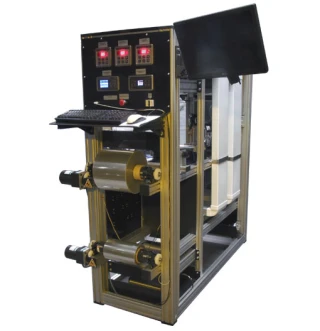
Hologram Manufacturing in industrial environments relies on precise optical and mechanical systems to transfer holographic patterns from masters to production substrates. On FindLight you can source specialized equipment used to emboss and replicate holographic images on films, foils, and other materials for security, packaging, and optical component applications.
These Hologram Manufacturing tools typically integrate web handling, precision rollers, heating and cooling zones, and alignment controls to maintain diffraction efficiency and pattern fidelity across large areas. Buyers should review how each system manages registration accuracy, surface quality, and throughput when scaling from prototyping to volume production.
Hologram Embossing Machines
Hologram Embossing Machines are used to imprint holographic microstructures from a shim or master roll onto thermoplastic substrates. In Hologram Manufacturing lines they form the core step where the interference pattern is physically embossed under pressure and controlled temperature. Key specifications include web width, line speed, embossing pressure range, temperature uniformity, and servo control for tension and registration.
When evaluating embossing systems, engineers should compare substrate compatibility (PET, PVC, BOPP, coated papers), achievable relief depth, surface roughness after embossing, and integration options with coating or metallizing units. Consider also ease of shim changeover, maintenance access, and monitoring interfaces for process stability.
Hologram Replication Machines
Hologram Replication Machines are designed to copy holographic masters into production-grade tooling or to generate multiple shims. Within Hologram Manufacturing workflows, these systems replicate the original hologram onto nickel or other suitable materials using electroforming or related processes. Critical parameters include replication accuracy, cycle time, master size, and compatibility with subsequent embossing equipment.
Procurement teams should compare tolerance on feature transfer, uniformity across the replicated area, and the equipment's capability to handle different hologram formats (2D/3D, dot matrix, e-beam). The goal is to maintain optical performance while enabling consistent tooling for repeated runs.
Buyer Guidance on FindLight
For Hologram Manufacturing projects, use FindLight to review detailed datasheets, compare key specs side by side, and match machine capabilities to your substrate, throughput, and pattern fidelity requirements. You can request quotes directly from multiple suppliers without registration, enabling fast technical clarification and pricing comparisons. This allows R&D teams and procurement engineers to identify suitable hologram embossing and replication solutions aligned with their process and integration constraints.