


Description
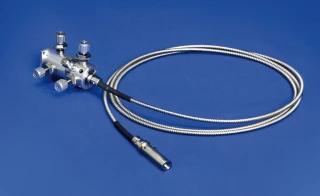
Pigtail style laser to fiber source couplers are precision‑engineered assemblies designed to provide highly efficient, low‑loss coupling of laser light into optical fibers over an exceptionally broad wavelength range from 200 nm to 2100 nm. By permanently bonding the fiber to a carefully selected focusing lens, these couplers deliver excellent alignment stability, low backreflection, and outstanding polarization performance that make them ideal for demanding laboratory, industrial, and OEM applications. Compared with adjustable bulkhead couplers or free‑space coupling solutions, pigtail style couplers minimize long‑term drift, simplify integration, and help maintain consistent optical performance in environments where vibration, temperature changes, or frequent usage can degrade conventional setups.
The internal fiber endface is polished at an angle and mated to the focusing optics to sharply reduce parasitic reflections back toward the laser source. Typical backreflection levels are better than −35 dB for multimode fibers and better than −40 dB for singlemode and polarization maintaining fibers, with optimized −60 dB versions available for particularly sensitive interferometric or high‑coherence laser systems. This low backreflection design helps protect laser sources from destabilizing optical feedback, improves signal‑to‑noise ratios in precision measurements, and enhances overall system reliability. Anti‑reflection coatings on internal surfaces further suppress Fresnel reflections and preserve signal integrity across the full operating wavelength band.
To address a wide range of power and beam quality requirements, these source couplers are offered with multiple lens technologies, including GRIN, achromatic, aspheric, and high‑durability plano‑convex or biconvex optics in fused silica or sapphire. GRIN lenses are well suited for compact, general‑purpose coupling and routinely handle more than 1 W of continuous‑wave power. Achromatic lenses support over 5 W CW and minimize chromatic aberrations for broadband or multi‑wavelength sources. Aspheric lenses provide superior focusing for single‑wavelength lasers at power levels above 10 W CW. For high‑power multimode or large mode area systems, fused silica and sapphire lenses, as well as axial GRIN options, support power levels beyond 100 W CW while maintaining robust thermal stability and beam quality. This flexibility allows designers to optimize the coupler for low‑power sensing setups, mid‑power lab lasers, or high‑power industrial sources using the same general platform.
The mechanical design emphasizes ruggedness, compact size, and long‑term stability. The fiber‑lens assembly is permanently glued and then mounted into a precision tilt adjustment flange, which is locked in place using fine‑pitch (80 TPI) tilt and locking screws along with radial set screws and an O‑ring interface. Once aligned, this configuration provides consistent coupling without the need for frequent realignment, even under moderate mechanical shock or vibration. The result is a stable optical interface that is well suited for permanent or semi‑permanent installations in interferometric sensors, fluorescence and absorption measurement setups, spectroscopy systems, biomedical instruments, and entertainment or laser show equipment. OEM system builders benefit from reduced assembly complexity and fewer field adjustments, which translate directly into improved throughput and lower service costs.
Outstanding coupling efficiency is a defining characteristic of these pigtail couplers. Typical performance exceeds 60 % for singlemode and polarization maintaining fibers and 80 % for multimode fibers when paired with well‑collimated laser beams and appropriate lenses. Such high coupling efficiency reduces the required source power, improves the effective dynamic range of detection systems, and minimizes thermal load in power‑sensitive components. Polarization maintaining versions offer extinction ratios above 20 dB as standard, with enhanced 25 dB and 30 dB options available for polarization‑critical applications such as interferometric sensing, coherent communication experiments, and precision metrology. Stable polarization performance ensures that downstream fiber components and measurement instruments can operate at their specified accuracy over extended periods.
These pigtail source couplers can be configured with singlemode, multimode, or polarization maintaining fibers over a comprehensive range of core and cladding sizes tailored to ultraviolet, visible, and infrared wavelengths. Fiber types and jacket materials are selectable to suit the intended environment, from compact, bare‑fiber style pigtails for integration into enclosed modules, to more robust, jacketed fibers suitable for benchtop use and frequent handling.
Pigtail Style Laser to Fiber Couplers
Specifications
| Type: | Other / Not Specified |
|---|---|
| Configuration: | Other |
| Splitting Ratio: | Other / Not specified |
| Wavelength: | 1550 nm |
| Fiber Type: | Single-mode (SM), PMI125/250, PMI80/165 |
| Connector Type: | FC, SC, ST, LC |
| Housing Material: | Stainless Steel, Plastic, Aluminum |
| Coupling Efficiency (singlemode/PM Fibers): | typically >60% |
| Coupling Efficiency (multimode Fibers): | >80% |
| Maximum Coupling Efficiency: | up to 90% |
| Backreflection (multimode Fibers): | <-35 dB |
| Backreflection (singlemode/PM Fibers): | <-40 dB |
| Backreflection (enhanced Version): | -60 dB |
| Polarization Extinction Ratio (standard): | >20 dB |
| Polarization Extinction Ratio (options): | 25 dB, 30 dB, 35 dB |
| Available Wavelength Range: | 200 nm – 2100 nm |
| Power Handling (GRIN Lenses): | >1 W CW |
| Power Handling (achromat Lenses): | >5 W CW |
| Power Handling (aspheric Lenses): | >10 W CW |
| Power Handling (fused Silica/sapphire Plano-convex & Biconvex Lenses, Multimode): | >100 W CW |
| Power Handling (axial GRIN Lenses, SM/PM/LMA): | >100 W CW |
| Mechanical Length: | 29.2 – 39.5 mm |
| Mechanical Diameter: | Ø33 mm |
| Tilt Adjustment Screw Pitch: | 80 TPI |
| Locking Screw Pitch: | 80 TPI |
| Fiber Jacket Type 1: | 900 µm OD Hytrel jacket |
| Fiber Jacket Type 3: | 3 mm OD Kevlar reinforced PVC cable |
| Fiber Type Options: | M (Multimode), S (Singlemode), P (Polarization Maintaining) |
| Example Fiber Core/Cladding Size: | 9/125 µm for 1300/1550 nm SM fiber |
| Available Connectors (examples): | 3S, 3U, 3A, 8, 8S, SC, SCA |
| Wavelength Specification Format: | numeric in nm (e.g., 633 for 633 nm) |
Got questions about specs? Use the inquiry form to ask.
 Download Data Sheet

Features
- High Coupling Efficiency up to 90% – Optimized optical design enables excellent laser-to-fiber coupling, typically >60% into singlemode and polarization maintaining fibers and >80% into multimode fibers, maximizing delivered optical power for demanding systems.
- Polarization Maintaining Performance up to 35 dB – Engineered for high polarization extinction ratios (PER >20 dB standard, 25 dB and 30 dB options, up to 35 dB capability) ensuring stable polarization for interferometric, sensing, and communication applications.
- Ultra-Low Backreflection – Angled polished internal fiber endface and optional AR coatings achieve backreflection levels <-35 dB (MM), <-40 dB (SM and PM), with -60 dB low-reflection versions available, reducing feedback into sensitive laser sources.
- Wide Wavelength Coverage: 200 nm – 2100 nm – Supports UV, visible, NIR and IR lasers in one platform, enabling use with spectroscopy, fluorescence, biomedical, and industrial laser systems across a broad spectral range.
- High Power Handling Capability – Robust lens and fiber designs support:
- >1 W CW with GRIN lenses
- >5 W CW with achromat lenses
- >10 W CW with aspheric lenses
- >100 W CW with fused silica or sapphire plano‑convex / biconvex lenses (multimode)
- >100 W CW with axial GRIN lenses (SM, PM, and LMA fibers)
- Rugged, Compact, and Stable Mechanical Design – Pigtail style construction with permanent fiber‑to‑lens bonding and precision tilt adjustment flange provides excellent long-term alignment stability in laboratory and industrial environments.
- Permanent Pigtail Coupler for Fixed Installations – Fiber is permanently glued to the focusing lens, forming a low-drift, maintenance-free assembly that is well-suited for permanent or semi-permanent setups where consistent performance is critical.
- Precision 80 TPI Tilt and Locking Adjustment – Integrated 80 TPI tilt adjustment and locking screws enable fine angular alignment of the lens-fiber assembly to maximize coupling efficiency and minimize backreflection.
- Low-Cost, High-Performance Solution – Designed to deliver premium optical performance at an economical price point, providing an excellent cost-to-performance ratio for OEMs and system integrators.
- Environmentally Stable Operation – Robust housing, O-ring sealing, and qualified adhesive processes ensure reliable performance under temperature and vibration, ideal for field-deployed sensors and industrial laser systems.
- Configurable for Singlemode, Multimode, and PM Fibers – Supports MM, SM, and PM fiber types, including standard core/cladding sizes (e.g., 9/125 µm) and LMA fibers, enabling flexible integration with a wide range of laser sources and delivery fibers.
- Broad Connector Compatibility – Available with popular connector types such as FC/PC (NTT), FC/UPC, FC/APC, ST, SC, SCA and others per standard tables, simplifying integration into existing fiber networks and lab setups.
- Laser Head Adaptors Available – Optional laser head adaptors provide convenient, repeatable interface between the source coupler and many common laser heads, enhancing usability and alignment repeatability.
- Adjustable Output Power and Optimized Beam Delivery – Mechanical adjustment capability and high numerical aperture coupling allow fine tuning of output power and spot size for maximum flexibility in applications such as spectroscopy and fluorescence.
- Wide Range of Applications – Specifically designed for:
- Interferometric and fiber optic sensors
- Medical, pharmaceutical, and chemical sensing
- Fluorescence measurements and microscopy
- Spectroscopy and metrology
- Laser shows, entertainment, and display systems
- OEM laser delivery and test systems
- Optimized for Minimum Feedback into Lasers – The angled internal fiber endface and potential AR-coated tip significantly reduce optical feedback, improving laser stability and protecting delicate laser diodes and narrow-linewidth sources.
Applications
- Interferometric Fiber Optic Sensors – High‑stability pigtail style coupling for Michelson, Mach–Zehnder, Sagnac, and Fabry–Pérot interferometers used in precision metrology, vibration analysis, and acoustic sensing.
- Fiber Optic Gyroscopes (FOG) and Inertial Navigation – Polarization‑maintaining coupling up to 35 dB PER supports low‑drift fiber gyros for aerospace, marine, and autonomous vehicle navigation systems.
- Distributed Fiber Sensing (DTS/DAS/OFDR) – Low‑backreflection coupling (<‑40 dB, optional –60 dB) improves signal quality in Raman/Brillouin/ Rayleigh‑based temperature, strain, and acoustic monitoring of pipelines, power cables, and structures.
- Medical, Pharmaceutical, and Chemical Sensing – Efficient source delivery into SM, PM, or MM fibers for in‑line and in‑vivo probes used in blood analysis, tissue diagnostics, process analytical technology (PAT), and bioreactors.
- Biomedical Imaging and Diagnostics – Stable coupling for OCT, endoscopy, confocal microscopy, and fluorescence imaging systems requiring low backreflection and controlled polarization.
- Fluorescence and Luminescence Measurements – High coupling efficiency and wide 200–2100 nm range for excitation light delivery in fluorescence, phosphorescence, and chemiluminescence assays in life‑science and biotech labs.
- UV–VIS–NIR–SWIR Spectroscopy – Broad spectral coverage from deep UV to 2.1 µm enables coupling of lasers and broadband sources into fiber for absorption, reflection, transmission, and Raman spectroscopy.
- Raman and Brillouin Spectroscopy – Low backreflection and high power handling (>10 W, >100 W with appropriate lenses) make these couplers ideal for fiber‑delivered Raman and Brillouin spectroscopy in materials science, chemistry, and process monitoring.
- Laser Pump Delivery for Fiber Lasers and Amplifiers – Efficient coupling into multimode, LMA, and PM fibers for pumping ytterbium, erbium, and other doped fiber lasers and optical amplifiers used in industrial and telecom systems.
- Seed and Reference Laser Injection – Stable, permanent pigtail coupling solutions for narrow‑linewidth seed lasers, frequency‑stabilized references, and metrology lasers in coherent and high‑precision systems.
- Laser Material Processing and Micromachining – High power handling and rugged design for delivering laser energy via fiber to cutting, marking, welding, drilling, and micro‑fabrication heads.
- Laser Shows, Entertainment, and Projection – Compact source couplers for routing visible and RGB lasers into multimode fibers for show projectors, stage lighting, simulators, and theme‑park attractions.
- OEM Laser Subsystems and Turn‑Key Instruments – Permanent pigtail design suited for integration into OEM modules such as fiber‑coupled DPSS lasers, diode laser engines, and analytical instruments.
- Telecommunications and Datacom Test Beds – Stable coupling into SM and PM fibers for R&D test setups, coherent communication experiments, polarization‑sensitive components, and modulator characterization.
- Quantum Optics and Quantum Communication – Polarization‑maintaining delivery of single‑photon and entangled‑photon sources into fiber networks for quantum key distribution, quantum sensing, and quantum information experiments.
- Metrology, Frequency Combs, and Precision Timing – Low‑noise, low‑backreflection coupling for frequency comb distribution, optical clocks, and ultra‑stable reference links through singlemode and PM fibers.
- Laboratory Fiber Coupling and R&D Setups – General‑purpose, high‑efficiency laser‑to‑fiber coupling for optics labs working in the 200–2100 nm range, where repeatable alignment and long‑term stability are critical.
- Environmental and Industrial Monitoring – Robust, environmentally stable couplers for fiber‑based sensing systems used in emissions monitoring, gas detection, oil & gas exploration, and structural health monitoring.
- Spectral Imaging and Hyperspectral Systems – Efficient source delivery in imaging spectrometers, line‑scan systems, and fiber‑fed hyperspectral cameras for remote sensing and machine vision.
- Education, Training, and Demonstration Systems – Durable, low‑maintenance fiber couplers for university teaching labs demonstrating laser coupling, polarization, interferometry, and fiber optic sensor concepts.
Frequently Asked Questions
What is a pigtail style laser‑to‑fiber source coupler and when should I use it?
What coupling efficiency and backreflection performance can I expect from this pigtail source coupler?
What wavelength range and power handling can this pigtail laser‑to‑fiber coupler support?
What fiber types, core sizes, and connectors are available for the pigtail source coupler?
How does the polarization‑maintaining version work and what polarization extinction ratio can I achieve?
Can I adjust or replace the fiber in the pigtail coupler, and how is alignment maintained?
What are typical applications for this pigtail laser‑to‑fiber source coupler and how does it compare to other solutions?
Got more questions? Use the inquiry form to ask the supplier directly.
Similar Products


Your inquiry has been received.
Create an account by adding a password
Why create an account?
- Auto-complete inquiry forms
- View and manage all your past messages
- Save products to your favorites
- Close your account anytime — no hassle