


Description
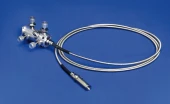
The Optoglide Precision Laser Delivery System from OZ Optics is an advanced laser-to-fiber coupling solution engineered for applications that demand outstanding optical stability, tight alignment tolerances, and long-term repeatability. In contrast to basic fiber couplers and generic free-space interfaces commonly found in research and industrial setups, Optoglide is purpose-built to provide stable, high-efficiency coupling into polarization-maintaining (PM) and singlemode fibers over a wide wavelength range. This makes it particularly well suited for multi-wavelength laser platforms, precision measurement systems, and critical OEM photonics modules where consistent beam quality and alignment are essential.
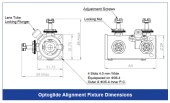
At the core of Optoglide is a PM single-mode optical fiber integrated into a compact precision alignment assembly that mounts directly to the laser source. The mechanical architecture supports true five-axis optical alignment, enabling accurate control of beam position, angle, and focus to maximize coupling efficiency. A high-performance lens assembly – including achromatic optics for multi-wavelength operation – is designed to efficiently couple laser light into the fiber, achieving typical coupling efficiencies greater than 65%. Depending on system requirements, the fiber output can be configured for either collimated free-space delivery or connectorized interfaces for straightforward integration into existing fiber-optic networks and instrumentation.
A distinguishing aspect of the Optoglide system is its proprietary low-wedge optical design. In many conventional couplers, small wedge errors in optics and mounts can lead to beam pointing drift as the laser head experiences thermal or mechanical changes. Optoglide minimizes these parasitic effects, significantly reducing pointing variations and maintaining consistent optical alignment over time. This stability is especially valuable in multi-line or combined-wavelength laser systems, where even slight pointing changes can degrade overlap between beams, reduce throughput, or disturb downstream interferometric or imaging performance. By ensuring repeatable coupling, Optoglide supports robust, long-term operation in demanding photonics environments.
The system is engineered to accommodate both standard and high-power laser configurations. It supports operating wavelengths from approximately 350 nm to 2000 nm for single-wavelength operation, with standard multi-wavelength options in the visible range around 400–640 nm. Input power handling can be configured for typical levels (such as tens of milliwatts in the violet and up to hundreds of milliwatts above 500 nm) or upgraded for higher power, where certain configurations can support power levels in the watt range. In addition, the use of PANDA-style PM fiber as the standard option delivers polarization extinction ratios on the order of 20 dB, providing the polarization control required for sensitive applications like coherent detection, nonlinear optics, and polarization-based sensing.
Optoglide is designed for versatility and straightforward integration into both new and existing setups. It is compatible with common optical mounting schemes used in laboratories and production environments, allowing it to be added to existing laser benches with minimal reconfiguration. Beyond the standard PM single-mode fiber, options are available for singlemode, multimode, or photonic crystal fibers to match specific mode-field, numerical aperture, or power-handling needs. Custom optical designs can be implemented for particular laser sources or wavelength combinations, enabling tailored performance for specialized lasers such as diode, DPSS, ultrafast, or frequency-doubled systems.
Across research laboratories, biomedical and life science instrumentation, precision metrology setups, industrial laser workstations, and OEM photonics platforms, the Optoglide Precision Laser Delivery System offers a reliable path from free-space laser output to stable, well-controlled fiber delivery. Its combination of high coupling efficiency, robust mechanical design, thermal and mechanical stability, and support for multi-wavelength and higher-power operation positions it as a strong choice wherever precise and repeatable laser-to-fiber coupling is required. By consolidating beam conditioning, alignment, and fiber coupling into a single integrated assembly, Optoglide simplifies system architecture and enhances long-term performance in sophisticated photonic systems.
Optoglide Precision Laser to Fiber Delivery System High Coupling Efficiency
Specifications
| Type: | Other / Not Specified |
|---|---|
| Configuration: | Other |
| Splitting Ratio: | Other / Not specified |
| Fiber Type: | Single-mode (SM), Multi-mode (MM), PMI125/250, PMI80/165 |
| Connector Type: | Other / Not specified |
| Housing Material: | Other / Not specified |
| Operating Wavelength (single Wavelength): | 350–2000 nm |
| Operating Wavelength (multi-wavelength Standard): | 400–640 nm |
| Standard Input Power Handling @ 405 Nm: | 25 mW |
| Standard Input Power Handling @ >500 Nm: | 100 mW |
| High Power Input Handling @ 405 Nm: | 200 mW |
| High Power Input Handling @ >500 Nm: | 2 W |
| High Coupling Efficiency (feature): | > 70% into singlemode or PM fiber |
| Coupling Efficiency (specification): | > 60% minimum, > 65% typical |
| Fiber Type (standard): | Panda style Polarization Maintaining Fiber |
| Fiber Type (options): | Singlemode, Multimode, or Photonic Crystal Fiber (PCF) |
| Polarization Extinction Ratio: | > 20 dB |
| High Power Handling Capability (feature): | > 5 W combined power handling with certain configurations |
| Supported Combined Optical Power (system Description): | Up to 500 mW |
| Alignment Axes: | Five-axis control of the optics |
Got questions about specs? Use the inquiry form to ask.
 Download Data Sheet

Features
- High Coupling Efficiency – Achieves >70% coupling into single-mode or polarization-maintaining (PM) fiber, and typically >60–65% minimum even under demanding conditions, maximizing delivered optical power and system throughput.
- Exceptional Beam Stability & Low Pointing Drift – Proprietary low‑wedge optical design minimizes beam pointing variations due to thermal and mechanical instabilities of the laser source, ensuring stable, repeatable coupling even in long-term or high‑duty‑cycle operation.
- Precision Five-Axis Alignment – Integrated precision alignment assembly with five-axis control (X, Y, Z, tip, tilt) allows fine-tuning of beam position and angle for optimal fiber coupling efficiency and easy, repeatable set-up.
- High Power Handling Capability – Supports up to >5 W combined optical power in certain configurations, with typical input power handling of 200 mW @ 405 nm and up to 2 W @ >500 nm in high‑power versions, making it suitable for demanding industrial and research applications.
- Wide Wavelength Range & Multi‑Wavelength Support – Operates from 350–2000 nm (single wavelength configurations) and supports 400–640 nm multi‑wavelength systems using achromatic lenses for high coupling efficiency across broad spectral ranges.
- Achromatic Lens Design – High‑performance achromatic lens assembly maintains focus and coupling performance over multiple wavelengths, ideal for collinear multi‑line or tunable laser systems.
- Polarization-Maintaining Fiber Delivery – Utilizes Panda‑style PM fiber as standard, delivering stable polarization with >20 dB polarization extinction ratio (PER), critical for sensitive interferometric, sensing, and nonlinear optics applications.
- Flexible Fiber Options – Available with PM, single‑mode, multimode, or photonic crystal fiber (PCF) to match specific application requirements in power handling, mode quality, and beam delivery.
- Collimated or Connectorized Output – Offers both fiber‑connector output (for integration into existing fiber networks) and collimated free‑space output options, enabling easy interfacing with downstream optics or instruments.
- Robust, Compact Mechanical Design – Compact precision alignment assembly mounts directly to the laser source, reducing footprint, improving mechanical stability, and minimizing alignment drift compared with free‑space optical benches.
- Compatible with Standard Mounting Schemes – Mechanical interface designed to integrate with common optical table and OEM mounting standards, simplifying retrofits and new system designs.
- Optimized for OEM and Industrial Integration – Engineered for long‑term reliability, repeatable performance, and ease of alignment, making it suitable for high‑throughput manufacturing tools, diagnostic equipment, and embedded OEM photonics modules.
- High Repeatability for Multi‑Laser Systems – Particularly well suited for systems using multiple collinear wavelengths, where stable alignment and repeatable coupling are essential to maintain power balance and beam quality over time.
- Low Maintenance & Long-Term Stability – Rigid optomechanical construction and low‑wedge optics reduce the need for frequent realignment, lowering downtime and operating costs in both lab and production environments.
- Custom-Configurable for Specific Lasers – Available with custom optics, coatings, fiber types, and mechanical interfaces tailored to particular laser sources, wavelength combinations, and integration constraints.
- Broad Application Coverage – Designed for multi‑wavelength laser systems, precision optical instrumentation, scientific research labs, biomedical and life‑science tools, industrial laser systems, and advanced OEM photonics integration.
Applications
- Multi‑wavelength and multi‑line laser systems
Precise, low‑wedge fiber coupling for systems that combine several collinear wavelengths (e.g., 405/488/561/640 nm lines) in a single polarization‑maintaining output. Ideal for confocal and multipoint excitation architectures where stable beam pointing and high coupling efficiency are critical. - Precision optical instrumentation and metrology
Integration into interferometers, spectroscopy benches, optical coherence systems, and reference beam delivery paths where sub‑micron stability, repeatable alignment, and controlled polarization are required over long measurement times. - Scientific research laboratories
Robust laser‑to‑fiber coupling for university and national lab setups, enabling quick swap of lasers, long‑term experiments, and hands‑off operation in:- Quantum optics and quantum information research
- Atomic, molecular, and optical (AMO) physics
- Nonlinear optics and multi‑photon excitation studies
- Ultrafast and time‑resolved spectroscopy testbeds
- Biomedical and life‑science instrumentation
Stable PM delivery of visible and NIR lasers into imaging and diagnostic platforms, including:- Confocal, multiphoton, and widefield fluorescence microscopy
- Flow cytometers and cell sorters
- DNA sequencers and high‑content screening systems
- Ophthalmic diagnostic instruments and retinal imaging
- Optogenetics and neurophotonics setups requiring polarization‑controlled excitation
- Industrial laser systems and manufacturing
Fiber coupling front‑end for low‑ to moderate‑power lasers in automated tools such as:- Laser micro‑machining and micro‑structuring stations
- Semiconductor wafer inspection and defect analysis systems
- PCB and micro‑electronics marking, trimming, and test equipment
- Display and flat‑panel inspection platforms
- Precision alignment, positioning, and machine‑vision illumination subsystems
- OEM photonics integration
Engineered as an OEM‑ready coupling module for laser‑based instruments, enabling:- Repeatable factory alignment and simplified system build
- Drop‑in laser head / fiber delivery modules for scalable production
- Custom wavelength sets, fibers (PM, SM, MM, PCF), and connector or collimated outputs
- Fiber‑based sensing and test systems
Stable injection of light into polarization‑maintaining or specialty fibers used in:- Fiber Bragg grating (FBG) sensing networks
- Distributed temperature and strain sensing (DTS/DSS/DAS)
- Polarization‑sensitive fiber sensors and interferometric sensors
- Optical component characterization and fiber test benches
- Laser communications and free‑space to fiber links
Precision alignment interface between free‑space beams and PM fibers for:- Test platforms for fiber‑optic communication devices and subsystems
- Laboratory links for free‑space optical communication research
- Stable reference channels in coherent and polarization‑multiplexed systems
- Quantum and polarization‑sensitive applications
Use in systems where polarization extinction ratio and mechanical stability directly affect performance, such as:- Entangled photon sources and quantum communication experiments
- Single‑photon and few‑photon counting setups
- Polarization‑encoded quantum key distribution (QKD) testbeds
- R&D and prototyping of laser‑based products
General‑purpose precision coupler for research groups and engineering teams developing new:- Laser diagnostic instruments
- Analytical and process spectroscopy tools
- Medical and cosmetic laser platforms
- Portable and compact fiber‑based photonic devices
Frequently Asked Questions
What is the Optoglide Precision Laser Delivery System and what does it do?
What coupling efficiency and power handling can Optoglide achieve?
What wavelength ranges and fiber types are supported by the Optoglide system?
How does the Optoglide design improve pointing stability and long‑term repeatability?
Is the Optoglide compatible with my existing laser and optomechanical mounts?
What polarization performance can I expect from Optoglide’s polarization‑maintaining fiber?
What are typical applications of the Optoglide Precision Laser Delivery System compared to other laser‑to‑fiber couplers?
Got more questions? Use the inquiry form to ask the supplier directly.
Similar Products


Your inquiry has been received.
Create an account by adding a password
Why create an account?
- Auto-complete inquiry forms
- View and manage all your past messages
- Save products to your favorites
- Close your account anytime — no hassle