
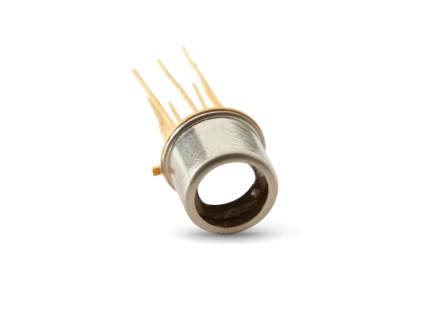
Description
Our pyroelectric detectors are a class of room temperature thermal detectors that produce a current output that is directly proportional to the rate of change of temperature when exposed to a source of radiation.
They are best described by an AC current source, capacitor and resistor. Their current output is governed by the equation I = p(T)·A·dT/dt, where I is current, p(T) is the pyro coefficient, A is the area as defined by the front electrode, and dT/dt is the rate of temperature change of the pyro crystal.
The advantages of a pyroelectric detector over other IR detectors are: room temperature operation, broad spectral response, high sensitivity (D*) and fast response (sub-nsec into 50 Ω).
Our passive discrete pyroelectric detectors range from 1 to 9 mm in diameter and are provided in two configurations: high sensitivity or high average power.
They present a pyroelectric detector element covered with our metallic coating (MT) and are packaged in a miniature TO-5 or TO-8 can. The diagram shown left identifies the pin-out for both types of detectors.
Our organic black coating (BL), increases the optical absorption and helps flatten the spectral response. We also offer a number of permanent IR Windows that can be added to the TO can. These discrete pyro detectors are ideal for pulsed laser applications.
Gentec-EO Discrete Pyroelectric Sensor QS5-H
Specifications
| Detector Type: | Pyroelectric |
|---|---|
| Spectral Range: | 0.1 – 1000 um |
| Size: | 5 mm |
| Maximum Power: | 0.5 W |
| Current Responsivity: | 0.25 μA/W |
| Thermal Frequency: | 5 Hz |
| Temperature Coefficient: | 0.2 %/°C |
| Aperture Diameter: | 5 mm |
| Dimensions: | 9.1Ø x 6.4D mm |
| Weight: | 0.001 kg |
| Package: | TO5 |
Got questions about specs? Use the inquiry form to ask.
 Download Data Sheet

Features
- Broad Spectral Response: Covers a wide range from 0.1 to 1000 µm, making it versatile for various applications.
- Four Product Families:
- QS-L: Discrete pyro detectors with low noise level.
- QS-H: Discrete pyro detectors designed for high average power.
- QS-IF: Hybrid pyro detectors in current mode with fast response.
- QS-IL: Hybrid pyro detectors in current mode with low noise level.
- Easy to Integrate Format: Available in TO5 and TO8 packages, making them compact and easy to integrate into existing systems.
- Large Area Sensors: Available in 5 mm and 9 mm diameter, simplifying optical alignment.
- Optional IR Windows: Choose from several options for different spectral ranges:
- Quartz: 0.2 – 3.5 µm
- Barium Fluoride: 0.2 – 17.5 µm
- Sapphire: 0.1 – 7.0 µm
- Silicon: 1.2 – 9.0 µm and 22 – 100 µm
- AR Germanium: 1.8 – 23 µm (10.6 µm peak)
- Measurement Capabilities: Designed for high precision and reliability in various conditions.
Applications
- Thermal measurements
- Laser optics
- Metrology
- Inspection
- Biomedical
- Military
Frequently Asked Questions
What applications are suitable for the QS5-H pyroelectric sensor?
The QS5-H pyroelectric sensor is suitable for pulsed laser applications, as well as thermal measurements, laser optics, metrology, inspection, biomedical, and military applications.
What are the advantages of using a pyroelectric detector?
The advantages of using a pyroelectric detector include room temperature operation, broad spectral response, high sensitivity, and fast response.
What are the physical characteristics of the QS5-H pyroelectric sensor?
The QS5-H pyroelectric sensor has a maximum average power of 500 mW, spectral range of 0.1-1000 μm, current responsivity of 0.25 μA/W, thermal frequency of 5 Hz, temperature coefficient of 0.2 %/°C, and aperture diameter of 5 mm.
What is a pyroelectric detector?
A pyroelectric detector is a thermal detector that produces a current output proportional to the rate of change of temperature when exposed to radiation.
What is the difference between high sensitivity and high average power configurations?
High sensitivity and high average power configurations refer to the two different types of pyroelectric detectors provided by Gentec-EO. High sensitivity detectors are designed for low noise level applications, while high average power detectors are designed for high power applications.
Got more questions? Use the inquiry form to ask the supplier directly.
Similar Products
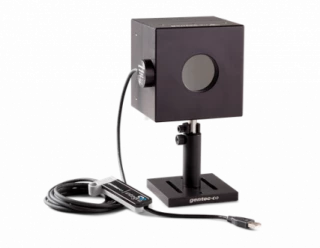
Integrating Sphere Detector for Fast Laser Power Measurement of up to 1 kW
Gentec-EO
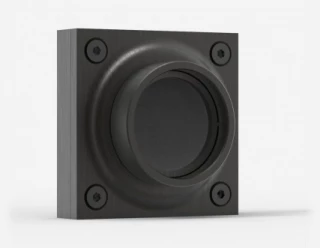
UPF10P-2S-H5-L-D0 Thermopile Laser Power Detector 2W
Gentec-EO
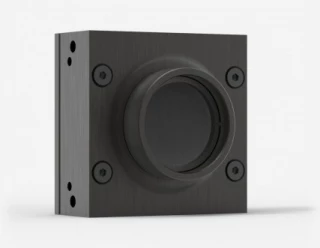
Gentec-EO High Power Detector UPF10K-2S-H5-L-D0
Gentec-EO
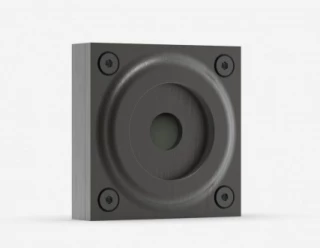
UP10P-2S-H5-L-D0 Thermopile Laser Power Detector
Gentec-EO
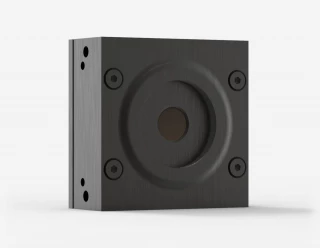
UP10K-2S-H5-L-D0 Thermal Detector for Laser Power Measurement
Gentec-EO
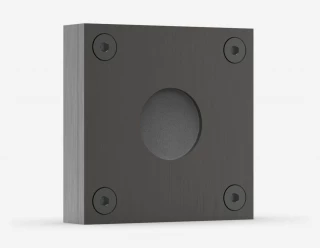
UP17P-6S-W5-D0 Thermal Laser Power Detector
Gentec-EO
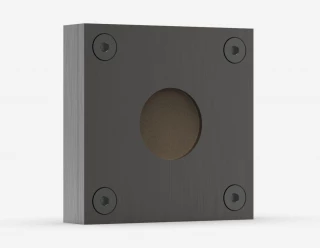
UP17P-6S-H5-D0 Ultra-Thin Thermal Detector for Laser Power Measurement
Gentec-EO
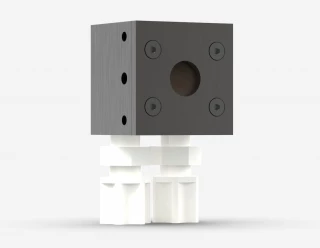
UP12E-70W-H5-D0 Thermal Detector for Laser Power Measurement
Gentec-EO
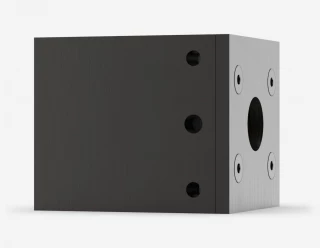
UP12E-20H-H5-D0 Thermal Detector for Laser Power Measurement
Gentec-EO
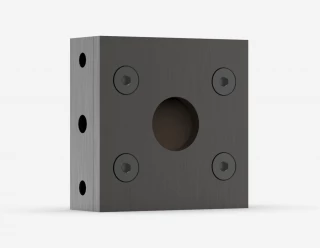
UP12E-10S-H5-D0 Thermal Detector for Laser Power Measurement
Gentec-EO
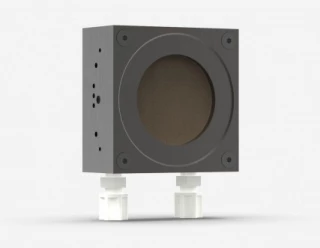
UP55M-500W-H12-D0 Thermopile Laser Power Detector
Gentec-EO
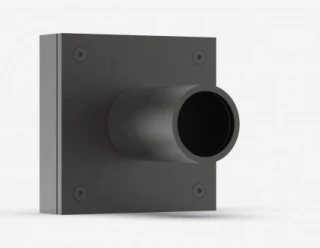
Gentec-EO High Power Detector XLP12-3S-VP-D0
Gentec-EO
Thank You!
Your inquiry has been received.
Create an account by adding a password
Why create an account?
- Auto-complete inquiry forms
- View and manage all your past messages
- Save products to your favorites
- Close your account anytime — no hassle