


Description
The M450±10-200-F200/22-V5W-AP is a high‑brightness, fiber‑coupled blue diode laser module designed for demanding industrial integration. Delivering up to 200 W of optical power at a nominal wavelength of 450 nm through a 200 μm core fiber, this OEM laser source offers an excellent balance of power density, beam quality, and long‑term stability. With a narrow spectral width of 6 nm (FWHM) and a typical beam parameter product of 20 mm·mrad, it is engineered for applications that require efficient coupling into fiber, uniform illumination, and reliable performance under continuous operation.
Leveraging a four‑submodule diode architecture, the unit provides robust power scaling while maintaining consistent optical characteristics. Each submodule operates with a low threshold current and high slope efficiency, contributing to a typical power conversion efficiency of nearly 25%. This means more usable optical power for processes such as materials processing, laser pumping, and illumination, while reducing thermal load and simplifying cooling system design. The design is optimized for operation with 20 ± 2 °C cooling water, ensuring stable thermal conditions and minimized wavelength drift during extended use.
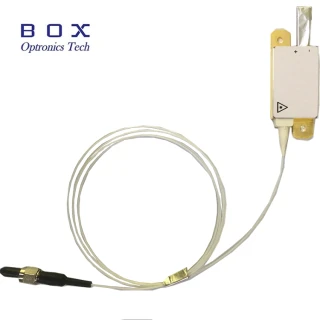
The integrated 200 μm core fiber pigtail with 0.22 numerical aperture provides a convenient and flexible delivery of the blue laser beam to the target. The SMA905 connector is widely used in industrial and scientific systems, facilitating straightforward mechanical integration and easy replacement in the field. Standard pigtail lengths from 1 m to 5 m support a wide variety of system layouts, whether in compact benchtop configurations or larger machine‑integrated platforms. This makes the module suitable for incorporation into precision optics assemblies, scanning heads, or multi‑axis motion systems where stable beam delivery is crucial.
A built‑in 650 nm red pilot beam offers a low‑power visible alignment aid, allowing accurate targeting and optical alignment without activating the full‑power blue output. This feature is particularly valuable in industrial environments, research laboratories, and OEM systems where frequent set‑ups or realignments are required. The integrated thermistor enables close monitoring and feedback control of the module temperature, supporting advanced thermal management strategies and improved operational safety. A dedicated photodiode is also available for power monitoring and stabilization within closed‑loop driver electronics.
Designed as an OEM component, this high‑power 450 nm laser module is intended for integration into larger laser systems and machines. It is well suited for applications such as plastic welding of light or transparent materials, surface treatment, additive manufacturing of polymers, laser soldering, semiconductor processing, fluorescence excitation, and high‑intensity blue illumination in inspection or machine vision. With a carefully specified operating humidity range and wide storage temperature window, the module withstands typical industrial environments when properly integrated into protected housings. Its combination of high optical power, compact fiber‑coupled output, and industrial‑grade electrical interface makes it a compelling choice for system builders seeking a reliable blue laser engine.
The M450±10-200-F200/22-V5W-AP does not include consumer‑level safety features and is not a stand‑alone turnkey laser. It is intended for qualified OEM and system integrators who will incorporate it into certified laser systems that comply with relevant IEC and CDRH regulations. When integrated with appropriate power supplies, interlocks, enclosures, and cooling infrastructure, this module forms the core of a high‑performance blue laser solution that can meet rigorous production, research, and inspection requirements.
450nm High-Power Fiber-Coupled Diode Laser
Specifications
| Laser Type: | Continuous Wave (CW), Modulated |
|---|---|
| Fiber Type: | Multi-Mode |
| Wavelength: | 450 nm |
| Output Power: | 200000 mW |
| Fiber Core Diamater: | 200 um |
| Fiber Cladding Diameter: | 360 um |
| Wavelength Range: | 440 - 460 nm |
| Typical Spectral Linewidth (FWHM): | 6.0 nm |
| Typical Beam Parameter Product (BPP): | 18 mm.mrad |
| Optical Fiber: | round or square fiber core |
| Fiber Connector: | SMA905 |
| Typical Threshold Current: | 0.35 A |
| Typical Operating Current: | 3.0 A |
| Available Standard Output Power: | 25W, 50W, 100W, 200W |
| Typical Cooling Water Temperature: | 20 °C |
| MTTF (100% - 80% Output Power): | >10,000 hours (under normal operation) |
Got questions about specs? Use the inquiry form to ask.
 Download Data Sheet

Features
- High Output Power 450 nm Blue Diode Laser – delivers a typical 200 W of optical power at the fiber exit, ideal for demanding industrial and scientific applications requiring high blue power density.
- Narrow 440–460 nm Emission Band – centered at 450 nm with a typical 6 nm FWHM spectral width, providing stable, well‑defined blue wavelength for processes such as materials processing, fluorescence excitation, and printing.
- High-Efficiency Multi-Diode Architecture – integrated 4-diode submodule design with a typical 18.9 W/A slope efficiency and ≈24.8% power conversion efficiency, reducing electrical power consumption and thermal load compared to older-generation blue lasers.
- Fiber-Coupled Output for Easy Beam Delivery – factory-aligned 200 µm core multimode fiber (196–204 µm) with 0.22 NA (0.20–0.24) enables flexible routing of the laser beam to the workpiece or experiment.
- Standard SMA905 Fiber Connector – robust and widely used SMA905 connector ensures compatibility with standard beam delivery systems, collimators, focusing optics, and industrial fiber handling accessories.
- Optimized Beam Quality for High Brightness – beam parameter product (BPP) of typically 20 mm·mrad (~18–20) from the fiber, allowing tight focusing and high irradiance on target for cutting, welding, and precision processing.
- Stable Operation with Water Cooling – specified for operation at 20 ± 2 °C cooling water, providing reliable power stability and wavelength control in continuous industrial use.
- Integrated Red Pilot Beam (650 nm) – built‑in 650 ± 5 nm red pilot diode enables safe and convenient beam alignment and positioning when the high‑power blue output is disabled.
- Thermistor for Active Temperature Monitoring – integrated 10 kΩ @ 25 °C thermistor supports precise temperature control and protection in OEM system designs.
- Compact OEM Submodule for Easy Integration – designed as an OEM industrial laser module for direct integration into machine tools, inspection systems, medical equipment (pre‑certification), and scientific instruments.
- Defined Electrical Characteristics for System Design – low 0.35 A threshold current and typical 2.80–3.00 A operating current at about 54.5–55.5 V simplify driver selection and system-level power budgeting.
- Wide Storage Temperature Range – qualified for −20 to +80 °C storage and up to 90% humidity, facilitating logistics, transport, and long‑term stocking without performance degradation when properly handled.
- Industrial-Grade Reliability – engineered for 24/7 use in industrial environments, offering stable power output, robust fiber coupling, and long lifetime comparable to other high‑power blue diode laser systems available on the market.
- Designed for Regulatory Integration – delivered as an OEM laser diode subassembly; final IEC/EN and CDRH laser safety compliance is managed at the system level, providing flexibility for machine builders and integrators.
Applications
- Industrial Materials Processing
High‑power 450 nm blue output (up to 200 W into 200 µm fiber) enables efficient absorption in many metals and plastics for:
– Precision cutting and micromachining of thin metals, foils, and reflective materials (copper, gold, aluminum)
– High‑speed laser welding and brazing for battery tabs, busbars, and electronic connectors
– Surface texturing, engraving, and marking on metals, ceramics, and polymers
– Laser cleaning, oxide and coating removal, and surface preparation prior to bonding or painting
– Additive manufacturing support, such as preheating, re-melting, or surface finishing of 3D printed parts - Electronics and Semiconductor Manufacturing
The 450 nm wavelength and good beam quality (BPP ~20 mm·mrad) are well suited for sensitive, high‑precision electronic processes, including:
– Soldering and micro‑soldering of SMD components, flexible circuits, and micro-connectors
– Wire bonding support, leadframe processing, and selective metal treatment
– Laser trimming of thick‑film resistors, sensors, and circuit elements
– Dicing, scribing, and drilling of wafers, ceramics, and brittle electronic substrates
– Selective depaneling and cutting of PCBs and flex circuits with minimal thermal damage - Battery, E‑Mobility, and Power Electronics
Strong absorption of blue light in copper and highly reflective metals makes this module ideal for next‑generation e‑mobility production lines:
– Laser welding of copper tabs, busbars, and cell interconnects in Li‑ion battery packs
– Manufacturing of stators, rotors, and power distribution components for electric drives
– Bonding and interconnection of power electronics modules and high‑current terminals
– Precision joining of dissimilar metals (e.g., Cu‑Al) where blue lasers outperform IR diode and fiber lasers - Laser Plastic Welding and Polymer Processing
With excellent coupling into a 200 µm fiber (NA 0.22), the laser can be integrated into scanning and beam‑delivery systems for plastics:
– Through‑transmission laser welding of transparent and absorbing polymer pairs
– Localized heating, forming, and reshaping of plastic parts in automotive and consumer devices
– Micro‑structuring and surface functionalization of polymers for adhesion, wetting, or optical properties
– Production of medical-grade disposable plastic components (e.g., housings, connectors, microfluidic parts) - Medical Device and Life‑Science Equipment Manufacturing (OEM Integration)
As an OEM blue diode module, it is well suited for integration into certified medical and life‑science systems, including:
– Precision welding and cutting of stainless steel and polymer components for surgical tools and implants
– Fabrication of catheters, endoscope parts, and minimally invasive instrument assemblies
– Micro‑machining of lab‑on‑chip devices, microfluidic channels, and biosensor structures
– OEM light sources in diagnostic and therapeutic instruments (once system‑level safety and regulatory compliance are achieved) - Scientific Research and Laboratory Systems
The combination of high power, narrow spectral width (~6 nm), and fiber delivery makes the module attractive for R&D setups:
– Pump source for optical parametric oscillators or frequency conversion stages in the blue‑visible regime
– High‑intensity excitation for spectroscopy, fluorescence studies, and photochemistry
– Optical trapping, manipulation, and optogenetic experiments requiring strong visible power
– Development platforms for new blue‑laser‑based materials processes and photonic applications - Printing, Imaging, and Display‑Related Processes
The 440–460 nm range and high brightness enable advanced imaging and exposure applications:
– Direct imaging for PCB production, maskless lithography, and photosensitive coating exposure
– High‑speed curing of specially formulated photoresists, varnishes, and inks responsive in the blue range
– Experimental projection and illumination sources in high‑luminance display or cinema systems (integrated at OEM level)
– Line and spot exposure systems for industrial inspection and process control - Photopolymerization and UV/Visible Curing
Many modern photoinitiators have strong absorption bands extending into the blue; this module can be used for:
– Curing of adhesives, sealants, and coatings in electronics, optics, and medical device assembly
– 3D printing and resin‑based additive manufacturing where resins are optimized for 450 nm exposure
– Fast, localized curing in roll‑to‑roll and high‑throughput production lines
– Hardening of protective layers, lacquers, and conformal coatings on sensitive components
Frequently Asked Questions
What is the PhotonTec Berlin M450±10-200-F200/22-V5W-AP blue fiber‑coupled laser and what are its key specifications?
What are common applications of a 200 W, 450 nm fiber‑coupled blue diode laser like this model?
How should the M450±10-200-F200/22-V5W-AP laser be cooled and what are its environmental operating limits?
What fiber output configuration does this 200 W blue laser use and can the fiber be customized or replaced?
How is the M450±10-200-F200/22-V5W-AP electrically driven and what driver requirements should be considered?
What is the function of the 650 nm red pilot laser and the internal monitoring components?
Does this 200 W blue OEM laser comply with IEC or FDA/CDRH laser safety standards and what are the integrator’s responsibilities?
Got more questions? Use the inquiry form to ask the supplier directly.
Similar Products




Your inquiry has been received.
Create an account by adding a password
Why create an account?
- Auto-complete inquiry forms
- View and manage all your past messages
- Save products to your favorites
- Close your account anytime — no hassle