
Description
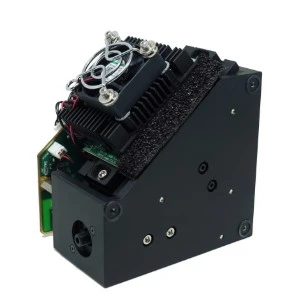
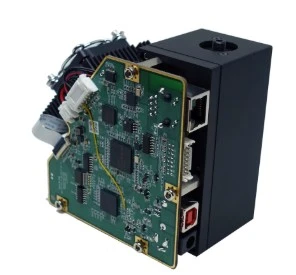
The GoldenBullet™ (GB) Series spectrometers are equipped with InGaAs linear array sensors and are designed for near-infrared (NIR) spectral detection. The system utilizes a hybrid transmissive–reflective optical architecture to improve optical stability while maintaining a high degree of customization flexibility. These spectrometers exhibit strong wavelength stability against temperature variations, minimizing wavelength drift and ensuring reliable performance.
GoldenBullet NIR Series Spectrometer
Specifications
| Wavelength Range (reflectance): | 900 – 2200 nm |
|---|---|
| Resolution: | 2 nm |
| Minimum Scan Time: | 6.0E-6 sec |
| Minimum Scan Time: | 6 μs |
| A/D Converter Type: | 16-bit ADC |
| Environmental Limits: | 0–90% RH, non-condensing |
| Storage Temperature: | -30°C to +70°C |
| Operating Temperature: | 0°C to +50°C |
| Power Requirements: | 5 V DC (model dependent) |
| Connector Type: | SMA905 fiber |
| Interfaces: | USB 2.0, Ethernet, 16-pin I/O |
| Stray Light: | <0.2% |
| Optical Resolution: | 2–22 nm (model dependent) |
| Dynamic Range: | Up to 12000 (model dependent) |
| Wavelength Range (reflectance): | 900-2200 (model dependent) |
| Integration / Scan Time Range: | 6 μs – 24 s |
| A/D Resolution: | 16-bit |
| Thermal Stability: | <0.03 nm/°C |
| Signal-to-Noise Ratio (SNR): | Up to 5000 (model dependent) |
| Cooling: | None / 1-stage TEC / 2-stage TEC (model dependent) |
| Detector Type: | InGaAs linear array (256 / 512 pixels) |
| Dimensions: | 100 × 97.5 × 68.9 mm (non-TEC) 109 × 97.5 × 69.8 mm (TEC models) |
| Minimum Scan Time: | 6 μs |
| Resolution: | 2-22nm (model dependent) |
Got questions about specs? Use the inquiry form to ask.
 Download Data Sheet

Features
- High-sensitivity InGaAs linear array sensors (256 / 512 pixels)
- Wavelength coverage from 900–1700 nm to 900–2200 nm (model dependent)
- Hybrid transmissive–reflective optical design for enhanced optical stability
- Compact optical platform for stable NIR measurements
- USB 2.0 and Ethernet communication with external I/O support
- Integration time range: 6 μs – 24 s
- Configurable slit widths and grating options
- High SNR (up to 5000) and dynamic range (up to 12000) depending on model and gain mode
- 16-bit, 15 MHz A/D conversion
- Multiple gain modes (Low Gain, 10×, 20×, 58×)
- Up to 4,000 spectra buffering for continuous acquisition
- 16-pin expansion port for external control and integration
- Optional one-stage and two-stage TEC cooling for reduced noise
- Flash ROM storage for wavelength, linearity, and intensity calibration
Applications
- NIR spectroscopy and optical metrology
- Film thickness inspection and material analysis
- Food, pharmaceutical, and biochemical applications
- Fabric and polymer analysis
- Environmental detection and agricultural sensing
- Process and quality control monitoring
- Material identification and composition analysis
- OEM and embedded system integration
Frequently Asked Questions
What is the GoldenBulletNIR Spectrometer?
What applications can the GoldenBulletNIR Spectrometer be used for?
What is the wavelength range of the GoldenBulletNIR Spectrometer?
What are the key performance specifications of the GoldenBulletNIR Spectrometer?
What interface options are available for the GoldenBulletNIR Spectrometer?
What are the dimensions of the GoldenBulletNIR Spectrometer?
What is the operating temperature range for the GoldenBulletNIR Spectrometer?
Got more questions? Use the RFQ form to ask the supplier directly.
Similar Products


Need pricing for this product? Send a quick inquiry
Your inquiry has been received.
Create an account by adding a password
Why create an account?
- Auto-complete inquiry forms
- View and manage all your past messages
- Save products to your favorites
- Close your account anytime — no hassle