


Description
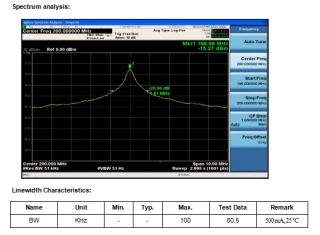
The 509 nm Single Frequency Fiber Laser is a high‑performance, frequency‑doubled laser source engineered for the most demanding scientific and industrial applications. Operating in true single frequency and single longitudinal mode with linear polarization, it delivers a remarkably narrow linewidth of <20 kHz and superior beam quality (M² <1.1). This combination of spectral purity, low phase noise, and low relative intensity noise (RIN) makes it ideally suited for next‑generation quantum technologies, optical frequency standards, and ultra‑precise metrology tasks where even minor noise contributions can limit system performance.
At its core, the system integrates a high‑power 1018 nm single frequency fiber laser with an efficient frequency‑doubling stage based on Periodically Poled Lithium Niobate (PPLN) technology. The two sections are fiber‑coupled for robust, alignment‑free operation, with polarization‑maintaining fiber used as the standard output format. This architecture preserves the low‑noise characteristics and narrow linewidth of the fundamental 1018 nm source while reliably converting the output to the green 509 nm region. The result is a turnkey, continuous‑wave (CW) laser delivering up to 1 W of optical power at 509 nm with high output stability and excellent long‑term reliability.
In advanced laboratories and quantum platforms worldwide, single frequency fiber lasers around 500 nm are increasingly used for laser cooling, trapping, and manipulation of atoms and ions, as well as for driving specific transitions in alkali and alkaline‑earth elements. The 509 nm Single Frequency Fiber Laser is optimized for these tasks, providing clean, narrowband radiation with a high side‑mode suppression ratio (SMSR ≥ 35 dB at typical values) and a polarization extinction ratio of ≥ 20 dB. Such characteristics are critical when building optical atomic clocks, cesium‑based time standards, or quantum sensors, where coherence time and frequency stability directly impact measurement accuracy.
The laser’s low RIN performance, with a typical RIN peak around 1 MHz of approximately −105 dBc/Hz and noise falling to about −140 dBc/Hz at 10 MHz, supports precision experiments that are sensitive to both amplitude and phase fluctuations. This includes Rydberg‑state excitation, quantum computing experiments based on neutral atoms, and high‑resolution spectroscopy. The narrow linewidth and low phase noise help minimize decoherence and broadening of atomic transitions, improving signal‑to‑noise ratios and enabling finer discrimination of spectral features in demanding research environments.
Integrated wavelength control functions further enhance the versatility of this laser. A thermal wavelength tuning mechanism provides a standard tuning range of approximately 0.3 nm, allowing coarse alignment of the emission to specific atomic or molecular transitions, or to match cavity resonances in optical setups. For fast, fine‑scale control, an optional PZT (piezoelectric) modulation feature enables high‑speed wavelength modulation over >10–15 GHz with linear modulation frequencies up to tens of kHz. This is particularly valuable for frequency locking to ultra‑stable optical cavities, implementing dither‑based locking schemes, or performing rapid scans over narrow spectral lines without sacrificing spectral purity.
In comparison with many conventional diode‑pumped solid‑state (DPSS) or free‑space frequency‑doubled systems, this 509 nm fiber laser emphasizes robust, alignment‑free operation and straightforward integration. Fiber‑coupled output via PM460 fiber (or optional free‑space collimated output) provides a convenient, stable beam delivery solution, reducing system complexity and alignment overhead in crowded optical tables. Output power stability is typically around 1% with options for enhanced stability, supporting long‑duration measurements and automated data acquisition where reproducibility over many hours or days is essential.
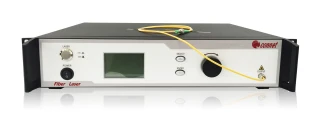
The laser is available in a benchtop form factor with integrated power supply and control electronics, simplifying deployment into existing setups. Operation is supported over a 0–40 ℃ temperature range, with standard AC 220 V input and an RS232 communication interface for remote control and monitoring. Users can adjust output power, monitor system status, and configure wavelength tuning or PZT modulation via external control, enabling seamless integration into complex experimental control systems or industrial platforms.
With its combination of watt‑level output power at 509 nm, true single frequency operation, narrow linewidth, and low RIN, this single frequency fiber laser is an excellent choice for laser cooling and trapping, cesium and optical atomic clock development, quantum sensing, Rydberg physics, quantum computing architectures, and nonlinear optics such
509nm Single Frequency Fiber Laser
Specifications
| Center Wavelength: | 509 nm |
|---|---|
| Output Power: | 0.5 W |
| Output Mode: | Continuous Wave (CW), Single Frequency, Single Longitudinal Mode |
| Beam Quality (M^2): | 1.05 |
| Spectral Linewidth: | 1.7E-8 nm |
| Output Power Stability: | 0.9% ~ 1.0% |
| Output Fiber Type: | PMF |
| Output Fiber Length: | 1 m |
| Interface: | RS-232 |
| Cooling: | Air Cooled |
| Electrical Requirements: | 220V - 50Hz |
| Linewidth: | 20 kHz |
| RIN Peak Frequency: | 1000 kHz |
| RIN Peak: | -105 dBc/Hz |
| RIN @10MHz: | -140 dBc/Hz |
| SMSR (50pm Resolution): | 35 dB |
| Output Polarization: | Linear |
| Polarization Extinction Ratio (PER): | 20 dB |
| Wavelength Thermal Tuning Range: | 0.3 nm |
| PZT Wavelength Modulation: | Optional |
| PZT Modulation Frequency (Linear): | 10 kHz |
| PZT Modulation Wavelength Range: | >10 GHz |
| Operating Temperature: | 0~40℃ |
| Storage Temperature: | -20~60℃ |
| Output Fiber Connector: | FC/APC (narrow key slow axis) or collimator |
| Dimension: | 510x480x150 mm |
Got questions about specs? Use the inquiry form to ask.
 Download Data Sheet

Features
- True Single-Frequency Operation – Genuine single-longitudinal-mode (SLM) output at 509 nm for ultra-stable, narrowband performance in demanding atomic and quantum experiments.
- Ultra-Narrow Linewidth (< 20 kHz) – Typical linewidth below 20 kHz (≤ 50 kHz max) minimizes phase noise and frequency drift, ideal for laser cooling, trapping, and precision spectroscopy.
- High Optical Power up to 1 W – Fiber-coupled continuous-wave (CW) output with typical power up to 500 mW and maximum up to 1 W at 509 nm, suitable for power-hungry applications such as optical pumping and OPO pumping.
- Excellent Beam Quality (M² < 1.1) – Near diffraction-limited TEM00 beam (M² ≈ 1.05) for efficient focusing, tight trapping, and high coupling efficiency into optical systems and cavities.
- Linear Polarization with High PER – Linearly polarized output with polarization extinction ratio typically > 20 dB, optimized for polarization-sensitive experiments and nonlinear conversion stages.
- Fiber-Based Architecture for Robustness – All-fiber design at 1018 nm followed by an integrated frequency-doubling unit, providing long-term stability, reliability, and alignment-free operation compared to bulk solid-state sources.
- High-Efficiency Frequency Doubling – Internal Periodically Poled Lithium Niobate (PPLN) module converts 1018 nm single-frequency light to 509 nm with high efficiency while preserving spectral purity and noise performance.
- Low Relative Intensity Noise (RIN) – Optimized low-noise design with RIN peak typically around −105 dBc/Hz and < −140 dBc/Hz at 10 MHz for improved stability in interferometric and quantum sensing setups.
- Low Phase Noise for Coherent Applications – Narrow linewidth and low phase noise support coherent manipulation of atomic states, frequency locking to ultra-stable references, and high-fidelity quantum operations.
- Thermal Wavelength Tuning – Built-in thermal tuning function with a typical wavelength tuning range of about 0.3 nm, enabling coarse frequency adjustment and matching to specific atomic or molecular transitions.
- Fast PZT Modulation (Optional) – Integrated PZT actuator allows high-speed frequency modulation from DC to 10–20 kHz with > 10–15 GHz wavelength (frequency) tuning range, ideal for laser locking, dithering, and rapid frequency scans.
- High Spectral Purity (SMSR ≥ 35 dB typ.) – Side-mode suppression ratio ≥ 30 dB (typ. 35 dB at 50 pm resolution) ensures a clean single-frequency spectrum with negligible side modes.
- Excellent Power Stability – Output power stability typically better than 1 % (≤ 3 % max) over time, minimizing intensity-related drifts in long measurement runs or clock operation.
- Optimized for Quantum and Atomic Physics – Wavelength, linewidth, and stability tailored for cesium atomic clocks, optical atomic clocks, Rydberg excitation, quantum computing, and advanced quantum sensing.
- Ideal for Laser Cooling and Trapping – 509 nm single-frequency output is well-suited for cooling, trapping, and state preparation of relevant atomic species in ultra-cold atom experiments.
- Suitable for Nonlinear and OPO Pumping – High-brightness, narrow-linewidth green output is an excellent pump source for optical parametric oscillators (OPOs) and other nonlinear frequency-conversion schemes.
- Flexible Output Options – Standard polarization-maintaining PM460 fiber output (0.8–1.2 m) with FC/APC connector (narrow key, slow axis aligned), or optional free-space collimated beam to match different experimental layouts.
- Benchtop or OEM Module Versions – Available in benchtop or module configurations to support both laboratory research and system integration in OEM platforms.
- User-Friendly Operation – Turnkey benchtop system with AC 220 V operation, RS‑232 communication interface, and intuitive controls for power, temperature, and modulation settings.
- Stable Over Wide Temperature Range – Designed for reliable operation from 0 °C to 40 °C with storage from −20 °C to 60 °C, ensuring performance stability in typical lab and industrial environments.
- Compact, Integrated Design – Integrated 509 nm single-frequency fiber laser and doubling unit in a compact 510 mm × 480 mm × 150 mm footprint, saving optical table space and simplifying system design.
Applications
- Laser cooling and trapping of neutral atoms – Generation of stable, narrow-linewidth 509 nm light for cooling and trapping atomic species such as cesium and other alkali/alkaline-earth-like atoms in magneto-optical traps (MOTs), optical molasses, and optical dipole traps.
- Cesium atomic clocks and next‑generation optical atomic clocks – Pumping and probing transitions in cesium and related species; frequency doubling from 1018 nm to 509 nm for ultra‑stable clock references, optical lattice clocks, and comb‑referenced clock systems requiring kHz‑class linewidth and low RIN.
- Quantum sensing and precision magnetometry – Interrogation lasers for atomic vapor cells and cold‑atom ensembles used in quantum magnetometers, gravimeters, gyroscopes, and accelerometers where phase noise and intensity noise directly impact sensitivity.
- Rydberg atom excitation and spectroscopy – Driving or assisting multi‑photon excitation schemes to high‑lying Rydberg states, enabling Rydberg‑based electrometry, quantum sensors, and fundamental studies of strongly interacting many‑body quantum systems.
- Quantum computing and quantum simulation – High‑coherence light source for addressing neutral‑atom qubits, Rydberg‑mediated two‑qubit gates, and site‑selective control in optical lattices or tweezer arrays requiring single‑frequency, linearly polarized output.
- Optical parametric oscillation (OPO) and nonlinear frequency conversion – Pump laser for OPO/OPA systems, sum‑frequency generation and difference‑frequency generation experiments, and seeding of nonlinear cavities using 509 nm radiation derived from a stable 1018 nm source.
- High‑resolution atomic and molecular spectroscopy – Narrow‑linewidth source for saturated absorption spectroscopy, Doppler‑free spectroscopy, and frequency‑stabilized reference cavities in the green spectral region around 509 nm.
- Frequency metrology and optical frequency comb referencing – Use as a CW reference laser for locking optical frequency combs, transferring stability between 1018 nm and 509 nm, and performing precision frequency measurements with sub‑kHz stability.
- Coherent population trapping (CPT) and electromagnetically induced transparency (EIT) – Probe and control fields in CPT and EIT experiments with atoms and Rydberg states, leveraging ultra‑low phase noise and single‑longitudinal‑mode operation.
- Interferometry and coherence‑based precision measurements – Source for Mach‑Zehnder, Michelson, and fiber‑based interferometers where coherence length, phase stability, and linear polarization are critical for displacement, vibration, and refractive‑index sensing.
- Optical lattice and tweezer trapping – Generation of state‑dependent or magic‑wavelength optical potentials using 509 nm light for neutral‑atom arrays, quantum simulators, and precision spectroscopy platforms.
- Laser linewidth narrowing and cavity‑stabilized systems – Seed laser for ultra‑stable cavity‑locked systems, Pound‑Drever‑Hall (PDH) locking schemes, and transfer locks that exploit the <20 kHz intrinsic linewidth and low RIN.
- Nonlinear optics research with PPLN and other crystals – Characterization of periodically poled lithium niobate (PPLN) and alternative nonlinear crystals, efficiency measurements, phase‑matching studies, and development of new frequency‑conversion schemes around 500–520 nm.
- Optical pumping and state preparation – Precise control of atomic and ionic internal states via optical pumping with narrowband 509 nm radiation, improving initialization fidelity in precision measurement and quantum‑information experiments.
- Cold‑atom inertial and gravitational sensors – Interrogation and manipulation beams for atom interferometer gravimeters, gradiometers, and gyroscopes where long‑term power and frequency stability at 509 nm reduce systematic errors.
- Laboratory test and characterization of photonic components – Stable CW green source for testing wavelength‑dependent performance of fibers, coatings, filters, waveguides, and detectors optimized for the visible regime.
- Education and advanced research laboratories – Flexible platform for graduate‑level experiments in quantum optics, atomic physics, and precision metrology, with straightforward fiber or free‑space output and thermo‑electric wavelength tuning.
Frequently Asked Questions
What is the Connet 509 nm single frequency fiber laser and what makes it different from other 509 nm lasers?
What are the main applications of a 509 nm single frequency fiber laser?
What are the key optical performance specifications (linewidth, noise, beam quality, polarization) of this 509 nm laser?
How is the wavelength of the 509 nm single frequency fiber laser tuned and stabilized?
What output configurations, fiber types, and connectors are available for the 509 nm laser?
What package options, power levels, and modulation options can I choose when ordering?
What are the electrical, mechanical, and environmental requirements for operating this 509 nm single frequency fiber laser?
Got more questions? Use the inquiry form to ask the supplier directly.
Similar Products



Your inquiry has been received.
Create an account by adding a password
Why create an account?
- Auto-complete inquiry forms
- View and manage all your past messages
- Save products to your favorites
- Close your account anytime — no hassle