


Description
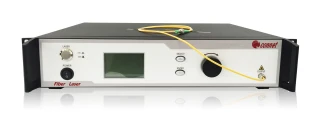
The 1550nm Fiber Laser (low power) is a compact, high-stability light source engineered for demanding applications in fiber sensing, optical testing, and laboratory research. Built around a high-quality DFB semiconductor laser chip and single-mode fiber output, this source delivers a narrow linewidth of ≤3 MHz with excellent power and spectral stability. Operating in the C-band around 1550 nm, it is well suited for modern telecommunications components, interferometric sensors, and a wide range of precision measurement setups where coherence and long-term reliability are critical.
To ensure consistent performance, the laser integrates a professionally designed driving circuit and thermoelectric cooler (TEC) control. This combination tightly regulates both current and temperature, maintaining the center wavelength at 1550 ± 0.5 nm (with options across 1540–1565 nm) while minimizing drift over time. Short-term output stability is typically within ±0.02 dB over 15 minutes, and long-term stability remains within ±0.05 dB over 8 hours, making it a dependable source for long-duration experiments, continuous monitoring systems, and automated production testing environments.
The laser is available with either standard single-mode fiber (SMF-28e) or polarization-maintaining PM1550 panda fiber, providing flexibility for both general-purpose and polarization-sensitive applications. The PM option is particularly advantageous in coherent detection schemes, interferometers, and fiber optic gyroscopes where maintaining a stable state of polarization is essential to achieve high signal-to-noise ratio and repeatable measurements. An FC/APC output connector helps minimize back reflections, further enhancing spectral purity and operational stability in high-precision optical setups.
For easy integration into different environments, the 1550nm fiber laser is offered in both desktop and compact module configurations. The desktop unit features straightforward front-panel button control and universal AC power input (100–240 V), making it ideal for laboratories, R&D benches, and educational facilities that require a self-contained, plug-and-play light source. The module version, powered by a 5 V DC supply, is designed for OEM integration and system builders, providing flexible control via an RS232 interface. This modular approach allows system designers to embed a stable, narrow-linewidth 1550 nm source directly into larger instrumentation platforms, fiber sensor networks, and automated test systems.
With output power options from 10 mW up to 200 mW, users can select the configuration that best matches their application requirements, from low-power reference sources and metrology to higher-power fiber sensing and component characterization. The broad operating temperature range of −5 °C to +55 °C and humidity tolerance of 0–70% support reliable field deployment as well as controlled indoor operation. Combined with robust engineering and flexible customization options for wavelength, power, and fiber type, this 1550nm Fiber Laser (low power) offers a versatile, cost-effective solution for engineers, researchers, and integrators seeking a high-quality C-band laser source with dependable, long-term performance.
1550nm Fiber Laser (low power)
Specifications
| Center Wavelength: | 1550 nm |
|---|---|
| Output Power: | 0.2 W |
| Output Mode: | Continuous Wave (CW) |
| Spectral Linewidth: | 0.024 nm |
| Output Fiber Type: | SMF-28, PM-1550 |
| Output Fiber Length: | 1 m |
| Interface: | RS-232 |
| Cooling: | Air Cooled |
| Electrical Requirements: | 110V - 60Hz, 115V - 50Hz, 115V - 60Hz, 120V - 60Hz, 127V - 50Hz, 127V - 60Hz, 220V - 50Hz, 230V - 50Hz, 230V - 60Hz, 240V - 50Hz |
| Spectrum Linewidth: | ≤ 3 MHz |
| Sideband Rejection Ratio: | > 50 dB |
| Output Power Options: | 10/20/50/100/200 mW |
| Short-term Stability (15 Minutes): | ≤ ±0.02 dB |
| Long-term Stability (8 Hours): | ≤ ±0.05 dB |
Got questions about specs? Use the inquiry form to ask.
 Download Data Sheet

Features
- Ultra-Stable 1550 nm Narrow Linewidth Output
Utilizes a high‑quality DFB laser chip to deliver a center wavelength of 1550 ± 0.5 nm (1540–1565 nm optional) with a linewidth ≤ 3 MHz, ideal for coherent detection, sensing, and high‑resolution optical testing. - Exceptional Power Stability and Low Noise
Professionally designed low‑noise driving circuitry and TEC control provide excellent output stability, with short‑term power fluctuation ≤ ±0.02 dB (15 min) and long‑term stability ≤ ±0.05 dB (8 hours) for demanding lab and field applications. - Flexible Output Power Options
Available in multiple factory‑set power levels of 10, 20, 50, 100, and 200 mW, with customized output power on request, allowing precise matching to fiber sensing, interferometry, calibration, and general fiber laser seeding requirements. - Single-Mode (SM) or Polarization-Maintaining (PM) Fiber
Choice of SMF‑28e for standard single‑mode applications or PM1550 panda fiber for high polarization extinction and stable polarization‑sensitive measurements, such as coherent communications and interferometric sensors. - High Sideband Suppression for Clean Spectra
Sideband rejection ratio of > 50 dB ensures a spectrally pure, single‑frequency output with minimal spurious modes, improving accuracy in fiber Bragg grating sensing, optical component characterization, and narrowband filtering experiments. - Robust Thermal Management via Integrated TEC
Built‑in thermoelectric temperature control (TEC) maintains the laser chip at a stable temperature, guaranteeing wavelength and power stability across a wide operating range and reducing drift in long‑duration measurements. - Two Package Options: Desktop or Compact Module
Offered as a user‑friendly desktop unit (260 × 280 × 120 mm) with front‑panel buttons, or as a compact module (125 × 150 × 20 mm) with RS232 control, supporting both laboratory benchtops and OEM/instrument integration. - Convenient Electrical Interfaces and Control
Desktop version operates from a 100–240 V AC mains supply (<30 W), while the module version uses a low‑voltage 5 V DC input (<15 W) and RS232 (DB9 female) communication, enabling easy configuration and remote monitoring in system designs. - Standard FC/APC Optical Interface
Uses a standard FC/APC connector to minimize back‑reflection and polarization disturbance, ensuring compatibility with common telecom‑grade fibers, patch cords, and test setups in laboratories and production lines. - Wide Operating Temperature and Humidity Range
Designed for reliable performance over an operating temperature range of −5 to +55 °C and humidity of 0–70%, suitable for both controlled lab environments and more challenging industrial or field conditions. - Ideal for Fiber Sensing, Testing, and Seeding
Optimized as a low‑power, narrow linewidth 1550 nm fiber laser for fiber Bragg grating sensors, distributed fiber sensing, fiber laser seeding, optical component testing, and other precision photonics experiments requiring stable CW 1550 nm light. - Customizable Configuration for OEM and Research
Supports customized wavelength (within 1540–1565 nm), output power levels, package type, and fiber configuration, enabling tailored solutions for spectroscopy systems, coherent communication testbeds, metrology setups, and other specialized applications. - Reliable DK Photonics Design and Manufacturing
Engineered and manufactured by DK Photonics, leveraging experience in fiber lasers and passive components, with a focus on long‑term reliability, low failure rate, and easy integration into existing optical infrastructures.
Applications
- Optical fiber sensing systems – ideal narrow-linewidth source for fiber Bragg grating (FBG) interrogation, distributed temperature and strain sensing (DTS/DSS), and long-baseline interferometric sensors used in civil engineering, energy, and industrial monitoring.
- Interferometric and coherent detection – provides a highly stable local oscillator for coherent optical communication experiments, coherent LIDAR, optical heterodyne detection, and phase‑sensitive measurements.
- Fiber laser seeding and pumping – used as a seed laser for high-power Erbium-doped fiber amplifiers (EDFA) and Er/Yb fiber lasers, master oscillator setups, and narrowband amplification chains at 1550 nm.
- Optical communication and transmission testing – reference light source for DWDM/CWDM channel emulation, BER testing, coherent receiver characterization, and general telecom component evaluation in the C‑band.
- Optical device characterization – stable CW source for testing and calibrating optical components such as filters, multiplexers/demultiplexers, circulators, isolators, splitters, switches, wavelength lockers, and integrated photonic circuits.
- Metrology and spectroscopy – narrow-linewidth laser for high‑resolution spectroscopy around 1550 nm, frequency locking experiments, optical path length calibration, and precision wavelength reference applications.
- Optical coherence tomography (OCT) and imaging research – single‑frequency light source for phase‑sensitive OCT, low‑coherence interferometry setups, and reference arm illumination in advanced imaging systems.
- Laser ranging and LIDAR development – suitable for eye‑safer 1550 nm laser ranging, prototype LIDAR transmitters and local oscillators, and range‑resolved sensing in automotive, aerospace, and surveying applications.
- Microwave photonics and RF-over-fiber – used for optical generation and transport of RF/microwave signals, phase‑stable links, delay lines, and photonic signal processing experiments requiring low noise and high coherence.
- Coherent fiber optics gyroscopes and inertial sensing – polarization‑maintaining option supports interferometric gyroscopes, rotation sensing, and other precision inertial measurement systems.
- Quantum optics and quantum communication – pump or reference laser for entangled photon generation (e.g., in periodically poled waveguides), quantum key distribution (QKD) at telecom wavelengths, and quantum channel characterization.
- Environmental and structural health monitoring – integrated in FBG- and interferometer‑based systems for pipelines, bridges, tunnels, wind turbines, railways, and smart structures requiring long‑term stable interrogation sources.
- Laboratory research and educational use – versatile, reliable C‑band source for university and R&D labs working on photonics, telecom, sensing, and instrumentation, both for teaching and advanced experiments.
- Calibration and reference light source – acts as a stable wavelength and power reference for calibrating optical spectrum analyzers, power meters, wavelength meters, and other precision test instruments.
- Integration into OEM test and measurement equipment – compact modular version can be embedded into customized fiber‑optic test sets, monitoring systems, rack‑mount platforms, and automated production‑line testers.
Frequently Asked Questions
What is the DK Photonics 1550 nm low‑power fiber laser and what are its key features?
What are the main applications of a 1550 nm narrow linewidth fiber laser from DK Photonics?
How do I select the correct model and configure the part number for the DK Photonics 1550 nm fiber laser?
What is the difference between the desktop and module versions of the 1550 nm fiber laser?
How stable is the output power and spectrum of the DK Photonics 1550 nm fiber laser?
What fiber and connector options are available for the 1550 nm fiber laser?
What are the operating conditions and how should I power and control the DK Photonics 1550 nm fiber laser?
Got more questions? Use the inquiry form to ask the supplier directly.
Similar Products



Your inquiry has been received.
Create an account by adding a password
Why create an account?
- Auto-complete inquiry forms
- View and manage all your past messages
- Save products to your favorites
- Close your account anytime — no hassle