


Description
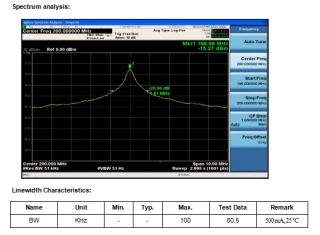
The CoSF-D-Tm-B-LP is a low-power single frequency fiber laser engineered around thulium-doped fiber to deliver ultra-stable performance in the 1900–2100 nm wavelength range. Built on distributed feedback Bragg grating (DFB) technology, this laser provides continuous-wave, single-frequency, single-longitudinal-mode emission with a narrow linewidth of less than 15 kHz and exceptionally low phase and frequency noise. Compared with typical 2 µm fiber lasers on the market, the CoSF-D-Tm-B-LP stands out with a combination of narrow spectral linewidth, low relative intensity noise (RIN), and high polarization stability, making it highly suitable for demanding coherent and metrology applications.
The output power of this thulium-doped fiber laser is available from 20 mW up to 100 mW, with 20 mW as a fixed configuration and 50 mW and 100 mW offered as adjustable-power options. A typical center wavelength of 1940 nm or 2050 nm is available, while any fixed wavelength within the 1900–2100 nm band can be specified to match application-specific absorption lines or system design requirements. Thanks to advanced fiber design and optimized cavity construction, the laser maintains excellent beam quality with an M² value close to 1 (typically 1.05), enabling efficient coupling into optical fibers, free-space optics, or nonlinear crystals for further frequency conversion.
The CoSF-D-Tm-B-LP is designed to minimize noise across multiple dimensions. It exhibits extremely low RIN with a RIN peak as low as −120 dBc/Hz in the 400–600 kHz range, along with low phase and frequency noise that are critical for coherent detection and high-resolution spectroscopy. The laser operates in stable linear polarization with a high polarization extinction ratio (typically 20 dB), ensuring excellent polarization control for polarization-sensitive experiments and systems such as coherent LiDAR, interferometry, and nonlinear frequency conversion schemes. This stability is further supported by output power stability better than ±0.5% (typical), enabling long-term, drift-free operation.
For dense spectral environments and precision measurement setups, the CoSF-D-Tm-B-LP offers a high side-mode suppression ratio (SMSR) of typically 45 dB at 50 pm resolution, ensuring a clean single-frequency spectrum with no mode-hopping. Users benefit from reliable single-longitudinal-mode operation, even over extended operating times and moderate environmental variations. Integrated optical isolation (up to 30 dB) protects the laser cavity from back-reflections, enhancing robustness in complex optical systems where feedback from downstream optics can otherwise destabilize performance.
Wavelength control is a key strength of this laser. Thermal tuning provides a wavelength adjustment range of approximately 0.6–0.8 nm, allowing alignment to specific absorption lines for gas sensing or to optimal working points for nonlinear interactions. For applications requiring fast and precise wavelength or frequency modulation—such as coherent LiDAR, high-resolution laser spectroscopy, and advanced sensing—an optional piezoelectric transducer (PZT) modulation interface is available. This enables linear modulation from DC up to 10–20 kHz with a modulation range of up to 8–10 GHz, supporting frequency locking, scanning, and phase-sensitive detection schemes.
The CoSF-D-Tm-B-LP is particularly well suited for frequency conversion at 2 µm, where thulium-doped fiber lasers are commonly used as pump sources for mid-infrared generation via nonlinear crystals or fiber-based parametric devices. Its narrow linewidth and excellent beam quality improve conversion efficiency and spectral purity in difference-frequency generation or optical parametric oscillators. In coherent LiDAR systems, the combination of narrow linewidth, low RIN, and single polarization output enables long coherence lengths and high signal-to-noise ratio, directly translating into improved range resolution and measurement accuracy over conventional broadband or multi-mode sources.
In laser spectroscopy and gas absorption measurement, the selectable center wavelength within the 1900–2100 nm band allows precise matching to absorption features of water vapor and other molecular species frequently probed around 2 µm. The fine wavelength tunability and low noise characteristics make it ideal for high-sensitivity, high-resolution absorption spectroscopy, cavity-enhanced techniques, and wavelength modulation spectroscopy. Researchers in fundamental optics, atomic and molecular physics, and environmental monitoring can take advantage of its spectral purity and stability to push detection limits and reduce systematic errors in long-term experiments.
From a practical standpoint, the CoSF-D-Tm-B-LP is delivered as a compact, benchtop unit measuring 430 × 450 × 105 mm and weighing u<
Narrow Linewidth Single Frequency Thulium Fiber Laser 1900 to 2100nm
Specifications
| Center Wavelength: | 1940 nm |
|---|---|
| Output Power: | 0.1 W |
| Output Mode: | Continuous Wave (CW), Single Frequency, Single Longitudinal Mode |
| Beam Quality (M^2): | 1.1 |
| Spectral Linewidth: | 1.88E-7 nm |
| Output Power Stability: | 0.9% ~ 1.0% |
| Output Fiber Type: | PMF |
| Output Fiber Length: | 0.5 m |
| Interface: | RS-232 |
| Cooling: | Air Cooled |
| Electrical Requirements: | 110V - 60Hz, 115V - 50Hz, 115V - 60Hz, 120V - 60Hz, 127V - 50Hz, 127V - 60Hz, 220V - 50Hz, 230V - 50Hz, 230V - 60Hz, 240V - 50Hz |
| Linewidth: | 15 kHz |
| RIN Peak Frequency: | 600 kHz |
| RIN Peak: | -110 dBc/Hz |
| SMSR (50pm Resolution): | 40 dB |
| Output Polarization: | Linear |
| Polarization Extinction Ratio (PER): | 18 dB |
| Output Isolation: | 25 dB |
| Wavelength Thermal Tuning: | 0.8 nm |
| PZT Wavelength Modulation: | Optional |
| Modulation Frequency (linear): | 20 kHz |
| Modulation Wavelength Range: | 10 GHz |
| Operating Temperature: | +15~+40 ℃ |
| Storage Temperature: | -20~+60 ℃ |
| Optical Connector: | FC/APC |
| Dimension: | 430x450x105 mm |
| Weight: | <5 kg |
Got questions about specs? Use the inquiry form to ask.
 Download Data Sheet

Features
- Ultra-Narrow Linewidth & Low Noise
– Typical linewidth 10 kHz (max. 15 kHz) for ultra-stable, high-coherence operation
– Very low phase and frequency noise for demanding coherent applications
– Low relative intensity noise (RIN) with peak RIN down to -120 dBc/Hz around 400–600 kHz - Single-Frequency, Single-Longitudinal-Mode Output
– True CW single-frequency operation with single longitudinal mode
– No mode-hopping across the specified operating range, ideal for precision metrology and sensing
– High side-mode suppression ratio (SMSR) ≥ 40–45 dB (50 pm resolution) - Linear Polarization with High PER
– Intrinsically linearly polarized output using PM fiber
– Polarization extinction ratio (PER) typically ≥ 20 dB for polarization-sensitive measurements
– Output via Panda PM1950 fiber (optional SMF output available) - Thulium-Doped 2 μm Fiber Laser Source
– Center wavelength selectable in the 1900–2100 nm band (e.g., 1940 nm, 2050 nm typical)
– Based on Tm-doped fiber for excellent beam quality and long-term stability
– Suitable for gas absorption lines and molecular spectroscopy around 2 μm - Adjustable Output Power with Excellent Stability
– Output power range from 20 mW to 100 mW
– 20 mW version fixed; 50 mW and 100 mW versions adjustable
– Power stability better than ±0.5% typ. (≤ ±1% max) for long-duration experiments - High Beam Quality & Integrated Optical Isolation
– Near-diffraction-limited beam with M² ≈ 1.05 (typ.), ≤ 1.1 max
– Built-in optical isolator with isolation typically 30 dB (≥ 25 dB) to protect the laser from back-reflections
– Output through FC/APC connector to minimize return loss - DFB Bragg Grating Technology for Wavelength Stability
– Distributed Feedback Bragg Grating (DFB) design for inherent single-frequency operation
– High wavelength stability under temperature and power fluctuations
– Proprietary packaging for robust, low-noise performance in lab and industrial environments - Wavelength Tuning & Fast Modulation Options
– Thermal wavelength tuning range of about 0.6–0.8 nm for coarse adjustment
– Optional PZT fast modulation for rapid wavelength/frequency scanning
– Linear modulation frequency range from DC to 10–20 kHz, with modulation range up to 8–10 GHz - Designed for Coherent LiDAR & Spectroscopy
– Narrow linewidth and low RIN optimized for coherent LiDAR and FMCW systems
– High coherence length suitable for high-resolution laser spectroscopy and interferometry
– Ideal for gas absorption measurements and environmental sensing around 2 μm - Ready for Frequency Conversion & Nonlinear Optics
– High spectral purity enables efficient frequency conversion and nonlinear processes
– Stable single-frequency 2 μm source for mid-IR generation and difference-frequency experiments
– Suitable pump for optical parametric oscillators (OPOs) and related nonlinear systems - Laboratory-Friendly Benchtop Design
– Compact benchtop module: approx. 430 × 450 × 105 mm, weight < 5 kg
– Universal AC power input: 100–240 V, 50/60 Hz
– RS232 communication interface for monitoring and remote control - Robust Environmental Performance
– Operating temperature range: +15 °C to +40 °C
– Storage temperature range: -20 °C to +60 °C
– Engineered for high reliability and long-term, maintenance-free operation - Configurable Output & Monitoring Options
– Standard PM fiber output; optional SMF output on request
– Optional monitoring output for power and stability diagnostics
– Ordering format supports user-defined wavelength, power level, fiber type, and PZT modulation - Ideal for Advanced Scientific & Industrial Research
– Tailored for precision metrology, sensing, atomic and molecular physics
– Suitable as a local oscillator or seed laser in coherent communication experiments
– Stable, low-noise platform for integration into complex optical systems
Applications
Applications of CoSF-D-Tm-B-LP Narrow Linewidth Single Frequency Fiber Laser
The CoSF-D-Tm-B-LP is a Thulium-doped single-frequency fiber laser with a tunable center wavelength in the 1900–2100 nm range, narrow linewidth (<15 kHz), low phase noise, low RIN, and linearly polarized single-longitudinal-mode output. These characteristics make it ideal for demanding scientific, industrial, and sensing applications where ultra-stable coherent light around 2 µm is required.
1. Frequency Conversion and Nonlinear Optics
- Optical parametric generation and amplification (OPG/OPA): Use as a narrow-linewidth pump source for optical parametric oscillators and amplifiers to generate mid‑infrared (mid‑IR) wavelengths for spectroscopy, defense, and free-space communications.
- Difference-frequency generation (DFG): Provide a stable seed for DFG systems to obtain tunable mid‑IR radiation for gas sensing and molecular fingerprinting.
- Second-harmonic and sum-frequency generation: Drive nonlinear crystals for frequency doubling and mixing to generate coherent radiation at alternative wavelength bands.
- Supercontinuum generation around 2 µm: Seed highly nonlinear fibers to produce broad supercontinuum spectra for calibration sources, metrology, and ultrafast spectroscopy.
- Mid‑IR combs and frequency metrology: Act as a narrow-linewidth source in frequency-comb and precision metrology setups, especially where 2 µm pumping improves conversion efficiency.
2. Coherent LiDAR and 3D Imaging
- Coherent Doppler LiDAR for wind and speed measurement: Use the low-linewidth, low-RIN output as a local oscillator and transmitter for coherent detection in atmospheric wind profiling, aviation safety, and turbine control.
- FMCW LiDAR for high-resolution ranging: Exploit the narrow linewidth and frequency/phase stability for frequency-modulated continuous-wave (FMCW) LiDAR in autonomous platforms, robotics, and infrastructure monitoring.
- Long-range free-space sensing at 2 µm: Benefit from eye-safer operation and reduced atmospheric scattering compared to shorter wavelengths for long-distance ranging and mapping.
- Velocity and vibration sensing: Implement coherent detection schemes for precise velocity, micro‑Doppler, and vibration measurements of mechanical and civil structures.
- Speckle-based 3D imaging: Use stable single-frequency output for speckle and interferometric imaging techniques where phase coherence is essential.
3. High-Resolution Laser Spectroscopy
- High-resolution molecular spectroscopy: Perform Doppler-limited or sub‑Doppler spectroscopy of gases with narrow absorption features in the 1900–2100 nm band (e.g., H2O, CO2, CH4, HF, and other overtone/combination bands).
- Cavity ring-down spectroscopy (CRDS): Use the narrow linewidth laser with high-finesse cavities to achieve extremely low detection limits for trace gas analysis.
- Saturated absorption and frequency locking: Implement saturated absorption spectroscopy and frequency-stabilized locking schemes for ultra-stable reference lasers.
- Photoacoustic spectroscopy (PAS): Drive photoacoustic cells with highly stable CW radiation to enhance sensitivity for environmental and industrial gas monitoring.
- Cavity-enhanced absorption spectroscopy (CEAS): Combine with long-path optical cavities to measure very weak transitions in research and metrology.
4. Gas Absorption Measurement & Environmental Sensing
- Tunable diode laser absorption spectroscopy (TDLAS): Use wavelength tunability and narrow linewidth for selective and quantitative detection of gases such as H2O, CO2, CH4, NH3, and others absorbing near 2 µm.
- In-situ industrial process monitoring: Integrate into process lines and combustion systems to monitor gas composition, temperature, and efficiency in power plants and refineries.
- Atmospheric and climate research: Deploy in field instruments for measuring greenhouse gases, water vapor profiles, and atmospheric pollutants using optical absorption techniques.
- Leak detection and safety monitoring: Implement fixed or portable leak detection systems for pipelines, chemical facilities, and storage tanks, exploiting strong absorption bands near 2 µm.
- Multi-pass cell measurements: Combine with Herriott or White cells for long effective optical path lengths and very low detection limits in laboratory or OEM analyzer platforms.
Frequently Asked Questions
What is the CoSF-D-Tm-B-LP narrow linewidth single frequency fiber laser and what makes it different?
What wavelength and output power options are available for the CoSF-D-Tm-B-LP fiber laser?
What are the typical linewidth, noise performance, and beam quality of this single frequency Thulium fiber laser?
Is the CoSF-D-Tm-B-LP laser polarization‑maintaining and how stable is its output?
How can I tune or modulate the wavelength of this narrow linewidth Tm-doped fiber laser?
What are the main applications of the CoSF-D-Tm-B-LP 2 µm single frequency fiber laser?
How is the CoSF-D-Tm-B-LP fiber laser packaged and what are the interface and power requirements?
Got more questions? Use the inquiry form to ask the supplier directly.
Similar Products



Your inquiry has been received.
Create an account by adding a password
Why create an account?
- Auto-complete inquiry forms
- View and manage all your past messages
- Save products to your favorites
- Close your account anytime — no hassle