

Description
C-Band Wavelength Tunable Fiber Laser – High-Stability, Ultra-Fine ITU Channel Control
This C-Band Wavelength Tunable Fiber Laser is engineered for demanding optical communication, sensing, and research applications that require precise wavelength control across the standard C-band. Covering a continuous tuning range from 1529.16 nm to 1567.95 nm (191.20–196.05 THz), it aligns with ITU standards from H60 to C12 and supports ultra-fine channel tuning in 1 GHz steps. With this configuration, users can access up to 4,931 discrete wavelength channels, making the laser exceptionally suitable for DWDM system development, component characterization, and advanced laboratory experiments.
Compared with typical C-band tunable lasers on the market, which often provide only coarse grid steps or a limited number of channels, this source combines 50 GHz ITU channel spacing for coarse selection with 1 GHz fine-tuning capability. This dual-level control allows users to rapidly switch between standardized ITU grid channels and then precisely adjust within each channel with sub-picometer precision (approximately 8 pm per 1 GHz step). Such granularity is particularly advantageous in filter calibration, wavelength routing tests, and performance verification of DWDM transceivers and passive components.
The laser delivers up to 20 mW of output optical power, which is well within the typical power range used in high-end telecommunication test setups and optical component R&D. The output exhibits a side-mode suppression ratio (SMSR) greater than 50 dB, ensuring a spectrally clean single-longitudinal-mode operation with minimal spurious modes. This level of spectral purity helps reduce measurement uncertainty, interference artifacts, and crosstalk when the source is used in multi-channel environments or in narrowband optical sensing schemes.
Short-term and long-term output stability are critical for accurate and repeatable optical measurements. This tunable laser achieves short-term power stability of ≤±0.01 dB over 15 minutes and long-term stability of ≤±0.025 dB over 8 hours across the entire temperature range. These stability figures are comparable to, and in many cases better than, other laboratory-grade tunable fiber lasers commonly used in telecom and metrology labs. As a result, users can conduct extended measurement sessions, automated wavelength sweeps, and long-duration reliability tests without frequent re-calibration.
The laser operates in a stochastic linear polarization state and is available with either SMF-28 or PM1550 output fiber, specified by the model configuration. When ordered with polarization-maintaining fiber (PM1550) and a polarization-maintaining configuration, the system delivers a polarization extinction ratio (PER) of ≥23 dB, helping maintain a stable and well-defined polarization state at the output. This is a key attribute for applications such as coherent detection experiments, interferometric sensing, and polarization-dependent component testing, where polarization stability directly impacts system performance and accuracy.
The standard output interface is an FC/APC connector, a widely adopted connector type in high-performance optical test setups due to its low back-reflection and stable mechanical coupling. The use of SMF-28 or PM1550 fiber ensures compatibility with the majority of C-band components, including multiplexers, demultiplexers, EDFAs, filters, and fiber-based sensors. This plug-and-play compatibility simplifies integration into existing test benches and fiber networks, reducing setup time and the need for special adapters.
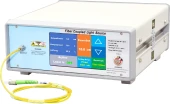
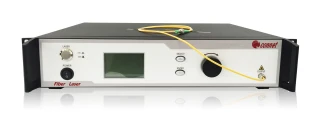
Designed as a compact desktop unit (B1 package), the tunable fiber laser has dimensions of 255 mm (W) × 285 mm (D) × 115 mm (H), making it suitable for both benchtop laboratory environments and production test racks. The system supports dual control modes: a front-panel touchscreen interface for straightforward manual operation and RS232 serial communication for remote or automated control. This flexibility allows the laser to function equally well as a stand-alone instrument for manual tuning or as a programmable source in automated test systems, manufacturing lines, or remote monitoring setups.
From an electrical and environmental standpoint, the laser operates from a universal 100–240 VAC power supply with power consumption under 30 W, which is typical for modern, energy-efficient photonics instrumentation. The operating temperature range of -5°C to +35°C and working humidity range of 0–70% support reliable use in standard laboratory conditions and controlled production environments. These specifications ensure stable performance without the need for elaborate environmental control beyond normal laboratory practice.
C-Band Wavelength Tunable Fiber Laser
Specifications
| Center Wavelength: | 1550 nm |
|---|---|
| Output Power: | 300 W |
| Output Mode: | Continuous Wave (CW) |
| Spectral Linewidth: | 40 nm |
| Output Power Stability: | </= 0.1% |
| Output Fiber Type: | PM-1550 |
| Output Fiber Length: | 1 m |
| Interface: | RS-232 |
| Cooling: | Air Cooled |
| Electrical Requirements: | 240V - 50Hz |
| Wavelength Tuning Range: | 1529.16–1567.95 nm |
| Frequency Tuning Range: | 191.20–196.05 THz |
| Channel Spacing (coarse, ITU Wavelength): | 50 GHz (≈0.4 nm) |
| Channel Interval (fine Tune): | 1 GHz (≈8 pm) |
| Side-mode Suppression Ratio: | >50 dB |
| Number Of Wavelength Channels: | 4931 |
| Output Optical Power: | 20 mW |
| Short-term Stability (15 Minutes): | ≤±0.01 dB |
| Long-term Stability (8 Hours): | ≤±0.025 dB |
| Polarization State: | stochastic linear polarization |
| Polarization Extinction Ratio (PER): | ≥23 dB |
| Fiber Type: | SMF-28 / PM1550 |
| Fiber Optic Connector: | FC/APC |
| Product Packaging Format: | Desktop, B1 |
| Control Method: | Touchscreen / RS232 serial communication |
| RS232 Connector Interface: | DB9 female |
| Supply Electricity: | 100–240 VAC, <30 W |
| Size: | 255(W) × 285(D) × 115(H) mm |
| Operating Temperature Range: | -5 to +35 °C |
| Working Humidity Range: | 0–70% RH |
| Typical Model: | TFL-C-4931-20-PM-B1 |
| Spectral Coverage: | C-4931 (C-band) |
| Output Fiber Type Options: | SM=SMF-28, PM=PM1550 |
| Packaging Format Option: | B1=Desktop |
Got questions about specs? Use the inquiry form to ask.
 Download Data Sheet

Features
- Wide C-Band Wavelength Tuning Range (1529.16–1567.95 nm)
Covers the full C-band according to ITU standards from ITU channels H60 to C12, ideal for DWDM, optical component characterization, and telecom system testing. - Precise Frequency Tuning (191.20–196.05 THz)
Enables accurate frequency selection for high-resolution experiments, coherent communication research, and metrology applications. - Fine & Coarse Channel Spacing Control
50 GHz coarse adjustment (≈0.4 nm) ITU-grid spacing for standard DWDM channels, plus 1 GHz fine tuning step (≈8 pm) for ultra-precise wavelength control and channel alignment. - High Side-Mode Suppression Ratio > 50 dB
Ensures ultra-clean single-frequency output with minimal spurious modes, reducing crosstalk and improving signal integrity in advanced optical systems. - Up to 4931 Tunable Wavelength Channels
Extremely dense channel availability across the C-band, providing exceptional flexibility for multi-channel simulations, spectral scanning, and device calibration. - 20 mW Stable Output Optical Power
Delivers sufficient power for most test and measurement setups, component evaluation, and system integration while maintaining excellent spectral purity. - Outstanding Short- and Long-Term Power Stability
Short-term stability ≤ ±0.01 dB over 15 minutes and long-term stability ≤ ±0.025 dB over 8 hours (single wavelength, full temperature range), guaranteeing repeatable and reliable measurements. - Linear Polarization Output with High PER (≥ 23 dB)
Provides stochastically linear polarization with a polarization extinction ratio ≥ 23 dB, suitable for polarization-sensitive experiments, coherent detection, and sensor systems. - Choice of SMF-28 or PM1550 Output Fiber
Available with standard single-mode fiber (SMF-28) or polarization-maintaining fiber (PM1550) to match telecom test setups, integrated photonics labs, and precision interferometry applications. - FC/APC Fiber Connector Interface
Low-back-reflection FC/APC output minimizes feedback into the laser cavity and improves stability; other connector options are available on request. - Desktop Package (B1) for Lab and Production Use
Compact benchtop housing of 255 (W) × 285 (D) × 115 (H) mm fits easily into optical tables and 19-inch rack environments with minimal footprint. - User-Friendly Touchscreen and Remote RS232 Control
Local control via intuitive touchscreen interface, and remote automation via RS232 (DB9 female), simplifying integration into test racks and automated measurement systems. - Universal AC Power Input with Low Consumption
Operates from 100–240 VAC with < 30 W power consumption, supporting global deployment in research labs, factories, and field testing facilities. - Wide Operating Temperature and Humidity Range
Reliable performance from -5°C to +35°C and 0–70% relative humidity, supporting both controlled lab environments and more demanding industrial conditions. - Optimized for DWDM, Components Testing, and Sensing
Tunable C-band fiber laser designed for optical filter testing, EDFA/ROADM characterization, DWDM equipment verification, fiber sensing interrogation, and coherent system R&D. - Model Example: TFL-C-4931-20-PM-B1
Typical configuration offering C-band spectral coverage with 4931 wavelength channels, 20 mW output, PM1550 polarization-maintaining fiber, and desktop (B1) packaging for laboratory-grade performance. - Professional Support and Custom Options
Backed by Yogel Fiber’s engineering team with options for customized connectors, fibers, and interface settings to suit specific telecom, research, and industrial applications.
Applications
Applications of C-Band Wavelength Tunable Fiber Laser (1529.16–1567.95 nm)
- DWDM System Testing and Development (50 GHz / 100 GHz / 200 GHz grids)
With a 1529.16–1567.95 nm tuning range and 50 GHz ITU channel spacing (approx. 0.4 nm), this tunable laser is ideal as a flexible light source for:- Design, characterization, and verification of DWDM systems and components
- Setting and sweeping any ITU-T C-band channel for R&D and production
- Simulating traffic channels in multi-channel coherent transmission links
- Optical Component Characterization (Filters, MUX/DEMUX, ROADMs)
Fine 1 GHz (≈8 pm) tuning resolution and >50 dB side-mode suppression ratio support precision measurement of:- Arrayed waveguide gratings (AWGs) and thin-film filters
- DWDM MUX/DEMUX and OADM/ROADM modules
- Wavelength-selective switches (WSS) and optical interleavers
- Fiber Optic Sensing and Interrogation (FBG, EFPI, and Distributed Sensors)
The excellent power and wavelength stability (≤±0.01 dB short-term, ≤±0.025 dB long-term) make this laser suitable as a scanning or reference source for:- Fiber Bragg grating (FBG) sensing arrays in strain, temperature, and pressure monitoring
- High-resolution interrogation of narrowband FBGs or cascaded sensors
- Distributed sensing schemes that require a stable C-band tunable source
- Coherent Communication and Receiver Testing
The narrow-linewidth, high SMSR output in C-band can be used as a:- Local oscillator (LO) source for coherent detection system evaluation
- Test laser for high-order modulation formats in advanced transceivers
- Reference source for phase and frequency stability characterization
- Optical Network Simulation, Training, and Education
The touchscreen/RS232 control and compact desktop (B1) format enable:- University and training labs to demonstrate C-band WDM concepts
- Simulation of variable-channel loading in metro and long-haul links
- Hands-on experiments in optical networking and photonics courses
- Telecom Equipment Production and Burn-In Testing
Stable 20 mW output across 4931 channels facilitates:- Automated production testing of WDM transceivers and modules
- Burn-in and reliability tests under controlled wavelength and power
- Incoming inspection of passive optical components in manufacturing lines
- PM and SM Fiber System Evaluation
With options for SMF-28 and PM1550 fiber output and PER ≥23 dB (PM version), the laser supports:- Polarization-maintaining (PM) system alignment and characterization
- Testing of polarization-sensitive devices and PM components
- General single-mode (SM) telecom component testing
- Optical Metrology and Calibration
Dense channel coverage over the entire C-band and fine 1 GHz tuning enable:- Calibration of wavelength meters, OSAs, and optical spectrum analyzers
- Characterization of dispersion and group delay in fibers and components
- Verification of passband shape and center wavelength of precision filters
- Nonlinear Fiber Optics Experiments (C-Band Pump Source)
The stable, tunable C-band output serves as a pump or signal source for:- Four-wave mixing (FWM) and parametric amplification studies
- Supercontinuum generation in highly nonlinear fibers (HNLF)
- Research on Kerr effects, Brillouin, and Raman scattering in fibers
- Optical Sensor Network Calibration and Maintenance
In large-scale FBG or distributed sensing networks, this laser source can:- Calibrate spectral responses of multiplexed sensor chains
- Verify channel allocation and guard bands in WDM sensor networks
- Serve as a field or lab reference when aligning sensing interrogators
- Lab-Grade Tunable Source for General Photonics Research
Suitable for a wide range of R&D tasks that require a stable, tunable C-band source:- Integrated photonics and silicon photonic chip testing
- Optical signal processing and all-optical switching studies
- Evaluation of new materials, waveguides, and modulators at 1.55 µm
- Quantum Communication and Single-Photon Experiments (Classical Pump/Probe)
While not a single-photon source, this laser can be used as:- Classical pump or probe laser in C-band quantum key distribution (QKD) testbeds
- Alignment and calibration source for quantum channels and filters
- Reference laser for timing synchronization
Frequently Asked Questions
What is the C-band wavelength tunable fiber laser TFL-C-4931-20-PM-B1 and what are its main features?
What wavelength tuning options and channel spacing does this C-band tunable laser support?
How stable is the output of this tunable fiber laser over time and temperature?
What polarization characteristics and fiber types are available for the TFL-C-4931 tunable laser?
What are the electrical, control, and interface options for integrating this C-band tunable laser into a test setup?
What are the typical applications of a 1529–1568 nm C-band wavelength tunable fiber laser with 20 mW output?
How do I interpret the model number TFL-C-4931-20-PM-B1 and what configuration options are available?
Got more questions? Use the inquiry form to ask the supplier directly.
Similar Products



Your inquiry has been received.
Create an account by adding a password
Why create an account?
- Auto-complete inquiry forms
- View and manage all your past messages
- Save products to your favorites
- Close your account anytime — no hassle