


Description
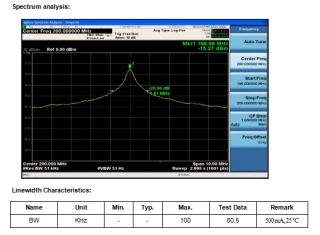
The 729 nm Single Frequency Fiber Laser (model CoSF-729-B-FA) is a high‑performance laser source engineered for advanced atomic and quantum experiments that demand exceptional coherence, stability, and beam quality. Operating in continuous‑wave (CW) single‑frequency and single longitudinal mode, this laser delivers ultra‑narrow linewidth below 50 kHz, low phase and frequency noise, and excellent power stability over extended measurement cycles. With output power levels from 20 mW up to 100 mW and linear polarization with high polarization extinction ratio (PER), it is ideal for precision‑sensitive laboratory and industrial environments.
Built on a mature distributed feedback Bragg grating (DFB) fiber laser platform at 1.1 µm and 1.9 µm, the system employs nonlinear frequency conversion to generate a clean and stable 729 nm output. This architecture provides a significant performance advantage over typical tapered amplifier (TA) based semiconductor lasers at similar wavelengths, offering narrower linewidth, lower phase noise, reduced frequency noise, and superior beam quality with M² close to 1. Such characteristics are critical for applications where long coherence times, tight locking to atomic transitions, and high spatial mode purity are required.
The 729 nm wavelength is widely used for trapped ion manipulation, optical qubits, and precision spectroscopy in quantum information science and metrology. This laser is particularly well suited for atom cooling, Rydberg excitation and related “Rydberg inspire” experiments, cold atomic physics platforms, optical atomic clocks, and a wide array of quantum measurement schemes. The combination of ultra‑narrow linewidth and high spectral purity (SMSR typically 40 dB) enables reliable addressing of narrow optical transitions, while the excellent beam quality ensures efficient coupling into optical cavities, fibers, and ion or atom traps.
For experiments that require dynamic control of the laser frequency, the system can be equipped with an optional PZT fast modulation function. This provides a wavelength modulation range on the order of tens of GHz and a modulation bandwidth extending from DC up to tens of kHz, supporting high‑speed frequency locking, sideband generation, and active stabilization schemes. Thermal tuning of the emission wavelength over a range of up to 0.5 nm with sub‑picometer adjustment accuracy allows precise alignment with specific atomic or ionic transitions, facilitating integration into complex optical frequency control architectures.
Power stability and tunability are central design considerations of this 729 nm single frequency fiber laser. With output power stability on the order of ±1% over 8 hours and a tunable power range from approximately 30% to 100% of the nominal output, users can maintain consistent experimental conditions and finely adjust optical intensities at the interaction region. The linear polarization output with a high PER (typically above 23 dB) and PM780‑HP polarization‑maintaining fiber delivery (slow axis aligned) help preserve polarization integrity throughout the optical setup, which is essential for polarization‑sensitive transitions and coherent manipulation protocols in quantum systems.
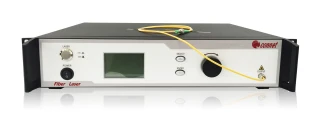
The laser is available as a benchtop or module‑type package and offers both fiber‑coupled (FC/APC) and free‑space output configurations, making it straightforward to integrate into existing optical tables, vacuum chambers, and metrology benches. Designed to operate reliably in the 15 to 35 °C range with standard AC mains input, the CoSF‑729‑B‑FA provides a robust and user‑friendly solution for research laboratories and instrumentation developers working at the forefront of quantum technology, atomic clocks, and high‑resolution spectroscopy. Its combination of ultra‑narrow linewidth, low noise, high beam quality, and flexible control features positions it as a competitive choice among state‑of‑the‑art 729 nm single frequency laser sources worldwide.
729nm Single Frequency Fiber Laser
Specifications
| Center Wavelength: | 729 nm |
|---|---|
| Output Power: | 0.1 W |
| Output Mode: | Continuous Wave (CW), Single Frequency, Single Longitudinal Mode |
| Beam Quality (M^2): | 1.05 |
| Spectral Linewidth: | 3.5E-8 nm |
| Output Power Stability: | 0.9% ~ 1.0% |
| Output Fiber Type: | PMF |
| Output Fiber Length: | 1 m |
| Interface: | RS-232 |
| Cooling: | Other |
| Electrical Requirements: | 220V - 50Hz |
| Wavelength Thermal Tuning Range: | 0.4 nm |
| Wavelength Adjustable Accuracy: | 0.1 pm |
| PZT Fast Wavelength Modulation Function: | Optional |
| PZT Modulation Wavelength Range: | 20 GHz |
| PZT Modulation Frequency: | DC-20 kHz |
| Linewidth: | 20 kHz |
| SMSR: | 40 dB |
| Output Polarization: | Linear |
| Polarization Extinction Ratio (PER): | 23 dB |
| Output Power Tunable Range: | 30 % |
| Storage Temperature: | 0~50 ℃ |
| Operating Temperature: | 15~35 ℃ |
| Output Fiber Connector: | FC/APC |
| PM Fiber Alignment Method: | Slow axis parallel |
| Dimension: | 430x450x105 mm |
Got questions about specs? Use the inquiry form to ask.
 Download Data Sheet

Features
- Ultra-Narrow Linewidth < 50 kHz – Provides exceptional spectral purity with typical linewidth around 20 kHz, ideal for ultra‑high‑resolution spectroscopy, quantum measurement, and precision metrology.
- True Single-Frequency, Single Longitudinal Mode Output – Delivers stable CW operation with single longitudinal mode, minimizing mode hopping and ensuring highly coherent 729 nm radiation for demanding atomic and quantum experiments.
- Low Phase Noise and Frequency Noise – Fiber-based single-frequency architecture with DFB Bragg grating design significantly reduces phase and frequency noise compared to traditional TA (tapered amplifier) semiconductor lasers, improving signal-to-noise ratio in quantum and atomic clock systems.
- High Output Power > 20 mW (up to 100 mW) – Provides > 20 mW output power as standard, with typical configurations up to 50–100 mW, supporting power-demanding applications such as atom cooling, Rydberg excitation, and optical lattice experiments.
- 729 nm Wavelength for Trapped-Ion and Atomic Physics – Center wavelength 729 ± 0.2 nm, specifically suited for Ca+ ion clock transitions, quantum logic gates, and precision spectroscopy in cold atomic physics setups.
- Thermally Tunable Wavelength with High Accuracy – Thermal tuning range of 0.3–0.5 nm with wavelength adjustment accuracy of 0.1 pm enables precise locking to atomic and molecular transitions and fine optimization in quantum optics experiments.
- Optional PZT Fast Wavelength Modulation – Integrated PZT actuator (optional) enables fast wavelength and frequency modulation with 10–20 GHz tuning range and modulation bandwidth up to DC–20 kHz (max 100 kHz), simplifying laser frequency locking and active stabilization.
- Linear Polarization with High PER – Linearly polarized output with polarization extinction ratio > 20 dB (typ. 23 dB) ensures excellent polarization stability, critical for interferometry, quantum state manipulation, and polarization-sensitive spectroscopy.
- Excellent Beam Quality (M² ≈ 1.05) – Near diffraction-limited beam quality (M² 1.05–1.1) offers clean Gaussian spatial mode, facilitating efficient coupling into optical cavities, fibers, and high‑NA objectives.
- Superior Stability for Long-Term Experiments – Output power stability within ±1% (typ.) over 8 hours supports long measurement runs and unattended operation in labs and industrial metrology systems.
- Adjustable Output Power 30–100% – Built-in power control allows continuous tuning of output power from 30% to 100% of rated power, simplifying optimization for different optical setups and preventing detector saturation.
- Robust Fiber-Based Frequency Conversion Design – Based on mature 1.1 µm / 1.9 µm DFB single-frequency fiber laser technology with nonlinear frequency conversion to 729 nm, providing higher reliability, stability, and lower noise than free-space or pure diode-based solutions.
- High SMSR > 30 dB – Side-mode suppression ratio ≥ 30 dB (typ. 40 dB) reduces spurious modes and background noise, improving contrast in precision spectroscopy and coherent control experiments.
- Polarization-Maintaining Fiber Output – Delivered via PM780-HP polarization-maintaining fiber (0.8–1.2 m), with slow-axis parallel alignment and FC/APC connector, ensuring stable polarization delivery to your experiment or system.
- Free-Space Output Option – Available with collimated free-space output (COL) or FC/APC fiber output (FA), giving flexibility for integration into existing optical benches and quantum optics platforms.
- Optimized for Quantum and Atomic Applications – Engineered for atom cooling, Rydberg excitation, cold atomic physics, atomic clocks, and quantum measurement, with parameters matched to leading setups in trapped-ion and neutral-atom research.
- Laboratory-Friendly Benchtop or OEM Module – Offered as a benchtop unit (B) with user-friendly front-panel controls or as a compact module (M) for OEM and system integration, both powered by standard AC 220 V, 50–60 Hz.
- Integrated Thermal Management for Frequency Stability – Precision temperature control of the laser cavity and nonlinear stage minimizes thermal drifts, assisting in long-term frequency stability for locked and free-running operation.
- Compact and Rigid Housing – Benchtop dimensions of 430 × 450 × 105 mm provide a mechanically stable platform that reduces vibration-induced noise and simplifies placement in crowded optical racks.
- Wide Operating Temperature Range – Operates reliably from 15–35 °C.
Applications
- 729 nm laser cooling and trapping of ions – Ideal for Doppler cooling and sideband cooling of trapped Ca⁺ and other alkaline-earth-like ions in linear Paul traps and Penning traps, enabling low motional temperatures for precision spectroscopy and quantum logic.
- Rydberg atom excitation and manipulation – Ultra-narrow linewidth and low phase noise support coherent excitation of Rydberg states in trapped ions and neutral atoms, improving gate fidelity and coherence times in Rydberg-based quantum information experiments.
- Optical clock transitions in Ca⁺ ions – Well suited for driving the narrow 4S1/2–3D5/2 clock transition in ⁴⁰Ca⁺ and related isotopes, providing a stable local oscillator for next-generation optical frequency standards and ion-based optical clocks.
- High-resolution spectroscopy of alkaline-earth(-like) ions – Supports ultra-high spectral resolution measurements of forbidden and intercombination transitions in calcium, strontium, barium, and ytterbium ions, enabling tests of fundamental physics and precision metrology.
- Cold atomic physics and quantum simulation – Provides a stable, narrowband laser source for experiments on laser-cooled ions and atoms, including quantum simulators, engineered spin models, and studies of many-body quantum dynamics.
- Quantum computing with trapped ions – The single-frequency, low-noise 729 nm output is ideal for implementing high-fidelity single- and multi-qubit gates, sideband transitions, and state preparation/measurement in trapped-ion quantum processors.
- Quantum measurement and quantum sensing – Supports quantum-enhanced measurements such as Ramsey interferometry, spin squeezing, and entanglement-based sensing schemes that require long coherence times and excellent frequency stability.
- Narrow-linewidth reference laser for frequency combs – Operates as a low-noise reference laser for stabilizing optical frequency combs around 729 nm, improving comb coherence in precision metrology and spectroscopy setups.
- Optical frequency metrology and stabilization – Used as a local oscillator in ultra-stable optical cavities and atomic references, enabling sub-kHz frequency stabilization and low-drift operation for national metrology labs and research institutions.
- Stimulated Raman transitions in trapped ions – Provides one arm (or both, via offset locking) of Raman beam pairs at 729 nm for implementing coherent population transfer, motional state control, and Raman sideband cooling in ion traps.
- Coherent population trapping and EIT experiments – High spectral purity and linear polarization support electromagnetically induced transparency, dark resonance spectroscopy, and Λ-scheme experiments in ion and neutral atom systems around 729 nm.
- Nonlinear optics and frequency conversion research – Serves as a stable pump or seed source for second-harmonic generation, sum-frequency generation, and other χ(2)/χ(3) nonlinear processes requiring a high-coherence 729 nm input beam.
- Optical lattice and trapping beams near 729 nm – Can be used to form shallow optical potentials or species-selective traps for ions or atoms when the wavelength is suitably detuned from specific transitions, taking advantage of the excellent beam quality (M² ≈ 1.05).
- Precision linewidth and phase noise characterization – Acts as a low-noise reference source for measuring the spectral properties of other lasers, high-finesse cavities, and interferometric setups requiring a sub-50 kHz linewidth standard.
- Interferometry and optical coherence experiments – Narrow linewidth and high PER enable long-baseline interferometry, coherent beam combination, and phase-sensitive measurements in research interferometers operating near 729 nm.
- Quantum networking with trapped ions – Forms part of ion–photon interfaces and node control lasers in quantum networks, where stable and narrow-line lasers at ion transition wavelengths are essential for coherent state transfer and entanglement distribution.
- Fundamental physics tests – Supports experiments probing variation of fundamental constants, parity violation, and searches for physics beyond the Standard Model using precision ion spectroscopy at 729 nm.
- Educational and advanced laboratory systems – Suitable for university and institute-level advanced teaching labs focusing on ion trapping, optical clocks, and laser cooling, where a robust, turnkey 729 nm single-frequency source is required.
Frequently Asked Questions
What is the CoSF-729-B 729 nm single-frequency fiber laser and what makes it unique?
What are the main applications of a 729 nm single-frequency fiber laser like the CoSF-729-B?
What are the key optical specifications of the CoSF-729-B 729 nm fiber laser?
How is the wavelength tuned and stabilized in the CoSF-729-B 729 nm laser?
What output configurations, fiber types, and connectors are available for the CoSF-729-B?
How does the CoSF-729-B compare to 729 nm diode or tapered amplifier lasers for quantum and atomic experiments?
What are the electrical, mechanical, and environmental requirements for operating the CoSF-729-B?
Got more questions? Use the inquiry form to ask the supplier directly.
Similar Products



Your inquiry has been received.
Create an account by adding a password
Why create an account?
- Auto-complete inquiry forms
- View and manage all your past messages
- Save products to your favorites
- Close your account anytime — no hassle