

Description
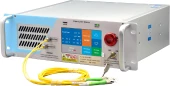
Yogel’s multimode fiber-coupled pump lasers are engineered as reliable, high-brightness pump sources for modern fiber laser and photonics systems. Designed around industry-standard 105/125 µm multimode fiber with NA = 0.22, these pump modules deliver continuous-wave output powers from 5 W up to 30 W, covering the most widely used pumping wavelengths: 793 nm, 808 nm, 878.6 nm, 915 nm, 940 nm, and 976 nm. By combining precise wavelength control with excellent power stability, they provide a robust building block for OEM integrators and laboratory users who require dependable, repeatable performance over many hours of operation.
In contrast to conventional free-space diode modules, these fiber-coupled pump lasers offer simplified beam delivery and superior alignment stability. The stabilized output is coupled directly into the multimode fiber, enabling easy integration into fiber lasers, fiber amplifiers, and other fiber-based architectures. With wavelength-locked configurations available at key pumping lines such as 976 nm and 808 nm, the modules are optimized for efficient absorption in Yb- and Nd-doped gain media, improving overall system efficiency and reducing thermal load. This makes them an excellent choice for designers upgrading from legacy pump diodes or building new high-brightness laser platforms.
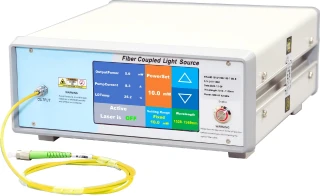
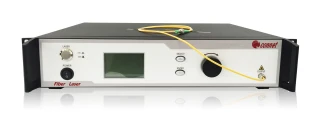
The product line supports both benchtop and compact module formats to match different integration requirements. Benchtop units feature touchscreen operation with local control of power setpoints and real-time monitoring, making them ideal for R&D environments, prototyping, and laboratory testing. For OEM and embedded applications, module versions with RS232 serial communication provide straightforward electronic control and monitoring via a host controller. This flexibility allows the same optical engine to be deployed either as a stand-alone laboratory source or as a deeply integrated subassembly inside a commercial system.
Yogel pays particular attention to power stability and spectral control, two parameters that are critical in precision fiber laser pumping and sensitive biomedical setups. The pump lasers operate in true continuous-wave mode, with short-term power stability on the order of ±0.02 dB (about ±0.5 %) over 15 minutes and long-term stability of ±0.05 dB (about ±1.2 %) over 8 hours. Depending on wavelength, spectral width is narrowed down to sub-nanometer levels for wavelength-locked versions, ensuring efficient and consistent absorption in doped fibers and minimizing gain fluctuations in high-performance fiber laser cavities. This level of stability and spectral purity is comparable to, and in many cases exceeds, typical specifications of similar high-power pump modules used in professional industrial and scientific systems.
The available wavelength and power combinations make these multimode fiber-coupled pumps suitable for a wide span of applications. At 808 nm and 878.6 nm they serve as excellent pump sources for Nd-doped lasers and certain specialty gain media used in solid-state and fiber systems. Around 915 nm and 940 nm, the modules are effective pumps for high-power Yb-doped fiber lasers where broader absorption bands are acceptable or even advantageous for thermal management. At 976 nm, where narrow absorption peaks of Yb-doped fibers are located, the wavelength-locked variants deliver maximum pump efficiency and are widely used in industrial fiber laser pumping, precision materials processing, and high-brightness fiber amplifiers. The 793 nm versions further support specialized fiber lasers and biomedical instrumentation requiring that specific spectral region.
From a system engineering standpoint, these pump modules offer a wide power adjustment range from 10 % to 100 % of rated power, allowing users to finely tune the output level during alignment, characterization, or closed-loop power control. The electrical interface (standard DB9 for RS232) and moderate power consumption simplify integration into existing control electronics. Operating temperature and humidity ranges are chosen to support typical laboratory and light industrial environments, enabling continuous use without stringent environmental conditioning. By combining practical mechanical formats, well-established fiber interfaces, and robust electronic control, Yogel’s multimode fiber-coupled pump lasers are a strong choice for designers who need dependable pump sources for fiber lasers, biomedical instruments, laser material processing tools, and fiber-optic communication or sensor systems.
With customizable output powers, wavelength options, fiber termination, and packaging (benchtop B2/B3 or module M31/M70), these pump lasers can be tailored to fit both new designs and retrofits of existing platforms.
Multi Mode Fiber Coupled High Power Pump Laser
Specifications
| Center Wavelength: | 793 nm |
|---|---|
| Output Power: | 30 W |
| Output Mode: | Continuous Wave (CW) |
| Output Power Stability: | 0.4% ~ 0.5% |
| Output Fiber Type: | MMF |
| Output Fiber Length: | 1 m |
| Interface: | RS-232 |
| Cooling: | Air Cooled |
| Electrical Requirements: | 240V - 50Hz |
| Operating Wavelength: | 793 / 808 / 876 / 878.6 / 915 / 940 / 976 nm |
| Wavelength Accuracy: | ±3 / ±3 / ±0.5 / ±1 / ±10 / ±5 nm |
| Spectral Width: | 3 / 6 / 0.7 / 0.5 / 6 / 3 nm |
| Output Power: | 5 / 8 / 10 / 12 / 20 / 25 / 30 W (customizable) |
| Power Adjustment Range: | 10%–100% |
| Short-term Stability (15 Min): | ≤ ±0.02 dB (≈ ±0.5%) |
| Long-term Stability (8 Hrs): | ≤ ±0.05 dB (≈ ±1.2%) |
| Fiber Type: | 105/125 μm multimode fiber, NA = 0.22 |
| Fiber Connector: | Bare fiber (optional fiber collimator) |
| Control Method (Benchtop): | Touchscreen / RS232 serial communication |
| Control Method (Module): | RS232 serial communication |
| Communication Interface: | DB9 female |
| Power Supply (Benchtop): | AC 100–240 V, < 120 W |
| Power Supply (Module): | DC 12 V, 60 W |
| Optical Power (Benchtop): | 5 / 8 / 10 / 12 / 20 / 25 / 30 W |
| Optical Power (Module): | 5 / 8 / 10 / 12 / 25 / 30 W |
| Dimensions / Code (Benchtop): | B2 / B3 |
| Dimensions / Code (Module): | M31 / M70 |
| Operating Temperature Range: | -5 to +35 °C |
| Operating Humidity Range: | 0–70% RH |
| Output Fiber Type (Ordering): | MM = 105/125 μm multimode fiber |
| Package (Ordering): | B2/B3 = Desktop, M31/M70 = Module |
Got questions about specs? Use the inquiry form to ask.
 Download Data Sheet

Features
- High Output Power up to 30 W – Delivers 5 W to 30 W of continuous-wave (CW) optical power for efficient pumping of fiber lasers, material processing, and high‑power biomedical applications.
- Multiple Wavelength Options – Available at 793, 808, 878.6, 915, 940, and 976 nm, covering the most common absorption bands for Yb‑doped, Nd‑doped, and other rare‑earth‑doped fiber lasers, as well as industrial and medical systems.
- Tight Wavelength Control & Locking – Wavelength-locked operation with accuracy down to ±0.5 nm and narrow spectral width as low as 0.5–0.7 nm (depending on model), ensuring stable absorption and consistent pump efficiency in precision fiber laser systems.
- Excellent Power Stability – Short‑term stability ≤ ±0.02 dB (≈ ±0.5%) over 15 minutes and long‑term stability ≤ ±0.05 dB (≈ ±1.2%) over 8 hours, comparable to leading global pump diode modules for demanding scientific and industrial applications.
- Continuous-Wave (CW) Operation – Optimized for CW operation, providing a smooth, low‑noise optical output ideal for CW fiber lasers, amplification stages, and stable illumination sources.
- Wide Power Adjustment Range (10–100%) – Electronically adjustable output from 10% to 100% of rated power, enabling flexible optimization of system performance, thermal load, and lifetime.
- Multimode Fiber-Coupled Output – Uses standard 105/125 μm multimode fiber, NA = 0.22, fully compatible with common high‑power pump combiners, delivery fibers, and commercial fiber laser architectures.
- Bare Fiber or Collimated Output Options – Supplied with bare fiber as standard; optional fiber collimator available for free‑space applications, alignment‑sensitive systems, and integration into optical benches.
- Benchtop or Module Configurations – Offered as a compact module (M31 / M70) for OEM integration or a benchtop unit (B2 / B3) for laboratory and R&D use, covering both product development and volume deployment needs.
- User-Friendly Control Interfaces – Benchtop versions feature an intuitive touchscreen and RS232 serial communication; modules provide RS232 via DB9 for easy integration with industrial controllers and lab automation systems.
- Universal Power Supply & Low Consumption – Benchtop units operate from AC 100–240 V with <120 W consumption, while modules use a standard 12 V DC, 60 W input, simplifying power integration in OEM equipment and portable platforms.
- Broad Operating Temperature Range – Designed for stable performance in environments from -5 to +35 °C with humidity up to 70%, suitable for research labs, production lines, and field‑deployed systems.
- High Reliability for Demanding Applications – Built with telecom‑ and industrial‑grade pump diodes, optical feedback protection, and robust thermal management, comparable to premium multimode pump laser modules used in modern fiber laser systems.
- Optimized for Fiber Laser Pumping – Wavelengths, fiber type, and output power levels are specifically selected for Yb, Nd, and other doped-fiber lasers, ensuring high absorption efficiency and simplified system design.
- Versatile Application Coverage – Ideal for fiber laser pumping, biomedical systems, laser material processing, fiber‑optic communication, and high‑brightness fiber laser sources, as well as scientific illumination and spectroscopy.
- OEM-Friendly Design & Compact Footprint – Module versions (M31 / M70) offer a compact, integrator‑oriented layout for tight spaces and multi‑channel pump architectures often used in high‑power industrial fiber lasers.
- Custom Configurations Available – Output power, wavelength, fiber type, and packaging can be customized on request to match specific system requirements; tailored solutions are supported for OEMs and research projects.
Applications
Applications of Multimode Fiber Coupled Pump Lasers
YOGEL multimode fiber coupled pump lasers (793 / 808 / 878.6 / 915 / 940 / 976 nm, up to 30 W CW) are high‑power, wavelength‑locked pump sources designed for demanding industrial, scientific, and medical applications. Below is a detailed, SEO‑optimized list of typical and emerging uses based on comparable products in the global market and on FindLight.
1. Fiber Laser Pumping and Fiber Laser Systems
- High‑power fiber laser pumping for Yb‑doped, Er‑doped, and Tm‑doped fiber lasers using 793 nm, 808 nm, 915 nm, 940 nm and 976 nm pump wavelengths.
- Single‑mode and multimode fiber laser oscillators in R&D laboratories and OEM laser platforms.
- Pulsed and CW industrial fiber lasers for precision manufacturing, marking, and engraving.
- Master‑oscillator power‑amplifier (MOPA) configurations where stable, wavelength‑locked pump diodes are required for high gain and low noise.
- High‑brightness pump combiners and pump modules in multi‑kilowatt fiber laser architectures.
2. Industrial Laser Material Processing
- Metal cutting and welding when integrated as pump sources for high‑power fiber and diode lasers used on stainless steel, carbon steel, aluminum, copper, and alloys.
- Laser marking, engraving, and coding on metals, plastics, ceramics, and coated materials.
- Laser cladding and surface hardening for wear‑resistant coatings and improved surface properties.
- Micro‑machining and precision drilling in electronics, micro‑mechanics, and semiconductor processing.
- Additive manufacturing / laser metal deposition as pump sources in fiber lasers for 3D printing of metallic components.
- Plastic and polymer welding using fiber lasers pumped by 9xx nm multimode fiber‑coupled diodes.
3. Biomedical and Medical Laser Applications
- Medical diode‑pumped solid‑state (DPSS) lasers for dermatology, ophthalmology, and surgery.
- Therapeutic and surgical fiber lasers for minimally invasive procedures, endoscopy, and tissue ablation.
- Optogenetics and neuroscience research using stable CW pump sources for visible and NIR lasers.
- Photodynamic therapy (PDT) and photothermal therapy where pump lasers drive specific treatment wavelengths.
- Fluorescence excitation and confocal microscopy in life‑science imaging setups using DPSS or fiber lasers.
- Medical imaging and diagnostics, including OCT pump modules and NIR excitation sources.
4. Fiber‑Optic Communications and Photonics
- Erbium‑doped fiber amplifier (EDFA) pumping using 980 nm and 1480 nm class systems, where 976 nm pump diodes are standard.
- Raman fiber amplifiers and distributed Raman pumping for long‑haul and ultra‑long‑haul optical links.
- Test and measurement equipment for fiber‑optic components, DWDM systems, and photonic integrated circuits.
- Optical networks in data centers and high‑capacity metro and backbone communication systems.
- Free‑space optical communication experiments where stable pump lasers feed high‑performance transmitters.
5. Scientific Research and Laboratory Use
- Nonlinear optics experiments, including frequency doubling, supercontinuum generation, and parametric conversion.
- Atomic, molecular, and optical (AMO) physics using pump lasers for DPSS and tunable laser systems.
- Laser spectroscopy and metrology requiring wavelength‑locked, narrow‑band pump sources.
- Quantum optics and quantum communication research, where fiber‑based pump lasers drive entangled photon sources.
- University and institute laser laboratories for education, prototyping, and advanced photonics research.
6. Sensing, LIDAR, and Measurement
- Fiber‑optic sensing systems (FBG, distributed temperature and strain sensing) using high‑power pump lasers for interrogation units.
- LIDAR and range‑finding pumped solid‑state or fiber lasers for industrial, automotive, and defense applications.
- Gas and environmental sensing where pump lasers enable narrow‑linewidth sources for absorption spectroscopy.
Frequently Asked Questions
What is a multimode fiber coupled pump laser and what are its typical applications?
Which wavelengths and output powers are available for the Yogel MHPL multimode fiber coupled pump lasers?
How stable is the output power of the MHPL fiber coupled pump laser over time?
What packaging options, control interfaces, and power supplies are available?
What is the wavelength locking and spectral width performance of these pump lasers?
What fiber type and connector options are supplied, and can I get a collimated output?
What are the operating environmental conditions and how is power adjusted?
Got more questions? Use the inquiry form to ask the supplier directly.
Similar Products



Your inquiry has been received.
Create an account by adding a password
Why create an account?
- Auto-complete inquiry forms
- View and manage all your past messages
- Save products to your favorites
- Close your account anytime — no hassle