


Description
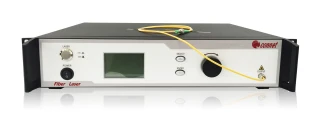
The DK Photonics 1550 nm High Power Fiber Laser is an advanced laser source engineered for demanding applications in fiber sensing, lidar, and fiber laser seeding. Based on a high-reliability DFB (Distributed Feedback) semiconductor laser chip and single‑mode fiber output, this source delivers narrow linewidth emission centered at 1550 nm with excellent short‑ and long‑term power stability. The design is comparable to leading 1550 nm benchtop and modular sources found in fiber optic test, lidar ranging, and coherent communication labs worldwide, while offering a compact footprint and flexible configuration options tailored to system integration or laboratory use.
Operating in the eye‑safer 1550 nm telecom band, this high power fiber laser is available with output levels of 5 W, 10 W, or 15 W, as well as lower dBm‑rated versions up to 43 dBm, allowing users to match the source precisely to their application’s power budget and link requirements. A typical linewidth of ≤0.1 nm and sideband rejection ratio greater than 50 dB support applications requiring spectral purity and low noise, such as interferometric fiber optic sensors, coherent detection schemes, and high dynamic range measurement systems. The source is built around single‑mode SMF‑28e or polarization‑maintaining PM1550 panda fiber, ensuring excellent beam quality and stable polarization performance when required.
The 1550 nm fiber laser employs a professionally designed driving circuit and TEC (thermoelectric cooler) control loop that tightly regulate the operating temperature of the DFB chip. This thermal management minimizes wavelength drift and output fluctuations, resulting in typical power stability better than ±0.02 dB over 15 minutes and ±0.05 dB over 8 hours. Such stability is critical for distributed fiber sensing (DAS, DTS, DFOS), long‑range lidar, and precision metrology, where signal integrity over time directly impacts measurement accuracy and repeatability. The integrated safety protections and optimized electronics contribute to long device lifetime and reliable field operation, on par with industrial‑grade sources widely used in telecom and sensing networks.
For maximum flexibility, the DK‑XS‑DT‑006‑A/2 series is offered in both desktop and compact module packages. The desktop unit is ideal for research laboratories and engineering test environments, featuring button‑based control and operation from a universal 100–240 V AC supply. Its robust chassis and standard FC/APC fiber connector make it easy to deploy on an optical bench alongside other test instruments. The module version targets OEM and system‑level integration, drawing low‑voltage 5 V DC power and supporting RS232 control via a DB9 interface. This enables straightforward integration into rackmount platforms, lidar systems, fiber laser architectures, and automated measurement setups where remote control and monitoring are essential.
Designed for reliable performance in real‑world environments, this 1550 nm fiber laser source operates over a wide temperature range of -5 to +55 °C and humidity levels from 0 to 70%. These specifications make it suitable for both controlled laboratory settings and more challenging industrial or field deployments. Users can select between single‑mode and polarization‑maintaining output, choose from the specified power levels, and request different operating wavelengths within the 1540–1565 nm range when needed. With this combination of high power, narrow linewidth, excellent stability, and flexible packaging, the DK Photonics 1550 nm High Power Fiber Laser is a robust solution for advanced fiber optic sensing, lidar, and laser system development applications.
1550nm Fiber Laser (high power)
Specifications
| Center Wavelength: | 1550 nm |
|---|---|
| Output Power: | 15 W |
| Spectrum Linewidth: | ≤ 0.1 nm |
| Sideband Rejection Ratio: | > 50 dB |
| Output Power Options: | 5/10/15 mW |
| Short-term Stability (15 Minutes): | ≤ ±0.02 dB |
| Long-term Stability (8 Hours): | ≤ ±0.05 dB |
| Fiber Type: | SMF-28e/PM1550 Panda |
| Optical Connector: | FC/APC |
Got questions about specs? Use the inquiry form to ask.
 Download Data Sheet

Features
- High Output Power at 1550 nm – Available in 5 W, 10 W, and 15 W output power levels (up to 43 dBm), ideal for demanding fiber laser and LIDAR applications requiring long-range and high SNR.
- Eye-Safer 1550 nm Wavelength – Operates in the 1550 ± 0.5 nm band (1540–1565 nm optional), offering improved eye safety compared with 1 µm sources, widely used in outdoor sensing, free-space communications, and laser radar.
- Narrow Linewidth for Coherent Applications – Typical spectrum linewidth ≤ 0.1 nm, suitable for coherent detection, interferometric fiber sensing, and high-resolution optical measurements.
- Excellent Spectral Purity – Sideband rejection ratio > 50 dB ensures clean single-frequency performance with low ASE and minimized spurious modes, improving signal quality in coherent systems.
- High Stability Output – Short-term power stability within ≤ ±0.02 dB (15 minutes) and long-term stability within ≤ ±0.05 dB (8 hours) for reliable, drift-free operation in laboratory and field environments.
- Single-Mode or Polarization-Maintaining Fiber Options – Choice of SMF-28e single-mode fiber or PM1550 panda polarization-maintaining fiber to match integration requirements in sensing, coherent communication, and polarization-sensitive systems.
- Flexible Packaging: Desktop or Module – Offered as a compact module (125 × 150 × 20 mm) for OEM integration or as a user-friendly desktop unit (260 × 320 × 120 mm) for R&D and production test setups.
- Robust, Actively Stabilized Design – Incorporates DFB semiconductor laser with dedicated low-noise driving circuitry and integrated TEC temperature control to maintain wavelength and power stability over wide environmental conditions.
- Standard FC/APC Fiber Interface – Output via FC/APC connector minimizes back-reflection and simplifies connection to existing fiber-optic components and measurement equipment.
- Wide Operating Temperature Range – Designed for reliable performance from -5 °C to +55 °C and humidity from 0–70%, supporting both laboratory and industrial or field deployments.
- Convenient Control & Interface Options – Desktop version supports front-panel button control; module version offers RS232 (DB9) digital interface for remote control and easy integration into OEM systems or automated test platforms.
- Universal Power Supply Options – Desktop unit operates from 100–240 V AC < 150 W, while the compact module runs on 5 V DC < 60 W, enabling flexible use in bench-top, rack-mounted, and embedded solutions.
- Multiple Output Power Grades – Output levels from 30 to 43 dBm allow optimization of system link budgets for fiber sensing networks, long-range LIDAR, and high-loss optical paths.
- Designed for Fiber Sensing & LIDAR – Optimized for fiber sensor systems, fiber lasers, and laser radar (LIDAR), where high power, narrow linewidth, and long-term stability are critical.
- Custom Configurations Available – DK Photonics supports customization of wavelength within the C-band, power levels, fiber type, and packaging to meet specific OEM, research, or system integration requirements.
Applications
- Fiber Optic Sensing and Distributed Measurement
- High-power light source for distributed acoustic sensing (DAS) and distributed temperature/strain sensing (DTS/DSS)
- Interferometric fiber sensors (Mach–Zehnder, Michelson, Sagnac, and Fabry–Perot based systems)
- Fiber Bragg grating (FBG) interrogation for structural health monitoring of bridges, tunnels, wind turbines, and aircraft
- Pipeline leak detection, perimeter security, and border monitoring using coherent fiber sensor arrays
- Seismic and geophysical monitoring with long-range fiber sensing lines
- LIDAR and Laser Radar Systems
- 1550 nm eye-safer high‑power source for coherent and direct-detection LiDAR
- Range-finding and long-distance laser radar for automotive, UAV, and industrial applications
- 3D mapping, surveying, and topographic LiDAR systems
- Doppler LiDAR for wind field measurement and atmospheric studies
- Obstacle detection and collision avoidance sensors for robotics and autonomous vehicles
- Fiber Laser Pumping and Seeding
- Seed laser for high-power 1550 nm fiber laser amplifiers and MOPA (master oscillator power amplifier) systems
- Pumping or seeding of Erbium- and Erbium/Ytterbium-doped fiber amplifiers (EDFA/EYDFA)
- Single-frequency narrow-linewidth source for coherent and pulsed fiber laser architectures
- Research and development of new fiber laser designs and prototype systems
- Optical Communication and Test
- High-power continuous-wave source for long-haul fiber-optic communication experiments
- Optical component testing (isolators, couplers, WDMs, filters, modulators, EDFAs, PM components)
- System characterization in C‑band networks, including nonlinearity and OSNR testing
- Laboratory reference laser for metrology and calibration in the 1550 nm band
- Coherent Detection and Heterodyne Systems
- Local oscillator source for coherent communication and coherent detection experiments
- Heterodyne and homodyne detection setups requiring narrow linewidth and high stability
- Frequency-offset locking and optical phase-locked loop (OPLL) applications
- Remote Sensing and Atmospheric Applications
- Eye‑safer atmospheric monitoring and aerosol detection at 1550 nm
- Range-resolved gas sensing and environmental monitoring
- Long-distance free-space optical experiments in the C‑band
- Defense, Security, and Surveillance
- Coherent and direct-detection LADAR for target identification and tracking
- Perimeter intrusion detection using fiber-optic sensing lines
- Laser-based rangefinding and designator subsystems operating at 1550 nm
- Industrial Positioning and Measurement
- Precision distance and displacement measurement using interferometric techniques
- Vibration, strain, and temperature monitoring in industrial plants via fiber sensors
- Alignment and calibration systems requiring stable, narrow-linewidth 1550 nm output
- Scientific Research and Education
- Nonlinear fiber optics research (Raman scattering, four-wave mixing, supercontinuum generation)
- Quantum optics and quantum communication experiments in the telecom band
- University and institute laboratories studying advanced fiber laser and sensing technologies
- System Integration and OEM Use
- Integration into OEM fiber-laser modules, LiDAR engines, and sensing platforms
- Compact module or desktop source for R&D test benches and system prototyping
- Replacement/upgrade of existing 1550 nm laser sources in commercial or custom systems
Frequently Asked Questions
What is the DK Photonics 1550nm High Power Fiber Laser and what output powers are available?
What are the key optical specifications of this 1550nm fiber laser (linewidth, stability, and spectral options)?
What fiber and connector types are supported, and is polarization‑maintaining fiber available?
What control interfaces and form factors are available (module vs. desktop) and how are they powered?
What are the main applications of this 1550nm high power fiber laser?
What environmental operating conditions does the DK Photonics 1550nm fiber laser support?
Can the 1550nm high power fiber laser be customized (wavelength, power, fiber type, and packaging)?
Got more questions? Use the inquiry form to ask the supplier directly.
Similar Products



Your inquiry has been received.
Create an account by adding a password
Why create an account?
- Auto-complete inquiry forms
- View and manage all your past messages
- Save products to your favorites
- Close your account anytime — no hassle