


Description
The 1570 nm Fiber Laser from DK Photonics is a high-performance, single-frequency laser source engineered for applications that demand narrow linewidth and exceptional power stability. Built around a high-quality DFB semiconductor laser chip with single-mode fiber output, this source delivers a highly coherent, low-noise optical signal centered at 1570 nm. The device is carefully integrated with a professional-grade driving circuit and TEC (thermoelectric cooler) control, ensuring reliable wavelength and power stabilization over a wide range of operating conditions.
Designed to meet the needs of advanced fiber sensing, fiber laser seeding, and optical component characterization, this 1570 nm fiber laser combines laboratory-grade stability with flexible deployment options. Users can choose between standard single-mode (SMF-28e) and polarization-maintaining (PM1550 panda) fiber outputs, enabling precise control of polarization where system performance depends on it. The available output power range of 10, 20, 30, 33, or 37 dBm supports both low-power interrogation schemes and higher-power test and measurement setups, while the narrow spectral linewidth of ≤0.1 nm and sideband rejection ratio above 50 dB deliver clean, high-quality spectra suitable for interferometric and coherent detection systems.
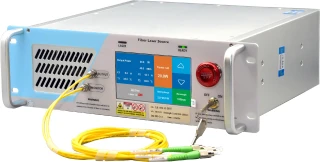
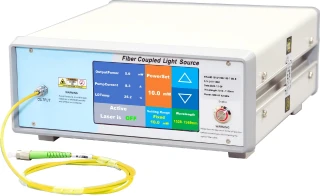
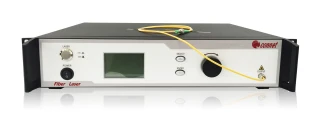
For system integration and laboratory use, the 1570 nm Fiber Laser offers two packaging formats: a compact module and a convenient desktop unit. The modular version, with 5 V DC low power consumption, is ideal for OEM integration into rack-mounted or portable systems, providing RS232 control and a DB9 interface for straightforward communication and remote management. The desktop version is tailored to benchtop operation, featuring an intuitive button-based interface and universal 100–240 V AC power input that simplifies deployment in diverse lab and production environments.
The laser’s stability specifications are tuned for demanding, long-duration measurements. Short-term power stability is maintained within ±0.02 dB over 15 minutes, while long-term drift is constrained to within ±0.05 dB over 8 hours, aligning with or exceeding the performance of comparable narrow-linewidth telecom-band fiber lasers on the market. This level of stability is particularly important in distributed fiber sensing (DTS, DAS, and related techniques), precision metrology, and high-resolution optical spectrum analysis, where even small fluctuations can adversely affect measurement accuracy and repeatability.
Operating across a broad temperature range from -5°C to +55°C and a humidity range of 0–70%, the 1570 nm Fiber Laser is suitable for both controlled laboratory environments and more demanding field conditions. The standard FC/APC optical connector minimizes back-reflections, preserving coherence and protecting the laser diode. Together with its configurable wavelength band, power levels, and fiber types, this source provides a robust, versatile platform for developers and researchers building fiber sensors, seeding fiber amplifiers or lasers around the 1.5 µm window, and evaluating optical components such as filters, multiplexers, and interferometric devices.
With a well-balanced combination of narrow linewidth, low noise, high sideband suppression, and flexible packaging, the DK Photonics 1570 nm Fiber Laser stands as a reliable, cost-effective solution for modern fiber-optic systems. Its performance characteristics and integration options make it an excellent choice for laboratories, manufacturers, and OEMs seeking a stable, telecom-band laser source for precision sensing, laser development, and optical device testing.
1570nm Fiber Laser
Specifications
| Center Wavelength: | 1570 nm |
|---|---|
| Output Power: | 5 W |
| Spectral Linewidth: | 0.1 nm |
| Output Power Stability: | </= 0.1% |
| Output Fiber Type: | SMF-28 |
| Interface: | RS-232 |
| Cooling: | Air Cooled |
| Electrical Requirements: | 110V - 60Hz, 115V - 50Hz, 115V - 60Hz, 120V - 60Hz, 127V - 50Hz, 127V - 60Hz, 220V - 50Hz, 230V - 50Hz, 230V - 60Hz, 240V - 50Hz |
| Spectrum Linewidth: | ≤0.1 nm |
| Output Power Options: | 10/20/30/33/37 dBm |
| Short-term Stability (15 Minutes): | ≤ ±0.02 dB |
| Long-term Stability (8 Hours): | ≤ ±0.05 dB |
| Fiber Type: | SMF-28e/PM1550 Panda |
Got questions about specs? Use the inquiry form to ask.
 Download Data Sheet

Features
- 1570 nm Narrow-Linewidth Output (≤0.1 nm) – Provides highly coherent, low-noise emission ideal for precision optical measurements, interferometry, and sensing applications where spectral purity is critical.
- High Sideband Suppression (>50 dB) – Excellent side mode suppression ratio (SMSR) ensures clean single-frequency operation, minimizing spurious signals and improving system signal-to-noise ratio.
- Stable Output Power (10 / 20 / 30 / 33 / 37 dBm Options) – Multiple power levels available to match diverse system requirements, from low-power sensing to higher-power fiber laser seeding and device characterization.
- Exceptional Power Stability – Short-term stability of ≤ ±0.02 dB (15 min) and long-term stability of ≤ ±0.05 dB (8 h) reduce drift and recalibration needs, supporting long-duration tests and unattended operation.
- Single-Mode or Polarization-Maintaining Fiber Options – Choice of SMF-28e or PM1550 panda fiber enables optimization for general-purpose use or polarization-sensitive systems such as coherent detection and interferometric sensors.
- DFB Semiconductor Laser Design – Uses a high-reliability DFB (Distributed Feedback) laser chip with single-mode output, offering narrow linewidth, excellent wavelength stability, and long operational lifetime compared to multimode sources.
- Precision TEC Temperature Control – Integrated laser driver and TEC (Thermo-Electric Cooler) maintain constant chip temperature, ensuring stable wavelength and output power over varying ambient conditions.
- Ultra-Stable Wavelength at 1570 ± 1 nm – Tight wavelength tolerance improves repeatability in WDM systems, reference sources, and lab setups that require fixed and well-defined emission wavelength.
- Desktop or Compact Module Packages – Available as a turnkey desktop unit for bench-top use or as a space-saving module (125 × 150 × 20 mm) for OEM and integration into larger systems.
- User-Friendly Control Interfaces – Desktop version with simple push-button operation; module version controllable via RS232 (DB9) interface for remote configuration, automation, and system integration.
- Standard FC/APC Optical Connector – Angled physical contact connectivity reduces back reflections and ensures compatibility with standard telecom-grade fiber components and test systems.
- Wide Operating Temperature Range (-5 to +55 °C) – Designed for reliable performance in typical laboratory and industrial environments, suitable for both R&D and field-deployed systems.
- Low Power Consumption – Desktop unit operates from 100–240 V AC (<30 W); module operates from 5 V DC (<15 W), simplifying power supply requirements and system thermal management.
- Ideal for Fiber Sensors and Interrogation Systems – High coherence and stability make it well-suited for fiber Bragg grating (FBG) sensors, interferometric sensors, distributed sensing (DAS/DTS/DFOS), and other precision fiber sensing platforms.
- Excellent Seed Source for Fiber Lasers – Narrow-linewidth, low-RIN characteristics and high SMSR make it an optimal seed for high-power fiber laser amplifiers and coherent communication experiments.
- Suitable for Optical Device and Component Testing – Provides a stable reference light source for characterizing filters, couplers, isolators, WDM devices, and other passive and active components in the C/L-band region.
- Robust OEM Solution – Compact module form factor, serial control, and configuration flexibility enable easy integration into measurement instruments, sensing platforms, and production test equipment.
- Customizable Specifications – Output power, fiber type, packaging, and other parameters can be customized (via P/N configuration) to meet specific application or system-level requirements.
- Global Support from DK Photonics – Backed by DK Photonics’ experience in fiber lasers and integrated photonics solutions, with engineering support and customization for research, telecom, industrial, and sensing markets.
Applications
- Fiber Optic Sensing and Distributed Sensing
- High-stability light source for fiber Bragg grating (FBG) interrogation systems
- Distributed temperature and strain sensing (DTS/DSS) in civil structures
- Pipeline, oil & gas well, and power cable condition monitoring
- Structural health monitoring of bridges, tunnels, dams, and railways
- Perimeter security and intrusion detection based on fiber sensing
- Fiber Laser Seeding and Pumping
- Seed laser for narrow-linewidth fiber amplifiers at 1.5 μm band
- Master oscillator in MOPA (Master Oscillator Power Amplifier) architectures
- Pumping and seeding of Erbium- and Erbium/Ytterbium-doped fiber lasers
- Low-noise source for coherent fiber laser systems
- Optical Communication and Coherent Systems
- Test and development source for DWDM/CWDM components near the C/L bands
- Local oscillator in coherent detection and coherent receiver testing
- High OSNR reference source for long-haul and metro network evaluation
- System margin and BER testing in advanced modulation format links
- Optical Device Characterization and Lab Use
- Characterization of passive components: filters, couplers, isolators, attenuators
- Performance testing of EDFAs and other optical amplifiers
- Calibration and verification of OSA, power meters, and optical switches
- General-purpose stable CW source in R&D laboratories and production lines
- LIDAR and Ranging
- Seed source for coherent (FMCW) LIDAR at eye-safer 1.5–1.6 μm window
- Optical frequency-modulated continuous-wave (FMCW) ranging systems
- Reference laser in laboratory LIDAR and time-of-flight experiments
- Metrology, Spectroscopy, and Frequency References
- Narrow-linewidth source for high-resolution gas absorption spectroscopy
- Optical frequency reference and wavelength calibration near 1570 nm
- Interferometry and precision phase-sensitive measurements
- Optical heterodyne and beat-note measurements for linewidth analysis
- Environmental and Industrial Monitoring
- Fiber-based monitoring of temperature, strain, and pressure in harsh environments
- Long-distance sensing in power grid, wind farm, and industrial plants
- Infrastructure health monitoring in smart city and smart grid deployments
- Aerospace, Defense, and Navigation
- Coherent sensing and navigation-grade interferometric systems
- Phase-stable source for inertial and gyroscope fiber-optic systems
- Test source for aerospace-grade fiber links and optical subsystems
- Quantum Optics and Advanced Research
- Stable pump or probe laser for quantum communication experiments in C/L band
- Optical source in entanglement distribution and quantum key distribution testbeds
- Frequency-stable laser for advanced photonics and nonlinear optics research
- Education and Training
- Demonstration of fiber laser principles in university and training laboratories
- Hands-on teaching of coherent detection, interferometry, and fiber sensing
- Practical exercises in optical device characterization and system integration
Frequently Asked Questions
What is the DK Photonics 1570 nm fiber laser and what are its key features?
What applications is the 1570 nm narrow linewidth fiber laser suitable for?
How do I choose between SMF-28e and PM1550 panda fiber types for this 1570 nm laser?
What are the packaging, control, and electrical options for the 1570 nm fiber laser?
How stable is the output power and spectrum of the DK Photonics 1570 nm fiber laser?
What are the environmental operating conditions for the 1570 nm fiber laser?
How do I specify and order a customized DK Photonics 1570 nm fiber laser?
Got more questions? Use the inquiry form to ask the supplier directly.
Similar Products



Your inquiry has been received.
Create an account by adding a password
Why create an account?
- Auto-complete inquiry forms
- View and manage all your past messages
- Save products to your favorites
- Close your account anytime — no hassle