


Description
The CoSF-D-TM-M Single Frequency Fiber Laser Module is a high‑performance thulium‑doped fiber laser engineered for applications that demand extremely narrow linewidth, low phase noise, and outstanding intensity stability in the 2 μm spectral region. Based on distributed feedback (DFB) Bragg grating technology, this laser delivers a stable single-frequency, single-longitudinal-mode output with a typical linewidth below 10 kHz and a maximum linewidth of 20 kHz. The combination of ultra‑narrow linewidth, excellent beam quality (M2 typically 1.05), and linear polarization makes it particularly suitable for advanced sensing, coherent detection, and precision spectroscopy.
Operating in the 1850 nm to 2100 nm wavelength range, the CoSF-D-TM-M module leverages thulium-doped fiber to provide flexible wavelength selection with typical center wavelengths at 1940 nm and 2050 nm, among others on request. Output powers of 20 mW, 50 mW, and 100 mW are available, with the 20 mW version as a fixed-output configuration and higher power options offered with adjustable output. This power and wavelength flexibility allows the laser to be optimized for different absorption lines and atmospheric windows, which is crucial for gas sensing, atmospheric research, and long‑range coherent LiDAR applications in the 2 μm band.
A key design advantage of the CoSF-D-TM-M is its external cavity relative intensity noise (RIN) suppression technology. By implementing RIN suppression outside the cavity, the laser maintains very low intensity noise across a broad frequency range, with typical RIN values around −110 dBc/Hz at the RIN peak and down to approximately −140 dBc/Hz at 10 MHz. Compared with conventional single-frequency fiber lasers and many competing 2 μm narrow-linewidth sources, this approach yields superior noise performance, improving measurement sensitivity and enhancing the signal‑to‑noise ratio in coherent detection and interferometric systems. The low phase noise and frequency noise characteristics are particularly beneficial for coherent LiDAR, distributed acoustic sensing, and high‑resolution spectroscopy, where noise directly limits system performance.
The laser delivers a stable single polarization output with a typical polarization extinction ratio of 22 dB, supported by PANDA PM1950 polarization‑maintaining fiber. This linear polarization is essential for polarization‑sensitive applications, coherent detection schemes, and interferometric measurement setups. High side‑mode suppression ratio (SMSR) of typically 50 dB further ensures clean single‑frequency operation with minimal spurious modes, improving stability and measurement accuracy over long integration times. Output power stability is typically within ±1%, helping to maintain consistent system calibration in demanding laboratory and field environments.
For applications requiring tunability and precise wavelength control, the CoSF-D-TM-M module supports thermal wavelength tuning of approximately 0.6 nm, along with optional PZT‑based wavelength modulation. The PZT modulation feature allows linear modulation from DC up to 10–20 kHz, with a typical modulation range of up to 8–10 GHz. This enables fine frequency scanning and high‑resolution wavelength locking, which are important in gas absorption spectroscopy, laser frequency stabilization, and narrow spectral line interrogation. The availability of both slow thermal tuning and fast PZT modulation provides a comprehensive toolkit for locking the laser to reference cells, cavities, or external optical frequency standards.
The CoSF-D-TM-M module is packaged in a compact, rugged housing of approximately 200 mm × 200 mm × 45 mm. This robust design offers strong resistance to environmental disturbances and mechanical vibrations, enhancing stability for both benchtop and system‑integrated use. The module is designed for continuous‑wave operation over an operating temperature range of 0 °C to +40 °C, with storage from −20 °C to +60 C. A 12 V DC power supply and RS485 communication interface support straightforward electrical integration, remote monitoring, and digital control in OEM platforms, industrial instruments, and scientific setups.
The 2 μm wavelength range, combined with the laser’s ultra‑narrow linewidth and low noise performance, makes the CoSF-D-TM-M an enabling source for a wide array of advanced optical systems. Typical use cases include distributed optical fiber sensing (such as distributed acoustic and temperature sensing), coherent LiDAR for wind and distance measurement, high‑resolution laser spectroscopy, and gas absorption measurements targeting key molecules with strong absorption lines in the mid‑infrared edge. In scientific research environments, the laser serves as a reliable narrow‑linewidth seed source for amplifiers and nonlinear frequency co<
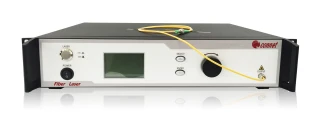
Connet CoSF-D-TM-M Single Frequency Fiber Laser Module
Specifications
| Center Wavelength: | 1940 nm |
|---|---|
| Output Power: | 0.02 W |
| Output Mode: | Continuous Wave (CW), Single Frequency, Single Longitudinal Mode |
| Beam Quality (M^2): | 1.05 |
| Spectral Linewidth: | 0.1 nm |
| Output Power Stability: | 0.9% ~ 1.0% |
| Output Fiber Type: | PMF |
| Output Fiber Length: | 0.5 m |
| Interface: | RS-485 |
| Cooling: | Air Cooled |
| Electrical Requirements: | Other / Not Specified |
| RIN Peak: | -110 dBc/Hz |
| RIN @10MHz: | -140 dBc/Hz |
| SMSR (50pm Resolution): | 50 dB |
| Polarization Extinction Ratio: | 22 dB |
| Output Isolation: | 35 dB |
| Wavelength Thermal Tuning: | 0.6 nm |
| PZT Wavelength Modulation: | Optional |
| Modulation Frequency (linear): | 10 kHz |
| Modulation Wavelength Range: | 8 GHz |
| Operating Temperature: | 0 to +40 ℃ |
| Storage Temperature: | -20 to +60 ℃ |
| Power Supply: | 12 V (DC) |
| Optical Connector: | FC/APC |
| Dimension: | 200x200x45mm |
Got questions about specs? Use the inquiry form to ask.
 Download Data Sheet

Features
- Ultra-Narrow Linewidth & Stable Single Frequency – Typical linewidth <10 kHz (max <20 kHz) for ultra-high coherence, stable single-frequency and single-longitudinal-mode output, ideal for high‑resolution sensing and spectroscopy.
- Customizable Operating Wavelength (1850–2100 nm) – Thulium-doped fiber design with selectable center wavelengths (e.g., 1940 nm, 2050 nm and others on request) to match specific gas absorption lines, LiDAR bands, and research needs.
- Low Noise Operation with Advanced RIN Suppression – Integrated extra‑cavity relative intensity noise (RIN) suppression technology ensures extremely low intensity and frequency noise, with RIN peak as low as −110 dBc/Hz and RIN @10 MHz down to −140 dBc/Hz, supporting demanding coherent detection applications.
- High Spectral Purity & Excellent SMSR – Single polarization output with side‑mode suppression ratio (SMSR) typically >50 dB, providing a clean, narrowband spectrum for coherent LiDAR, interferometry, and precision metrology.
- Linear Polarization with High PER – Linearly polarized output using Panda PM1950 fiber, with polarization extinction ratio (PER) typically ≥22 dB, enabling polarization‑sensitive measurements and minimizing polarization‑induced noise.
- Superior Frequency & Phase Noise Performance – Very low phase noise and frequency noise compared with standard fiber lasers, significantly improving signal‑to‑noise ratio in coherent systems, OFDR/OTDR, and long‑range interferometric setups.
- Excellent Power Stability & Output Isolation – Output power stability typically within ±1% and integrated optical isolator providing >35 dB isolation, reducing back‑reflection sensitivity and ensuring stable long‑term operation.
- High Output Power Options – Available with 20 mW fixed power and adjustable 50 mW or 100 mW configurations, delivering sufficient optical power for distributed optical fiber sensing, free‑space experiments, and laboratory setups.
- High Beam Quality – Near diffraction‑limited beam with M² typically 1.05–1.1, ensuring excellent focusability and efficient coupling into fibers and photonic devices for precision experiments.
- Wavelength Tuning & Modulation Capability – Built‑in thermal wavelength tuning (typically up to ~0.6 nm) plus optional PZT wavelength modulation offering linear modulation up to 10–20 kHz and tuning range up to 8–10 GHz, ideal for laser spectroscopy, gas absorption measurement, and frequency‑locking schemes.
- Robust OEM Fiber Laser Module – Compact 200 × 200 × 45 mm module with rugged packaging and strong anti‑interference design, well suited for system integration, field deployment, and industrial environments.
- Reliable CW Single-Frequency Operation – Continuous‑wave operation with stable single‑mode, single‑frequency output over 0–40 °C operating temperature, ensuring consistent performance in real‑world sensing and LiDAR systems.
- Thulium-Doped Fiber Architecture – Efficient Tm‑doped fiber design covering the important 2 µm spectral window, widely used in atmospheric sensing, eye‑safer coherent LiDAR, and mid‑IR pump schemes.
- Easy System Integration – 12 V DC power supply and RS485 communication interface for straightforward control and monitoring in OEM platforms and scientific instruments.
- Standardized Fiber & Connector Interfaces – Panda PM1950 output fiber (>0.5 m) with standard FC/APC connector for low back‑reflection coupling into existing fiber networks and experimental setups.
- Wide Range of Precision Applications – Optimized for distributed optical fiber sensing, coherent LiDAR, laser spectroscopy, gas absorption measurement, and advanced scientific research where ultra‑narrow linewidth and low noise are critical.
- High Reliability & Long-Term Stability – Based on DFB fiber laser technology with patented design and independent intellectual property, delivering long‑life, maintenance‑friendly operation comparable to leading single‑frequency fiber lasers in its class.
Applications
- Distributed Optical Fiber Sensing – Ideal narrow-linewidth source for long-range distributed acoustic sensing (DAS), distributed temperature sensing (DTS), and distributed strain sensing (DSS) in oil & gas pipelines, power cable monitoring, perimeter security, and structural health monitoring.
- Coherent LiDAR and FMCW LiDAR – Stable single-frequency, single-polarization output in the 1850–2100 nm band supports coherent detection, frequency-modulated continuous-wave (FMCW) LiDAR, Doppler wind LiDAR, and high-resolution 3D mapping with superior phase and frequency stability.
- High-Resolution Laser Spectroscopy – Ultra-narrow <20 kHz linewidth and low phase noise enable precision absorption, transmission, and cavity ring-down spectroscopy for molecular fingerprinting, isotope ratio measurements, and fundamental physics experiments.
- Gas Absorption and Trace Gas Detection – Tunable operation around key mid‑IR overtone and combination bands in the 1850–2100 nm window makes the laser a robust source for tunable diode laser absorption spectroscopy (TDLAS) and multi-pass gas cells for gases such as CO, CO2, CH4, H2O, and NH3.
- Optical Frequency Metrology and Frequency Comb Seeding – Provides a highly stable reference for optical frequency standards, laser locking, and seeding of mid‑IR or near‑IR frequency combs in metrology labs and precision timing systems.
- Scientific and Academic Research – Suited for experiments in quantum optics, nonlinear optics, cold atom and molecule studies, and precision interferometry where low RIN, single-longitudinal-mode emission, and narrow linewidth are essential.
- Interferometric and Coherent Sensing – Enables high-sensitivity Michelson, Mach–Zehnder, and Sagnac interferometers for vibration sensing, acoustic sensing, and rotation sensing (fiber-optic gyroscopes) requiring long coherence length and low noise.
- Fiber-Optic Gyroscopes (FOG) – Single-frequency, linearly polarized output with excellent RIN performance is well suited for advanced interferometric FOG designs in navigation, aerospace, marine, and defense applications.
- Optical Coherence Tomography (OCT) and Low‑Coherence Interferometry – Can be used as a narrowband, highly coherent source or as a frequency-swept seed in specialty OCT and interferometric imaging systems in the 2 µm region, particularly for tissue imaging and industrial metrology.
- Nonlinear Optics and Frequency Conversion – Acts as a stable pump or seed for second-harmonic generation (SHG), difference-frequency generation (DFG), optical parametric oscillators (OPO), and supercontinuum generation in thulium-doped and highly nonlinear fibers.
- Mid-Infrared Source Development – Serves as a seed laser for mid‑IR fiber lasers and amplifiers, enabling broadband or narrowband sources used in spectroscopy, free-space communications, and infrared countermeasures research.
- Free-Space Optical Communications (FSO) – Narrow linewidth and low phase noise improve coherent FSO links around 2 µm for secure, high-capacity point‑to‑point communication and atmospheric channel characterization.
- Test and Measurement Instruments – Integrates into high-performance optical analyzers, heterodyne detection setups, reference interferometers, and spectrum measurement benches where a frequency-stable, low-RIN CW source is required.
- Optical Coherent Communication Research – Useful as a local oscillator or transmitter laser in coherent receiver testbeds, M‑QAM modulation experiments, and advanced modulation format development in the 2 µm waveband.
- Environmental and Atmospheric Sensing – Supports active remote sensing (lidar) of atmospheric gases and aerosols near 2 µm, including greenhouse gas monitoring and visibility studies owing to strong absorption lines and eye‑safer operation.
- Biomedical and Surgical Research – Wavelengths around 2 µm overlap with strong water absorption bands, making the laser suitable as a seed or pilot beam in systems for soft-tissue interaction studies, medical laser development, and photothermal therapy research.
- Industrial Process Monitoring – High spectral purity and tunability make it suitable for in‑line gas monitoring, combustion diagnostics, and real-time process control in power plants, chemical processing, and manufacturing.
- Laser Radar and Rangefinding – Single-frequency operation and high coherence support coherent radar-like ranging systems in the eye‑safer 2 µm band for defense, automotive, and UAV‑based ranging platforms.
Frequently Asked Questions
What is the CoSF-D-TM-M single frequency fiber laser and what makes it different?
What are the typical applications of this 2 µm single frequency fiber laser?
What wavelength and output power options are available for the CoSF-D-TM-M laser module?
How narrow is the linewidth and how stable is the output of this fiber laser?
What polarization characteristics and beam quality does the CoSF-D-TM-M provide?
Does the CoSF-D-TM-M support wavelength tuning or modulation, and how is it controlled?
What are the mechanical, fiber, and connector specifications and how can I integrate this module into my system?
Got more questions? Use the inquiry form to ask the supplier directly.
Similar Products



Your inquiry has been received.
Create an account by adding a password
Why create an account?
- Auto-complete inquiry forms
- View and manage all your past messages
- Save products to your favorites
- Close your account anytime — no hassle