


Description
The High Temperature Fiber Bragg Grating (FBG) from DK Photonics is engineered to deliver reliable performance in environments where extreme heat and harsh conditions are a constant challenge. Fiber Bragg gratings are integral components in modern optical systems, widely utilized in telecommunications, laser systems, and advanced sensing applications. This high-temperature variant is specifically designed to maintain its optical properties and structural integrity even when exposed to temperatures ranging from -40°C up to 300°C, making it an ideal solution for demanding industrial, aerospace, and energy sector applications.
Utilizing advanced apodized grating technology, the High Temperature FBG ensures exceptional wavelength and reflectivity stability, which is critical for precision sensing and signal processing. The gratings are fabricated on polyimide-coated SMF-28 fiber, renowned for its durability and resistance to thermal degradation. The polyimide recoating further enhances the fiber’s resilience, allowing it to withstand repeated thermal cycling and mechanical stress without compromising performance.
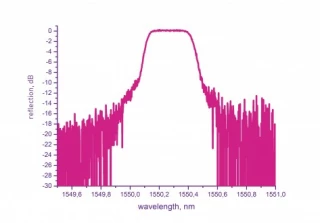
This product is available with customizable grating profiles—either apodized or uniform—to suit specific application requirements. With a center wavelength range of 1510 nm to 1590 nm and a narrow -3dB bandwidth of ≤0.3 nm, the High Temperature FBG provides high selectivity and low insertion loss. Its high reflectivity (>60%) and superior side lobe suppression ratio (>15 dB) ensure clean, accurate signal reflection, which is essential for high-precision monitoring and feedback systems.
The High Temperature FBG is supplied as a bare fiber with a standard length of 1 meter, offering flexibility for integration into various optical setups. Its robust construction and stable optical characteristics make it a preferred choice for engineers and researchers seeking reliable performance in fiber optic sensing, structural health monitoring, and high-power laser applications where conventional FBGs may fail.
High Temperature Fiber Bragg Grating
Specifications
| Center Wavelength Range: | 1510 – 1590 nm |
|---|---|
| FBG Length: | 10 mm |
| Reflectivity: | >50% |
| FBG Profile: | Apodized or Uniform |
| Wavelength Tolerance (nm): | +/-0.5 |
| Standard FBG Length (mm): | 10 |
| Reflectivity: | > 60% |
| -3dB Bandwidth (nm): | ≤0.3 |
| SLSR (dB): | >15 |
| Recoat: | Polyimide |
| Fiber Type: | Polyimide coated SMF-28 fiber |
| Fiber Terminator: | Bare Fiber |
| Operating Temperature (℃): | -40 ~ 300 |
Got questions about specs? Use the inquiry form to ask.
 Download Data Sheet

Features
- Wide Operating Temperature Range: Designed for reliable performance in extreme environments, withstanding temperatures from -40°C to +300°C.
- High Stability: Offers highly stable wavelength and reflectivity, ensuring consistent operation in harsh conditions.
- Customizable FBG Profiles: Available in both apodized and uniform grating profiles to suit diverse application requirements.
- Precision Center Wavelength: Covers a broad range from 1510 nm to 1590 nm with a tight wavelength tolerance of ±0.5 nm.
- High Reflectivity: Reflectivity greater than 60% for efficient signal reflection and minimal loss.
- Narrow Bandwidth: -3dB bandwidth ≤ 0.3 nm for high spectral selectivity and reduced cross-talk.
- Excellent Side Lobe Suppression Ratio (SLSR): SLSR > 15 dB for superior signal quality and noise reduction.
- Durable Polyimide Coating: Utilizes polyimide-coated SMF-28 fiber for enhanced mechanical strength and thermal resistance.
- Standard and Custom Lengths: Standard FBG length of 10 mm and fiber length of 1 meter (custom lengths available upon request).
- Bare Fiber Termination: Supplied with bare fiber ends for easy integration into various optical systems.
- Ideal for Sensing and Telecom Applications: Perfect for high-temperature sensing, structural health monitoring, and advanced telecommunications.
- Manufactured with Advanced Apodization Technology: Minimizes side lobes and enhances grating performance for demanding applications.
Applications
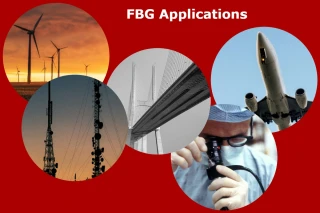
- High Temperature Sensing: Ideal for monitoring temperature in harsh environments such as industrial furnaces, power plants, and gas turbines, where conventional sensors may fail.
- Structural Health Monitoring: Used in civil engineering for real-time monitoring of bridges, tunnels, dams, and pipelines exposed to extreme temperatures.
- Oil & Gas Industry: Suitable for downhole temperature and pressure monitoring in oil wells and pipelines, ensuring safe and efficient operations.
- Aerospace Applications: Employed in aircraft engines and spacecraft for temperature and strain measurements under high thermal stress.
- Energy Sector: Used in nuclear and thermal power plants for continuous temperature monitoring of reactors, generators, and other critical components.
- Industrial Process Control: Enables precise temperature control and monitoring in chemical processing, metal smelting, and glass manufacturing industries.
- Fire Detection Systems: Integrated into fire detection and alarm systems for early warning in tunnels, subways, and industrial facilities.
- Telecommunications: Ensures stable wavelength referencing and signal integrity in fiber optic communication networks operating in extreme environments.
- Laser Systems: Used for wavelength stabilization and feedback control in high-power laser systems exposed to elevated temperatures.
- Scientific Research: Supports experiments requiring accurate temperature measurements in high-temperature laboratory setups and test chambers.
- Automotive Industry: Applied in engine and exhaust system monitoring for performance optimization and emissions control.
- Renewable Energy: Monitors temperature in solar thermal plants and geothermal installations to enhance efficiency and safety.
Frequently Asked Questions
What is a High Temperature Fiber Bragg Grating (FBG)?
What are the key features of DK Photonics High Temperature FBGs?
What applications are suitable for High Temperature FBGs?
What is the operating temperature range for DK Photonics High Temperature FBGs?
What fiber type and coating are used in DK Photonics High Temperature FBGs?
Can DK Photonics High Temperature FBGs be customized for specific applications?
What are the typical specifications of DK Photonics High Temperature FBGs?
Got more questions? Use the inquiry form to ask the supplier directly.
Similar Products
Your inquiry has been received.
Create an account by adding a password
Why create an account?
- Auto-complete inquiry forms
- View and manage all your past messages
- Save products to your favorites
- Close your account anytime — no hassle