


Description
Fiber Optic Beam Splitters and Combiners – Precision Light Management for Demanding Photonic Systems
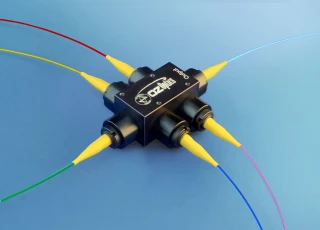
Fiber optic beam splitters and combiners are key building blocks in modern photonic systems, enabling precise division and recombination of optical power between multiple fibers. In this product line, light from one or two input fibers is first collimated into free space, directed through a high-quality beam-splitting optic, and then efficiently refocused into multiple output fibers. This free-space micro-optic approach supports both 1×N and 2×N configurations with up to eight or more output ports, while maintaining low insertion loss and low back reflection. The result is a robust, alignment-stable solution suitable for laboratory, industrial, and field-deployed optical networks.
Unlike fused fiber splitters that are optimized mainly for fixed-ratio power splitting over narrower design spaces, these beam splitter assemblies leverage modular internal optics to support a broad variety of wavelengths, power levels, and fiber types. The design can be tailored to work across wide spectral bands, from the visible through the telecom C/L bands and into specialty wavelength windows, while preserving beam quality and spectral performance. This broadband, free-space based architecture is especially advantageous in systems that must accommodate tunable lasers, supercontinuum sources, or multi-line sources without sacrificing stability or repeatability.
A major strength of this platform is its mechanical and optical flexibility. Each port can be configured with a different fiber type, allowing combinations of singlemode, multimode, and polarization-maintaining (PM) fibers within a single housing. Internally, different types of beam splitter optics—such as non-polarizing beam splitters, polarizing beam splitters, or customized coatings for specific split ratios—can be combined. This makes it possible to consolidate several discrete optical functions into one compact package, for example integrating circulators, polarizing elements, and non-polarizing splitters in a single module. Such integration not only reduces footprint and cabling complexity, but also improves long-term stability compared with discrete, connectorized components.
These devices are available in both pigtail and receptacle styles. Pigtail-style beam splitters are supplied with fibers permanently attached at each port, ensuring optimal alignment, minimal connector-induced loss, and superior polarization performance. This is especially critical in singlemode and PM configurations, where connector tolerances can otherwise degrade extinction ratio and add unwanted insertion loss. Receptacle-style versions are offered for applications that require frequent reconfiguration or the flexibility to plug in different patch cords, but when ultimate stability and polarization control are priorities, the pigtail format is strongly recommended. For users with tight space constraints, miniature splitter variants provide significantly reduced package dimensions while preserving core optical performance.
Within this family, two of the most widely used categories are polarization-maintaining (PM) splitters and polarizing beam splitters (PBS). PM splitters are designed to handle linearly polarized light launched along a specific axis of PM fiber. Using a partially reflective element, they transmit a defined fraction of the input power to a main output port and reflect the remaining power to one or more auxiliary ports. All PM ports are carefully aligned so that the polarization state, when launched parallel to the stress rods in the input fiber, is preserved through the device and emerges along the corresponding axes of the output fibers. This ensures high extinction ratios and stable polarization states, which are crucial for coherent detection, interferometric sensing, and polarization-sensitive measurements.
Polarizing beam splitter configurations, on the other hand, exploit polarization-selective coatings or birefringent elements to separate an input beam into two orthogonal polarization components. One polarization is directed to one output port, while the orthogonal polarization is routed to a second port. When fiber-coupled with PM fibers, this enables precise polarization analysis and control within fiber optic networks, making the components ideal for polarization mode dispersion compensation setups, polarization extinction ratio testing, and polarization-resolved sensing schemes. In advanced architectures, combinations of polarizing and non-polarizing elements within the same package can realize complex routing functions for quantum communication, coherent communication, and other polarization-encoded protocols.
Fiber Optic Beam Splitters-Combiners
Specifications
| Splitting Ratio: | 50/50 |
|---|---|
| Central Wavelength: | 1550 nm |
| Power Handling: | > 1W |
| Return Loss: | 40 dB |
| Product Type: | Fiber optic beam splitter / combiner |
| Splitter Configurations: | 1×N and 2×N |
| Maximum Number Of Outputs: | 8 or more outputs |
Got questions about specs? Use the inquiry form to ask.
 Download Data Sheet

Features
- High-Performance Fiber Optic Beam Splitting – Precisely divides light from one or two input fibers into multiple output fibers (1×N and 2×N configurations) while maintaining low insertion loss and low return loss for demanding optical systems.
- High Power Handling Capability – Engineered for high optical power levels, making these beam splitters ideal for EDFA and Raman amplifier systems, high‑power laser delivery, and other intensive photonics applications.
- High Extinction Ratio & Polarization Integrity – Polarization maintaining (PM) and polarizing versions provide excellent polarization extinction ratios, preserving polarization state for accurate polarization measurements, PMD compensation, and coherent communication links.
- Flexible, Modular Optical Design – Supports combinations of circulators, polarizing splitters, and non‑polarizing splitters within a single package, enabling compact, application‑specific solutions for sensing, telecom, and quantum optics.
- Supports Multiple Fiber Types and Configurations – Can be configured with different fiber types on different ports (SM, MM, PM fibers and specialty fibers), offering broad compatibility with existing fiber networks and custom photonic setups.
- Pigtail and Receptacle Styles Available – Offered with permanently attached pigtail fibers for highest performance, or with connectorized receptacles on each port for easy plug‑and‑play integration and rapid reconfiguration.
- Enhanced Alignment Stability with UV-Curing Method – Optional 1×2 and 2×2 pigtailed beam splitters fabricated using a UV‑curing alignment process deliver improved long‑term mechanical and thermal stability compared to traditional tip‑tilt alignment.
- Miniature Form Factor Options – Compact and miniature splitter packages are available when space is at a premium, enabling integration into densely packed optical modules and portable instrumentation.
- Wide Wavelength Coverage & Broadband Operation – Designed for broad spectral performance across key telecom and specialty bands (e.g., 780 nm, 980 nm, 1064 nm, 1310 nm, 1550 nm and others on request), suitable for DWDM, CATV, and laboratory systems.
- Bi-Directional Functionality – Supports light propagation in both directions, enabling use as a splitter or combiner in fiber laser architectures, interferometric sensors, and bidirectional communication links.
- Mode-Independent Multimode Performance – In multimode fiber configurations, the splitter behavior is effectively mode independent, offering stable splitting ratios and repeatable performance over a wide range of launch conditions.
- Low Insertion Loss & Low Back Reflection – Precision collimating and focusing optics minimize coupling losses and back‑reflection, improving overall system signal‑to‑noise ratio and reducing power penalties in high‑speed networks.
- Rugged and Reliable Construction – Robust optical packaging provides high stability against vibration, temperature variation, and mechanical stress, suitable for field‑deployed systems, industrial environments, and long‑term experiments.
- Ideal for Amplifiers, Sensing, and Quantum Systems – Optimized for applications including EDFA and Raman amplifier combiners, fiber optic sensors, polarization extinction ratio testing, coherent communication systems, and quantum cryptography.
- Custom Designs and OEM Integration – Fully customizable in split ratio, wavelength range, fiber type, connector style, and package size, with tailored solutions for OEM assemblies, research labs, and specialized industrial deployments.
Applications
- Erbium-Doped Fiber Amplifier (EDFA) Systems – Splitting and combining optical pump and signal paths in telecom C- and L-band EDFAs for gain flattening, power monitoring, and redundancy paths.
- Raman Fiber Amplifier Combiners – Combining high-power pump lasers and signal channels in distributed and discrete Raman amplifiers for long-haul and ultra-long-haul DWDM links.
- Coherent Optical Communication Systems – Splitting coherent local oscillator (LO) signals, combining in-phase and quadrature (I/Q) components, and routing polarization channels in advanced modulation formats (QPSK, QAM).
- Polarization Mode Dispersion (PMD) Compensation – Managing and compensating PMD by separating and recombining orthogonal polarization states in high-speed backbone and metro networks.
- Polarization Extinction Ratio (PER) Measurements – Characterizing PER of polarization maintaining (PM) fibers, components, and lasers by splitting orthogonal polarization components with high extinction ratio.
- Fiber Optic Sensor Systems – Distributing and recombining light in interferometric, polarimetric, and intensity-based sensors used in structural health monitoring, oil & gas, and industrial sensing.
- Interferometry and Coherent Detection – Building Mach–Zehnder, Michelson, and Sagnac interferometers for precision phase, displacement, and refractive index measurements.
- Quantum Communication and Quantum Cryptography – Routing and combining polarization-encoded or path-encoded qubits in quantum key distribution (QKD) and quantum optics experiments.
- Optical Test and Measurement Setups – Splitting reference and measurement beams, power sampling, and creating stable test branches for R&D and production testing of fiber optic components.
- Laser Source Distribution and Monitoring – Delivering light from a single laser to multiple instruments or subsystems and tapping a small portion of the beam for real-time power and stability monitoring.
- High-Power Fiber Laser Systems – Handling higher optical powers for beam combining, power scaling, and pump/signal management in industrial, medical, and scientific fiber lasers.
- Polarization Maintaining Fiber Networks – Routing PM signals while preserving polarization state in sensing arrays, coherent communication links, and laboratory optical benches.
- Optical Coherence Tomography (OCT) – Splitting and recombining sample and reference arms in time-domain and swept-source OCT systems for biomedical imaging.
- Spectroscopy and Metrology – Sending a stable reference beam to one arm and a probe beam to another for absorption, fluorescence, and Raman spectroscopy setups.
- Fiber-Based Gyroscopes (FOGs) – Implementing Sagnac loops and managing counter-propagating beams in high-sensitivity inertial navigation systems.
- Multipoint and Distributed Sensing Networks – Feeding multiple sensing nodes from a single source and collecting return signals in distributed temperature, strain, and vibration sensing.
- Optical Signal Tapping and Monitoring – Creating low-loss taps in live networks for out-of-band monitoring, fault location, and performance analysis.
- Wavelength-Division Multiplexed (WDM) Systems – Providing power balancing, redundancy routing, and monitoring channels in DWDM and CWDM transmission systems.
- Fiber Laser Pump-Signal Management – Combining or splitting pump and signal paths inside fiber oscillators and amplifiers where stable polarization and low insertion loss are critical.
- Research and Laboratory Photonics Platforms – Enabling flexible routing, polarization control, and signal distribution in universities, national labs, and corporate R&D photonics benches.
- Embedded OEM Photonic Modules – Integration into compact OEM assemblies where miniature, pigtail-style beam splitters and combiners are required for stable long-term operation.
- Optical Feedback and Stabilization Loops – Splitting off a controlled fraction of light for servo loops that stabilize laser wavelength, power, or polarization.
- Microwave Photonics and RF-over-Fiber – Distributing modulated optical carriers to multiple antennas or receivers while maintaining low noise and high linearity.
- Biomedical and Life Science Instrumentation – Beam routing in confocal microscopy, endoscopy, and diagnostic imaging systems using fiber-delivered laser sources.
Frequently Asked Questions
What is an OZ Optics fiber optic beam splitter/combiner and how does it work?
What is the difference between polarizing and polarization maintaining fiber optic splitters?
Should I choose pigtail style or receptacle style fiber optic beam splitters?
What are the typical applications of OZ Optics polarization maintaining and polarizing beam splitters?
What advantages do OZ Optics beam splitters offer in terms of performance and design flexibility?
What is the UV curing alignment method, and how does it improve splitter stability?
Are miniature or custom fiber optic beam splitters available from OZ Optics?
Got more questions? Use the inquiry form to ask the supplier directly.
Similar Products


Your inquiry has been received.
Create an account by adding a password
Why create an account?
- Auto-complete inquiry forms
- View and manage all your past messages
- Save products to your favorites
- Close your account anytime — no hassle