


Description
Chromamix Multi‑Wavelength Fiber Combiners for Laser Engines and Delivery Systems
Chromamix multi‑wavelength fiber combiners from OZ Optics are advanced, custom‑engineered solutions for integrating multiple laser sources across the ultraviolet, visible, and near‑infrared spectrum into a single fiber output. Unlike standard fused fiber WDMs and catalog combiners, these devices are built to exact OEM specifications, enabling precise wavelength management, high optical stability, and exceptional beam quality in demanding applications. By bringing together several discrete laser lines into one multimode, singlemode, polarization‑maintaining, photonic crystal, or other specialty fiber, Chromamix combiners help simplify optical architectures while maintaining polarization and minimizing insertion loss.
In contrast to off‑the‑shelf combiners commonly found in spectroscopy, microscopy, or telecom markets, Chromamix units are tailored to the exact wavelength set, power level, fiber type, and connector configuration required for each project. OEM system designers can specify custom combinations of UV, visible, and NIR lines, along with the desired fiber geometry and polarization properties, to achieve high coupling efficiency, low insertion loss, and high polarization extinction ratios (PER). This level of customization allows the combiner to become an integral part of the optical system rather than a compromise between catalog options, especially in multi‑line fluorescence excitation, Raman spectroscopy, quantum photonics, or semiconductor metrology platforms.
For OEMs and researchers working in fluorescence microscopy, confocal imaging, flow cytometry, and bio‑analytical instrumentation, Chromamix combiners support precise, repeatable delivery of several excitation lines through a single fiber to the sample or instrument interface. Similarly, in Raman and multi‑line spectroscopy systems, combining multiple pump or excitation wavelengths into one polarization‑maintaining or photonic crystal fiber output improves signal consistency and simplifies the routing of light into spectrometers or probe heads. In quantum optics, integrated multi‑wavelength delivery is essential for experiments requiring carefully controlled polarization states and stable mode profiles, making this type of custom combiner a key enabling component.
The platform can be configured with optional integrated laser diodes to create compact laser engines, giving OEMs a path to highly integrated light sources with minimized cabling and alignment steps. By embedding the combiner into the laser engine itself, manufacturers can market turnkey multi‑wavelength modules that deliver all required lines through a single output fiber. This reduces assembly steps at the system level, standardizes the optical interface, and facilitates modular designs where different wavelength combinations can be swapped or upgraded without changing the downstream optical train.
By replacing complex free‑space beam combining assemblies with a compact, alignment‑free module, Chromamix multi‑wavelength fiber combiners provide a powerful route to higher performance and reliability in next‑generation laser systems. From laboratory research prototypes to volume‑manufactured OEM instruments, these custom combiners help reduce alignment overhead, enhance optical stability, and streamline the transition from concept to production‑ready multi‑wavelength platforms.
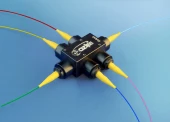
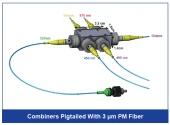
Chromamix Custom Multi Wavelength Fiber Combiner for OEM Laser Delivery Systems
Specifications
| Splitting Ratio: | Unspecified |
|---|---|
| Power Handling: | > 200mW |
| Return Loss: | 40 dB |
| Insertion Loss (Max): | 2 dB |
| Extinction Ratio (Min): | 18 dB |
| Wavelength Range: | 390–410 nm, 430–488 nm, 505–535 nm, 565–600 nm, 630–800 nm |
| Fiber Types: | Single Mode (SM), Polarization-Maintaining (PM), Photonic Crystal Fiber (PCF), Specialty fibers |
| Output Fiber Options: | Multimode, singlemode, polarization-maintaining, photonic crystal |
| Fiber Type: | 3/125 μm for SM or PM fiber |
| Polarization Performance: | High polarization extinction ratio (PER) |
| Insertion Loss: | Typical < 1.5 dB for 5 color combiner |
| Coupling Efficiency: | High |
| Optional Functions: | Built-in manual attenuator; available with integrated laser diodes |
| Design Type: | Custom-engineered, designed-to-spec OEM solution |
| Mechanical / Environmental: | Compact, alignment-free, compliant with low-outgassing / space / ultra-clean applications |
Got questions about specs? Use the inquiry form to ask.
 Download Data Sheet

Features
- Custom multi‑wavelength fiber combiner (UV to near‑IR) – Combine multiple ultraviolet, visible and near‑infrared laser lines into a single output fiber, ideal for advanced laser engines and multi‑line instrumentation.
- Supports SM, PM, PCF and specialty fibers – Available with singlemode, polarization‑maintaining, photonic crystal fiber and other specialty fibers to match diverse laser sources and system architectures.
- Low insertion loss & high coupling efficiency – Precision optical design and alignment minimize optical loss and maximize power throughput for demanding OEM and research applications.
- High polarization extinction ratio (PER) – Maintains polarization state through the combiner, ensuring stable, repeatable performance for polarization‑sensitive techniques such as Raman, quantum optics and interferometry.
- High power handling capability – Engineered for robust power operation compared with conventional fused‑fiber WDMs, supporting modern high‑brightness lasers in UV, visible and IR bands.
- Free‑space wavelength multiplexing architecture – Utilizes free‑space beam combining inside a rugged package to overcome the wavelength and power limitations of traditional fused fiber couplers.
- Compact, alignment‑free fiber‑based solution – Replaces bulky free‑space beam combiners with a compact, factory‑aligned module that requires no user alignment, simplifying integration and field deployment.
- Stable, monolithic construction – Precision opto‑mechanical design delivers excellent long‑term stability against vibration, thermal drift and handling, critical for OEM systems and 24/7 operation.
- Integrated with OptoGlide Precision Laser Delivery – Optimized to complement OZ Optics’ OptoGlide systems, providing end‑to‑end laser delivery from multi‑line source to application point.
- Optional integrated laser diodes for OEM engines – Available with built‑in laser diodes for compact, turnkey multi‑wavelength laser engines that minimize footprint and assembly complexity.
- Optional built‑in manual attenuator – On‑board attenuation enables precise power balancing between wavelengths or channels without external optics.
- Low‑outgassing, ultra‑clean and space‑ready options – Materials and processes compatible with vacuum, semiconductor, space and ultra‑clean applications where contamination is critical.
- Custom fiber types, lengths and jacketing – Configure fiber length, jacket material, cabling and protection to match routing constraints, environmental conditions and bend‑radius requirements.
- Wide connector compatibility – Supports common connector types (e.g., FC/PC, FC/APC, LC, SMA and others on request) to ensure plug‑and‑play compatibility with existing systems.
- Collimated or focused output options – Choose factory‑aligned collimated beams (with specified beam diameter) or focused spots (with defined spot size and working distance) for direct integration into microscopes, scanners or free‑space setups.
- Engineered for fluorescence & confocal microscopy – Delivers multiple excitation wavelengths through a single fiber to microscopes and imaging systems, improving stability and simplifying alignment.
- Optimized for flow cytometry and bio‑analytical systems – Stable, polarization‑controlled multi‑line delivery enhances signal repeatability and simplifies optical layouts in cytometers and diagnostic instruments.
- Ideal for Raman and multi‑line spectroscopy – Combines multiple excitation lines into one fiber for flexible spectroscopy platforms requiring high stability, low noise and high PER.
Applications
- Fluorescence Microscopy and Confocal Imaging
Ideal for combining multiple excitation wavelengths (UV, blue, green, red, NIR) into a single, stable fiber output for advanced fluorescence microscopes and confocal systems. Enables high signal-to-noise imaging, rapid wavelength switching, and compact multi-line laser engines for life science research and high-content screening. - Flow Cytometry and Cell Sorting
Integrates several visible and near‑IR laser lines into one polarization-maintaining or singlemode output to drive flow cytometers and cell sorters. Provides excellent beam quality, low insertion loss, and high polarization extinction ratio to improve scatter and fluorescence detection sensitivity while simplifying optical alignment. - Bio-Analytical and Clinical Diagnostic Instrumentation
Supports OEM multi-laser subsystems for DNA sequencing, PCR / qPCR, immunoassays, hematology analyzers, and point-of-care diagnostics. Multi-wavelength fiber combining reduces footprint and enhances long-term stability in integrated analytical platforms used in hospitals, core labs, and pharmaceutical environments. - Raman Spectroscopy and Multi-Line Spectroscopy
Combines several excitation wavelengths into one delivery fiber for Raman, SERS, CARS, and general multi-line spectrometers. High coupling efficiency and low background make it suited to both benchtop and portable Raman analyzers for materials identification, chemical process monitoring, and on-site security / pharma inspections. - Quantum Optics, Quantum Communication, and Photonics Research
Provides polarization-maintaining and photonic crystal fiber options for stable delivery of multiple quantum-relevant wavelengths to single-photon sources, entanglement experiments, and integrated photonic circuits. High PER and low loss support demanding quantum key distribution (QKD), cold-atom, and quantum sensing setups. - Semiconductor Inspection, Wafer Metrology, and Lithography Support
Supports UV and visible multi-line illumination for semiconductor wafer Inspection, critical dimension (CD) metrology, overlay measurements, and defect review tools. The UV-capable combiner helps deliver tightly controlled beams into inspection heads where stability, low outgassing, and compact routing are critical. - UV Metrology, Surface Profiling, and Thin-Film Characterization
Delivers multiple UV/visible wavelengths into ellipsometers, reflectometers, interferometers, and surface profilers. Fiber-based multi-wavelength delivery simplifies beam routing in precision metrology systems used for coatings, optical components, and high-value manufacturing quality control. - Laser Engines for Microscopy and Imaging Platforms
Functions as a core multi-wavelength combiner inside OEM laser engines powering widefield, TIRF, spinning-disk confocal, multiphoton pre-alignment stages, and structured illumination systems. Replaces bulky free-space combiners, reducing alignment effort, drift, and maintenance while delivering consistent illumination to microscopes and endoscopes. - Endoscopy, Ophthalmic, and Biomedical Imaging Systems
Enables compact, multi-color illumination sources for endoscopy, ophthalmic diagnostics, OCT adjunct channels, and intraoperative imaging tools. Fiber-based combining supports remote laser placement, flexible routing, and robust operation in clinical and surgical environments where reliability and footprint are critical. - Industrial Machine Vision and Multispectral Inspection
Combines multiple visible and NIR lasers into a single delivery fiber for machine vision lighting, line-scan illumination, and multispectral inspection. Useful in electronics assembly, PCB inspection, packaging, and precision manufacturing lines requiring wavelength-selective contrast enhancement and stable, maintenance-free illumination. - Materials Processing Pre-Aligned Delivery (Marking, Scribing, Micro‑Machining)
Offers a stable, high-power-capable fiber interface for multi-wavelength laser processing heads used in fine marking, micro-structuring, polymer treatment, and thin-film ablation. Multi-line combining enables process optimization at different wavelengths without reconfiguring free-space optics. - Laser-Based Printing, Lithography, and Holography
Provides multi-color, polarization-controlled delivery to digital printing engines, maskless lithography systems, and holographic exposure setups. Compact fiber-based combining simplifies system integration and helps maintain precise beam overlap and stability over long operating periods.
Frequently Asked Questions
What is the Chromamix multi-wavelength fiber combiner and what makes it different from standard fiber WDMs?
Which wavelengths and fiber types can the Chromamix fiber combiner support?
What applications are Chromamix multi-wavelength fiber combiners best suited for?
How does the Chromamix combiner handle polarization and power, and what is the typical insertion loss?
Can the Chromamix multi-wavelength combiner include integrated laser diodes or variable attenuation for OEM laser engines?
How do I specify and order a custom Chromamix multi-wavelength fiber combiner?
What advantages does a Chromamix fiber-based combiner offer over traditional free-space beam combiners in laser delivery systems?
Got more questions? Use the inquiry form to ask the supplier directly.
Similar Products


Your inquiry has been received.
Create an account by adding a password
Why create an account?
- Auto-complete inquiry forms
- View and manage all your past messages
- Save products to your favorites
- Close your account anytime — no hassle