
Description
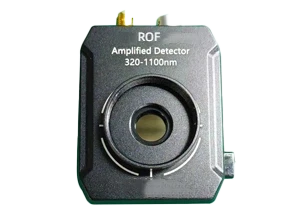
The ROF-PR-11M-B is a high‑performance silicon (Si) photodetector with an integrated transimpedance amplifier and adjustable gain, engineered for precision detection of optical signals from 320 nm to 1100 nm. Covering the near‑UV, visible, and near‑infrared spectral regions, this detector is ideal for laboratory, industrial, and field applications where accurate low‑light measurement and high‑speed response are required. With a 3 dB bandwidth of up to 11 MHz at low gain settings and low RMS noise, it offers an excellent balance between sensitivity and temporal resolution, comparable to professional lab‑grade detectors widely used in photonics R&D, optical test benches, and communication setups.
A defining characteristic of the ROF-PR-11M-B is its 8‑position rotary switch that allows users to adjust the gain in 10 dB steps, from 0 dB up to 70 dB. At the highest gain settings, the device achieves a maximum transimpedance gain of up to 4.75 × 10⁶ V/A on high‑impedance loads, making it particularly effective for weak light detection where signal levels are close to the noise floor. At low gain (0 dB) the detector offers a bandwidth up to 11 MHz, while higher gain settings trade bandwidth for sensitivity, with selectable operating points such as 1.4 MHz, 1.0 MHz, 400 kHz and down to tens of kilohertz for very low‑signal environments. This flexible gain‑bandwidth trade‑off allows users to optimize the detector for time‑resolved measurements, continuous monitoring, or low‑noise averaging depending on the experimental or system requirements.
The built‑in buffer amplifier is designed to drive both high‑impedance and 50 Ω loads. The output can reach up to 10 V into a high‑impedance input and provides approximately 5 V when driving a 50 Ω load, supporting direct connection to oscilloscopes, digitizers, data acquisition cards, and other instrumentation without additional amplification. Internally, a 50 Ω series terminating resistor is used at the amplifier output, forming a defined voltage divider with any external load impedance and improving signal integrity in high‑frequency applications. Typical output bias is maintained at approximately ±8 mV (maximum ±20 mV), which helps minimize baseline offset and simplifies downstream signal processing and calibration routines commonly required in high‑precision optical measurement systems.
The ROF-PR-11M-B features a relatively large active area of about 9.8 mm in diameter (≈ 75.4 mm2), which simplifies free‑space optical alignment and collection of weak, divergent, or unfocused beams. This large‑area design, combined with low inherent noise and carefully optimized electronics, enables stable detection in a wide range of illumination conditions—from faint signals in optical sensing and spectroscopy setups to moderate‑power beams in alignment or monitoring tasks. When operated at near‑infrared wavelengths around 850 nm, the device achieves its specified bandwidth; at longer near‑IR wavelengths, users should consider the slightly slower response of the silicon photodiode, as is typical for similar detectors in this class, which may modestly reduce effective rise time.
Mechanically, the ROF-PR-11M-B is designed for seamless integration into standard optomechanical systems. The housing incorporates a detachable threaded connector (SM1T1) and a fixed ring (SM1RR), both compatible with SM1‑type optical accessories via internal and external threads. This allows users to mount a wide variety of 1‑inch‑series components—such as bandpass filters, neutral density filters, polarizers, lenses, and apertures—directly in front of the detector for easy spectral conditioning and power management. The spatial (free‑space) optical input is standard, and fiber coupling is available as an option by using compatible adapters, providing a straightforward path to integrate the detector into fiber‑optic sensing systems, telecom‑band test setups, or distributed measurement networks.
With its combination of wide spectral coverage, adjustable gain, high sensitivity, and configurable bandwidth, the ROF-PR-11M-B is particularly well suited for weak light detection, space and free‑space optical communication links, optical time‑of‑flight measurements, and precision monitoring in laser alignment or stabilization schemes. It is also an excellent choice for educational and research laboratories that require a flexible, general‑purpose Si detector capable of handling tasks ranging from low‑level signal characterization to moderate‑speed modulation analysis.
ROF PR 11M B Silicon Adjustable Gain Photodetector 11MHz 320nm - 1100nm
Specifications
| Diode Type: | Silicon (Si) |
|---|---|
| Wavelength Of Operation (Typical): | 532 nm |
| Spectral Range: | 320 – 1100 nm |
| Peak Responsivity (Rmax): | Not Specified |
| Peak Quantum Efficiency: | Not Specified |
| Max Frequency Response: | DC - 10 MHz |
| Active Area: | 75.4 mm^2 |
| Dark Current: | Not Specified |
| Package Type: | Custom Package |
| Built-In Amplifier: | Not Specified |
| Model: | ROF-PR-11M-B |
| Detector Type: | Silicon (Si) adjustable-gain photodetector |
| Spectral Range: | 320 nm ~ 1100 nm |
| Response Frequency: | DC – 11 MHz |
| 3 DB Bandwidth (max): | 11 MHz |
| Maximum Gain Setting (high-impedance Load): | 4.75 × 10^6 V/A |
| Output Voltage (high-impedance Load): | up to 10 V |
| Output Voltage (50 Ω Load): | 5 V |
| Gain Adjustment: | 8-position rotary switch in 10 dB steps (0–70 dB) |
| Photosensitive Area Diameter: | Ø 9.8 mm |
| Photosensitive Area: | 75.4 mm² |
| 0 DB Setting Gain (high Resistance >5 KΩ): | 1.50 × 10^3 V/A ±2% |
| 0 DB Setting Gain (50 Ω): | 0.75 × 10^3 V/A ±2% |
| 0 DB Setting 3 DB Bandwidth: | 11 MHz |
| 0 DB Setting Noise (RMS): | 400 µV |
| 0 DB Setting Bias (typical): | ±8 mV |
| 0 DB Setting Bias (maximum): | ±20 mV |
| 10 DB Setting Gain (high Resistance >5 KΩ): | 4.75 × 10^3 V/A ±2% |
| 10 DB Setting Gain (50 Ω): | 2.38 × 10^3 V/A ±2% |
| 10 DB Setting 3 DB Bandwidth: | 1.4 MHz |
| 10 DB Setting Noise (RMS): | 350 µV |
| 10 DB Setting Bias (typical): | ±8 mV |
| 10 DB Setting Bias (maximum): | ±20 mV |
| 20 DB Setting Gain (high Resistance >5 KΩ): | 1.50 × 10^4 V/A ±2% |
| 20 DB Setting Gain (50 Ω): | 0.75 × 10^4 V/A ±2% |
| 20 DB Setting 3 DB Bandwidth: | 1.0 MHz |
| 20 DB Setting Noise (RMS): | 380 µV |
| 20 DB Setting Bias (typical): | ±8 mV |
| 20 DB Setting Bias (maximum): | ±20 mV |
| 30 DB Setting Gain (high Resistance >5 KΩ): | 4.75 × 10^4 V/A ±2% |
| 30 DB Setting Gain (50 Ω): | 2.38 × 10^4 V/A ±2% |
| 30 DB Setting 3 DB Bandwidth: | 400 kHz |
| 30 DB Setting Noise (RMS): | 380 µV |
| 30 DB Setting Bias (typical): | ±8 mV |
| 30 DB Setting Bias (maximum): | ±20 mV |
| 40 DB Setting Gain (high Resistance >5 KΩ): | 1.50 × 10^5 V/A ±2% |
| 40 DB Setting Gain (50 Ω): | 0.75 × 10^5 V/A ±2% |
| 40 DB Setting 3 DB Bandwidth: | 150 kHz |
| 40 DB Setting Noise (RMS): | 500 µV |
| 40 DB Setting Bias (typical): | ±8 mV |
| 40 DB Setting Bias (maximum): | ±20 mV |
| 50 DB Setting Gain (high Resistance >5 KΩ): | 4.75 × 10^5 V/A ±2% |
| 50 DB Setting Gain (50 Ω): | 2.38 × 10^5 V/A ±2% |
| 50 DB Setting 3 DB Bandwidth: | 50 kHz |
| 50 DB Setting Noise (RMS): | 520 µV |
| 50 DB Setting Bias (typical): | ±8 mV |
| 50 DB Setting Bias (maximum): | ±20 mV |
| 60 DB Setting Gain (high Resistance >5 KΩ): | 1.50 × 10^6 V/A ±2% |
| 60 DB Setting Gain (50 Ω): | 0.75 × 10^6 V/A ±2% |
| 60 DB Setting 3 DB Bandwidth: | 20 kHz |
| 60 DB Setting Noise (RMS): | 760 µV |
| 60 DB Setting Bias (typical): | ±8 mV |
| 60 DB Setting Bias (maximum): | ±20 mV |
| 70 DB Setting Gain (high Resistance >5 KΩ): | 4.75 × 10^6 V/A ±2% |
| 70 DB Setting Gain (50 Ω): | 2.38 × 10^6 V/A ±2% |
| 70 DB Setting 3 DB Bandwidth: | 10 kHz |
| 70 DB Setting Noise (RMS): | 1.43 mV |
| 70 DB Setting Bias (typical): | ±8 mV |
| 70 DB Setting Bias (maximum): | ±20 mV |
| Output Series Termination Resistor: | 50 Ω |
| Test Wavelength For Bandwidth Spec: | 850 nm |
Got questions about specs? Use the inquiry form to ask.
 Download Data Sheet

Features
- Wide Spectral Response (320–1100 nm) – High-sensitivity silicon (Si) photodiode responsivity from UV to near‑IR, ideal for laser diodes, LEDs, and broadband sources in the visible and NIR bands.
- Adjustable Transimpedance Gain in 10 dB Steps – Integrated 8‑position rotary switch provides discrete gain settings from 0 dB to 70 dB, enabling optimization of signal level, dynamic range, and noise performance for different optical power levels.
- High Maximum Gain up to 4.75 × 10⁶ V/A – At the highest gain setting (high‑impedance load), the ROF‑PR‑11M‑B offers extremely high conversion gain, making it well suited for weak light and low‑signal detection applications.
- DC to 11 MHz Bandwidth – 3 dB bandwidth up to 11 MHz at low gain, supporting high‑speed modulation, pulsed laser detection, and time‑resolved measurements over a broad frequency range.
- Configurable Bandwidth–Gain Tradeoff – Multiple gain steps (0, 10, 20, 30, 40, 50, 60, 70 dB) allow users to balance bandwidth and sensitivity, with bandwidths ranging from ~11 MHz down to ~10 kHz as gain is increased.
- High-Performance Low-Noise Design – RMS noise as low as ~350–400 µV at typical gain settings and 1.43 mV at the highest gain, enabling precise measurement of low‑level optical signals with an excellent signal‑to‑noise ratio.
- Large-Area 9.8 mm Active Diameter – Photosensitive area of approximately 75.4 mm² provides efficient free‑space collection of expanded beams and diffuse light, simplifying alignment in laboratory and system integrations.
- Buffered Output with High Drive Capability – Integrated amplifier buffer delivers up to 10 V into high‑impedance loads and up to 5 V into a 50 Ω load (with internal 50 Ω series resistor), suitable for direct interfacing with oscilloscopes, digitizers, and data acquisition systems.
- Built‑In 50 Ω Series Termination – Internal 50 Ω output resistor forms a matched source for 50 Ω instruments and cables, minimizing reflections and signal distortion in high‑frequency measurements.
- Stable Output Offset – Low output bias of approximately ±8 mV (typical), ±20 mV (max) across gain settings, ensuring stable baselines and reducing the need for frequent offset correction.
- Compatible SM1 Threaded Mechanical Interface – Supplied with a detachable SM1T1 threaded connector and fixed SM1RR retaining ring, providing direct compatibility with standard 1.035"-40 (SM1) optical accessories such as lenses, tubes, irises, and beam conditioning modules.
- Easy Integration of Optical Filters – Internal and external thread options enable straightforward mounting of bandpass, neutral density, or long‑pass filters in front of the detector, allowing spectral shaping, stray light suppression, and dynamic range management.
- Flexible Optical Coupling Options – Designed primarily for free‑space (spatial) optical input with optional fiber coupling using compatible SM1‑threaded fiber adapters, supporting both bench‑top experiments and fiber‑optic system use.
- DC-Coupled Operation – Supports detection from true DC up to RF frequencies, making it suitable for continuous‑wave light monitoring, power stabilization loops, and low‑frequency modulation measurements.
- Optimized for 850 nm and Near‑IR Operation – Performance characterized at 850 nm, a common wavelength for VCSELs and telecom‑grade sources, with notes on bandwidth limitations at longer near‑IR wavelengths due to photodiode rise time.
- Robust Metal Housing for Laboratory and OEM Use – Sturdy enclosure protects the photodiode and electronics, offers mechanical stability, and simplifies mounting into optical posts, stages, or system chassis.
- Ideal for Weak Light and Precision Sensing – High gain, low noise, and broad spectral coverage make the ROF‑PR‑11M‑B well suited for weak light detection, fiber‑optic sensing systems, space optical communication, beam diagnostics, and low‑power laser monitoring.
- Complementary InGaAs Version Available – The ROF‑PR‑13M‑A variant covers 900–1700 nm with an InGaAs detector and higher bandwidth (DC–13 MHz), enabling a coherent product family for applications spanning visible to telecom‑band infrared.
Applications
- Weak light level detection and low-signal research – Ideal for capturing very low optical power levels thanks to its high maximum gain (up to 4.75×10⁶ V/A with high-impedance load) and low noise. Suitable for precision labs, optical test benches, and R&D setups where weak light detection is critical.
- Fiber optic sensing systems – Used as a high-sensitivity receiver in fiber optic sensors for strain, temperature, pressure, vibration, and structural health monitoring. The DC–11 MHz bandwidth supports both static and dynamic fiber sensing techniques.
- Free-space and space optical communication – Functions as a receiver module in short- and medium-range free-space optical links and satellite/ground optical communication experiments due to its wide spectral range (320–1100 nm) and fast response.
- Laser power monitoring and alignment – Suitable for monitoring CW and modulated laser sources in the visible and near‑IR range, including laser alignment, power stabilization loops, and safety interlocks, using adjustable gain to accommodate different power levels.
- Time‑resolved and high‑speed optical measurements – With a 3 dB bandwidth up to 11 MHz at low gain, it can be used in time‑resolved intensity measurements, modulation response studies, and characterization of LEDs, laser diodes, and pulsed light sources with microsecond to sub‑microsecond dynamics.
- Optical metrology and calibration setups – Useful for calibrating light sources, optical attenuators, filters, and integrating spheres where a stable, linear photodetector with adjustable gain is required across 320–1100 nm.
- Biomedical optics and spectroscopy (320–1100 nm) – Applicable to reflectance and transmission measurements in biological samples, tissue optics experiments, optical density monitoring, and basic fluorescence and absorbance detection when paired with suitable filters.
- Environmental and atmospheric monitoring – Used in instruments that measure ambient light, UV/visible radiation, scattered light, or aerosol optical properties, aided by the capability to mount external optical filters via the SM1-threaded mechanical interface.
- Optical laboratory teaching and university experiments – Well-suited as a general-purpose detector for undergraduate and graduate labs demonstrating photodiode operation, modulation, lock‑in techniques, and basic optical communication experiments.
- Optical encoder and position sensing experiments – Can be used in laboratory or prototype setups to detect modulated light from optical encoders, chopper wheels, and position indicators in the visible and near‑IR range.
- Optical test and measurement equipment integration – Integrates into benchtop and OEM optical test systems as a versatile detector module for characterizing sources, optical components, and systems where configurable gain and 50 Ω or high‑impedance readout are needed.
- Fluorescence and luminescence detection (laboratory level) – When combined with appropriate excitation sources and bandpass filters, it can detect fluorescence or chemiluminescence signals within its spectral range for analytical and bio‑analytical experiments.
- Optical safety, interlock, and monitoring channels – Acts as a monitoring photodetector for safety interlocks and system-health channels in laser systems, optical benches, and production lines, using high gain settings for reliable trip thresholds at low light.
- Inspection and quality control in photonics manufacturing – Used in production test stations for LEDs, laser diodes, photonic components, and optical assemblies, taking advantage of the rotary 8‑position gain control for quick adaptation to different DUT intensities.
- Optical filter and lens characterization – Combined with monochromatic or broadband sources, it helps measure transmission curves, insertion loss, and spectral response of optical filters, lenses, and windows across 320–1100 nm.
- General-purpose visible and near‑IR photodetection module – Serves as a compact, ready‑to‑use detector for any experiment or system requiring reliable Si photodetection with flexible gain, SM1-compatible mechanical mounting, and the option for free‑space or fiber coupling.
Frequently Asked Questions
What is the ROF-PR-11M-B Si adjustable gain photodetector and what are its key specifications?
What applications is the ROF-PR-11M-B adjustable gain photodetector best suited for?
How do I select and use the gain settings on the ROF-PR-11M-B for my measurement?
What are the bandwidth and noise performance of the ROF-PR-11M-B at different gain settings?
How do I connect the ROF-PR-11M-B output to instruments such as oscilloscopes or data acquisition systems?
How can I mount optics or fibers to the ROF-PR-11M-B photodetector?
What is the difference between the ROF-PR-11M-B and the ROF-PR-13M-A, and how do I choose between them?
Got more questions? Use the inquiry form to ask the supplier directly.
Similar Products


Your inquiry has been received.
Create an account by adding a password
Why create an account?
- Auto-complete inquiry forms
- View and manage all your past messages
- Save products to your favorites
- Close your account anytime — no hassle