
Description
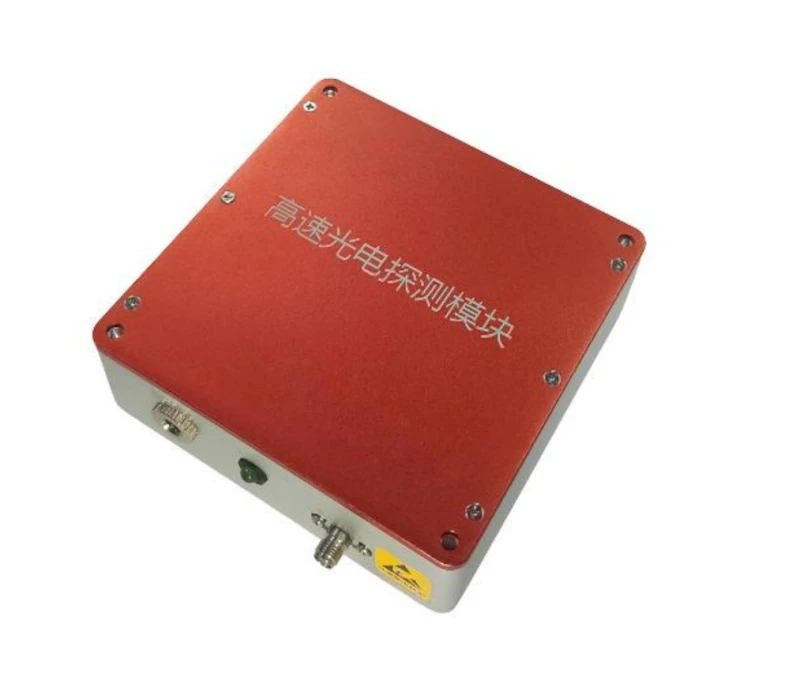
ROF-PD 10G High-Speed Photodetector Light Detection Module
The ROF-PD 10G high-speed photodetector light detection module is an advanced optoelectronic receiver engineered for demanding high‑frequency optical applications. Utilizing a high‑performance 10 GHz PIN photodiode, this module offers a typical responsivity of 0.8 A/W at 1550 nm and a wide spectral response range from 1100 nm to 1650 nm, making it ideal for C‑band and L‑band fiber‑optic systems as well as longer‑wavelength test and measurement setups. Its integrated transimpedance and post‑amplifier stage deliver a gain of up to 40 V/W, enabling the detection of low‑level optical signals with high electrical output while maintaining low noise and excellent linearity.
Designed for high‑speed communications and optical test environments, the ROF-PD 10G module provides a 3 dB bandwidth up to 10 GHz with a corresponding rise time of approximately 35 ps. This bandwidth and temporal performance are comparable to many 10 Gb/s and even pre‑emphasis‑optimized 25 Gb/s receiver front ends found in contemporary optical communication systems. The combination of high bandwidth and flat gain response across the working frequency range ensures accurate reproduction of fast optical pulses, clean eye diagrams, and minimal waveform distortion, which are critical for BER testing, digital link characterization, and high‑frequency modulation analysis.
The module is optimized for both single‑mode and multimode fiber operation, allowing flexible integration into a wide variety of laboratory and field systems. It supports FC/PC and FC/APC fiber connectors, enabling straightforward connection to standard telecom‑grade patch cords and sensor leads. The polarization dependent loss is carefully controlled, typically around 0.2 dB and not exceeding 0.6 dB, helping to maintain stable, repeatable performance even in polarization‑varying environments. With an optical return loss of approximately −35 dB, the module minimizes back‑reflection into upstream lasers and active components, which is especially important when working with narrow‑linewidth sources and coherent detection setups.
On the electrical side, the ROF-PD 10G features a 50 Ω SMA female output connector and an output impedance matched to 50 Ω, allowing it to interface seamlessly with oscilloscopes, sampling oscilloscopes, high‑speed digitizers, vector network analyzers, and RF test instruments. Electrical return loss is typically better than −10 dB from DC to 10 GHz, which helps maintain signal integrity and reduce reflections in high‑frequency measurement chains. The module operates from a single +12 V DC supply, simplifying power integration in benchtop test setups, rack systems, and OEM platforms.
With its combination of high sensitivity, wide dynamic range, and robust mechanical construction, this photodetector module is well suited for high‑speed fiber‑optic communication links, microwave‑over‑fiber and radio‑over‑fiber (ROF) systems, and next‑generation access network development. It provides reliable performance for R&D labs engaged in high‑data‑rate system prototyping, modulation format evaluation, and component characterization. The fast response also makes it an excellent choice for high‑speed optical pulse detection, timing distribution, and precision optical trigger applications where low timing jitter and faithful pulse reproduction are required.
In addition to communication uses, the ROF-PD 10G is well adapted for distributed and point‑type fiber sensing schemes, including systems based on Brillouin scattering. Its bandwidth and sensitivity enable the detection of subtle backscattered or modulated signals in fiber‑optic sensing configurations, supporting high‑resolution measurement of strain, temperature, and vibration over long distances. By combining single‑mode or multimode fiber inputs with low dark current (on the order of several nA at 25 °C) and stable responsivity, the module helps ensure a high signal‑to‑noise ratio even in challenging sensing environments.
Mechanically, the ROF-PD 10G light detection module is delivered in a compact housing of approximately 100 mm × 100 mm × 34 mm. This footprint is suitable for dense integration into 19‑inch rack chassis, portable test instruments, or bespoke system enclosures. The device is rated for operation from −10 °C to +60 °C, with storage temperatures from −40 °C to +85 °C and relative humidity from 5 % to 90 %, offering a level of environmental robustness in line with many lab and light industrial applications. Maximum input optical power is specified around 10 mW, which supports a broad range of telecom and sensing power levels while safeguarding the photodiode from over‑illumination.
ROF-PD 10GHz High Speed Fiber Photodetector Light Detection Module
Specifications
| Diode Type: | Indium Gallium Arsenide (InGaAs) |
|---|---|
| Wavelength Of Operation (Typical): | 1550 nm |
| Spectral Range: | 1100 – 1650 nm |
| Peak Responsivity (Rmax): | 0.8 A/W |
| Peak Quantum Efficiency: | Not Specified |
| Max Frequency Response: | DC - 10 GHz |
| Active Area: | Not Specified |
| Dark Current: | Not Specified |
| Package Type: | Custom Package |
| Built-In Amplifier: | Not Specified |
| Product Model: | ROF-PD-10G |
| Spectral Range: | 1100–1650 nm |
| Response Wavelength (min): | 1100 nm |
| Response Wavelength (max): | 1650 nm |
| -3 DB Bandwidth: | 10 GHz |
| Dark Current (Typ): | 10 nA @ 25 ºC |
| Responsivity: | 0.8 A/W @ 1550 nm |
| Rise Time: | 35 ps |
| Polarization Dependent Loss (Typ): | 0.2 dB |
| Polarization Dependent Loss (Max): | 0.6 dB |
| Optical Return Loss: | -35 dB |
| Gain: | 40 V/W |
| Electrical Return Loss S22: | ≤ -10 dB @ DC–10 GHz |
| Output Impedance: | 50 Ω |
| Operating Voltage (nominal): | DC +12 V |
| Module Dimensions (L×W×H): | 100 × 100 × 34 mm |
| Input Fiber Type: | Single-mode / multimode fiber |
| Fiber Connector Options: | FC/PC, FC/APC |
| Output Connector: | SMA (female) |
| Maximum Input Optical Power: | 10 mW |
| Operating Temperature Range: | -10 to +60 ºC |
| Storage Temperature Range: | -40 to +85 ºC |
| Humidity (non-condensing): | 5–90 %RH |
| Operating Wavelength Option: | 1100–1650 nm |
| Fiber Mode Options: | SM (single mode), MM (multi mode) |
| Connector Type Options: | FP (FC/PC), FA (FC/APC) |
| Coupling Method Options: | DC, AC |
Got questions about specs? Use the inquiry form to ask.
 Download Data Sheet

Features
- 10 GHz High-Speed Bandwidth – True 3 dB bandwidth up to 10 GHz with typical 35 ps rise time, ideal for high‑speed optical pulse detection and 10G optical communication links.
- Wide Spectral Response (1100–1650 nm) – Optimized for O-, E-, S-, C- and L-band operation, covering common telecom wavelengths such as 1310 nm and 1550 nm for maximum application flexibility.
- High‑Performance 10 GHz PIN Photodiode – Integrated high‑speed PIN detector delivers low noise, high sensitivity optical‑to‑electrical conversion for demanding RF and microwave photonics systems.
- High Responsivity and Gain – Typical responsivity of 0.8 A/W at 1550 nm and transimpedance gain of 40 V/W provide strong electrical output signals even at low optical input power.
- Single-Mode / Multi-Mode Fiber Input – Flexible input interface supports both single‑mode and multi‑mode fibers for easy integration into various fiber networks and laboratory setups.
- Standard FC/PC or FC/APC Fiber Connectors – Available with FC/PC (FP) or low‑reflection FC/APC (FA) connectors to minimize back‑reflection and ensure stable, repeatable coupling.
- 50 Ω SMA (f) RF Output – DC–10 GHz SMA female output with 50 Ω impedance and typical electrical return loss S22 ≈ −10 dB for direct connection to oscilloscopes, analyzers, and RF instruments.
- DC or AC Coupling Options – Configurable coupling method (DC or AC) to match system requirements for time‑domain pulse detection or RF/microwave signal measurement.
- Excellent Polarization and Return Loss Performance – Low polarization dependent loss (PDL ≤ 0.6 dB, typically 0.2 dB) and optical return loss around −35 dB for stable, polarization‑insensitive measurements.
- Compact, Robust Module Design – 100 × 100 × 34 mm metal housing provides mechanical stability, effective shielding, and convenient integration into benchtop or rack‑mount test setups.
- Convenient +12 V DC Operation – Operates from a single DC +12 V supply, simplifying power requirements for laboratory, production testing, and field deployment.
- Wide Operating Temperature Range – Reliable performance from −10 °C to +60 °C with storage from −40 °C to +85 °C and humidity tolerance of 5–90% RH, suitable for diverse environments.
- Designed for High‑Speed Optical Communication – Ideal front‑end detector module for 10G optical communication systems, fiber‑optic transmit/receive testing, and eye diagram analysis.
- Optimized for RF over Fiber (ROF) Links – High bandwidth and low noise characteristics make it well‑suited for microwave and millimeter‑wave analog RF‑over‑fiber links and photonic down‑conversion.
- Excellent for Optical Fiber Sensing – Supports Brillouin and other distributed optical fiber sensing systems where high‑speed, high‑sensitivity detection of backscattered or modulated light is required.
- Low Dark Current – Typical dark current in the nA range at 25 °C minimizes noise, improving dynamic range and detection sensitivity in low‑light applications.
- Protected Operating Limits – Maximum input optical power of 10 mW and specified operating voltage of 12 V help protect the detector and ensure long‑term reliability.
- Customizable Configurations – Ordering options for fiber type (SM/MM), connector style (FC/PC or FC/APC), bandwidth, and coupling (DC/AC) allow tailoring to specific system requirements.
- Professional OEM/ODM Support – Developed by a professional and advanced manufacturer of photoelectric products, with support for customized modules and integration into larger systems.
Applications
- High‑Speed Optical Fiber Communication Links (up to 10 Gbit/s)
Designed for 10 GHz operation, the ROF‑PD High‑Speed Photodetector Light Detection Module is ideal for OC‑192/STM‑64, 10GbE, and other high‑data‑rate optical links in telecom and datacom networks. It is used in optical receivers, test points, and performance monitoring ports for long‑haul, metro, and data center interconnect systems in the 1100–1650 nm band. - Radio‑over‑Fiber (ROF) and Microwave Photonics
With its wide 3 dB bandwidth up to 10 GHz, 50 Ω SMA(f) output, and excellent electrical return loss, this module is suitable for radio‑over‑fiber front‑ends, microwave photonic links, and antenna remoting. It converts modulated optical carriers into RF electrical signals for 5G/4G fronthaul, distributed antenna systems (DAS), satellite IF over fiber, and radar signal distribution. - Brillouin and Distributed Fiber Sensing Systems
The module’s high responsivity (≈0.8 A/W at 1550 nm), low polarization dependent loss, and high gain (≈40 V/W) make it well‑suited for Brillouin Optical Time‑Domain Analysis (BOTDA, BOTDR) and other distributed sensing techniques. It is used to detect weak backscattered or stimulated Brillouin signals in structural health monitoring, oil and gas pipeline surveillance, and perimeter security sensing. - High‑Speed Optical Pulse Detection and Characterization
With a typical rise time of 35 ps and 10 GHz analog bandwidth, the ROF‑PD module is an excellent tool for measuring and monitoring picosecond/nanosecond laser pulses. It serves in laboratories and production lines for mode‑locked lasers, Q‑switched lasers, and fast optical modulators where real‑time temporal pulse analysis is required using oscilloscopes and sampling scopes. - Optical Time‑Domain Reflectometry (OTDR) and Fault Localization
The high sensitivity and low noise characteristics support use in high‑resolution OTDR and reflectometry systems. It can be integrated in instruments used for locating fiber breaks, splice losses, and connector reflections in telecom, CATV, and enterprise fiber‑optic networks. - Coherent and Direct‑Detection Test Rigs
In coherent and direct‑detection research setups, the module acts as a high‑speed detector for heterodyne/homodyne receivers, optical beat‑note detection, and linewidth or phase‑noise measurements. Its wide spectral range (1100–1650 nm) enables use with common telecom lasers and tunable sources in R&D laboratories. - Optical Modulator and Component Characterization
The 10 GHz bandwidth and flat gain response make the ROF‑PD module suitable for characterizing high‑speed LiNbO3 modulators, EAMs, integrated photonic modulators, and optical switches. It is commonly used with network analyzers or arbitrary waveform generators to measure frequency response, insertion loss, and chirp behavior of high‑speed components. - Optical Signal Integrity and Jitter Analysis
Used as a front‑end detector for eye‑diagram, jitter, and BER pre‑compliance measurements, the module converts high‑speed optical data into electrical waveforms compatible with oscilloscopes and BERTs. This makes it valuable in transceiver development, quality control, and production testing for 10G‑class optical modules (SFP+, XFP, XENPAK, etc.). - Microwave and Millimeter‑Wave Signal Generation via Optical Beating
When illuminated by two closely spaced lasers, the ROF‑PD module generates a beat frequency in the GHz range, acting as a source of low‑phase‑noise RF or microwave signals. This is used in photonic generation of microwave and millimeter‑wave carriers for radar, wireless backhaul, and precision timing applications. - Optical Fiber Gyroscopes and Interferometric Sensors
The combination of low PDL, good ORL (≤ −35 dB), and high sensitivity supports interferometric detection in fiber‑optic gyroscopes (FOG), hydrophones, and vibration or acoustic sensors. The module converts minute phase‑induced intensity variations into high‑fidelity electrical signals for inertial navigation and industrial sensing. - Laboratory Photonics Education and Research
Owing to its rugged module format, FC/PC or FC/APC fiber input, and SMA output, this detector is practical for university and research labs. It is used in teaching experiments on optical communication, ultrafast optics, RF photonics, and sensor systems where a reliable, ready‑to‑use 10 GHz photodetector is required.
Frequently Asked Questions
What is the ROF-PD-10G high-speed photodetector light detection module and what are its key specifications?
What are the typical applications of the ROF-PD-10G photodetector module in fiber optic and RF systems?
How do I connect and operate the ROF-PD-10G photodetector safely (fiber, RF, and power)?
Should I choose DC coupling or AC coupling for the ROF-PD-10G, and what is the difference?
What fiber and connector options are available for the ROF-PD-10G and how do they affect performance?
How does the 10 GHz bandwidth and 35 ps rise time of the ROF-PD-10G impact data rate and measurement capability?
What environmental and reliability limits should I consider for the ROF-PD-10G photodetector module?
Got more questions? Use the inquiry form to ask the supplier directly.
Similar Products



Your inquiry has been received.
Create an account by adding a password
Why create an account?
- Auto-complete inquiry forms
- View and manage all your past messages
- Save products to your favorites
- Close your account anytime — no hassle