
Description
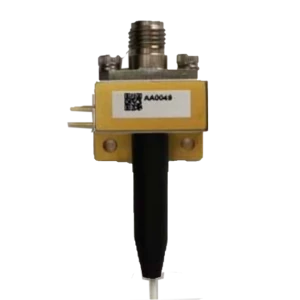
The ROF-PD1570G is a high‑speed InGaAs photodetector module engineered for demanding optical fiber communication and microwave photonic applications. Designed as a DC‑coupled detector with an integrated bias‑T, it offers wide electrical bandwidth and excellent RF performance, enabling accurate conversion of high‑frequency optical signals into the electrical domain. A hermetically sealed package with a precision V‑type RF connector and FC/APC‑terminated single‑mode fiber pigtail ensures low‑loss coupling, stable performance, and high reliability in both laboratory and field‑deployed systems.
Optimized for the 1550 nm telecom wavelength window and adjacent bands, this InGaAs photodetector delivers high responsivity with low dark current, making it suitable for high dynamic range links and precise test setups. Its wide 3 dB bandwidth supports multi‑gigahertz signal transmission, while the flat amplitude response across the operating band preserves waveform integrity, reduces distortion, and simplifies system equalization. The integrated design helps minimize parasitics and reflections, improving overall link linearity and signal‑to‑noise ratio.
In high‑speed optical fiber communication systems, the ROF-PD1570G serves as a front‑end receiver for analog and digital signals, including high‑bit‑rate data, CATV transport, and radio‑over‑fiber links. For microwave photonic links, it enables the transport of RF and microwave signals over optical fiber with low added noise and high linearity, supporting radar remoting, antenna distribution, timing distribution, and other advanced RF‑over‑fiber architectures. Its saturation optical power performance allows operation over a useful input power range without significant compression, supporting accurate amplitude and phase measurements.
The module is also suited for high‑speed test and measurement applications where stable, repeatable opto‑electronic conversion is required. Typical uses include frequency response characterization of modulators and transmitters, eye‑diagram testing, bit‑error‑rate setups, and photonic component evaluation. The internal bias‑T simplifies integration into existing RF environments by providing convenient DC biasing while maintaining a clean RF path to the output connector, reducing the need for external biasing circuitry and associated board space.
Mechanically, the ROF-PD1570G features a compact, robust housing with carefully controlled dimensions, allowing easy integration into optical benches, OEM instruments, and rack‑mounted subsystems. The 9/125 μm single‑mode fiber pigtail with FC/APC connector provides low‑reflection coupling, which is essential for minimizing back‑reflections in high‑speed and high‑power systems. The female V‑connector RF interface is widely used in microwave and millimeter‑wave measurement setups, providing a stable, low‑VSWR connection to analyzers, oscilloscopes, and other RF front‑end equipment.
The device operates over a wide case temperature range, making it suitable for both controlled laboratory environments and engineered outdoor or telecom enclosures. Its hermetic sealing and compliance with stringent reliability requirements (including GJB8120‑2013 reliability assurance standards) ensure long‑term stability under thermal cycling, humidity, and mechanical stress. Low dark current, low polarization‑dependent loss, and good RF return loss contribute to consistent performance over the product lifetime and across operating conditions.
For optimal lifetime and performance, the ROF-PD1570G is used with appropriate handling precautions. The InGaAs detector and internal electronics are sensitive to electrostatic discharge, so suitable ESD controls are required during storage, transport, and installation. The single‑mode fiber pigtail should not be bent below a 20 mm radius to prevent micro‑bending losses or breakage, and the FC/APC connector end‑face must be kept clean to avoid coupling loss and signal degradation. When integrated according to best practices, the ROF-PD1570G offers a reliable, high‑bandwidth, low‑noise solution for advanced optical communication, microwave photonic links, and precision photonic testing.
ROF 1550nm InGaAs Photoreceiver High Speed InGaAs Photodiode
Specifications
| Diode Type: | Indium Gallium Arsenide (InGaAs) |
|---|---|
| Wavelength Of Operation (Typical): | 1550 nm |
| Spectral Range: | 1000 – 1650 nm |
| Peak Responsivity (Rmax): | 0.6 A/W |
| Peak Quantum Efficiency: | Not Specified |
| Max Frequency Response: | Other / Not specified |
| Active Area: | Not Specified |
| Dark Current: | Not Specified |
| Package Type: | Custom Package |
| Built-In Amplifier: | Not Specified |
| Product Model: | ROF-PD1570G |
| Type: | High Speed InGaAs Photodetector |
| Storage Temperature Range: | -45 ~ +85 °C |
| Operating Case Temperature Range: | -40 ~ +70 °C |
| Overall Length L1 (max/nom/min): | 22.1 / 22.0 / 21.9 mm |
| Overall Height H1 (max/nom/min): | 8.7 / 8.6 / 8.5 mm |
| Overall Width W1 (max/nom/min): | 17.1 / 17.0 / 16.9 mm |
| Length L6 (max/nom/min): | 7.9 / 7.8 / 7.7 mm |
| Length L7 (max/nom/min): | 6.1 / 6.0 / 5.9 mm |
| Diameter D (max/nom/min): | 5.23 / 5.08 / 4.93 mm |
| Length L2 (max/nom/min): | 2.1 / 2.0 / 1.9 mm |
| Height H2 (max/nom/min): | 1.6 / 1.5 / 1.4 mm |
| Width W2 (max/nom/min): | 11.2 / 11.0 / 10.8 mm |
| Length L3 (max/nom/min): | 17.2 / 17.0 / 16.8 mm |
| Length L4 (max/nom): | 25.0 / 17.0 mm |
| Lead Length L5 (min): | 1000.0 mm |
| Radius R (max/nom/min): | 1.65 / 1.55 / 1.45 mm |
| Diameter Φ1 (max): | 5.0 mm |
| Diameter Φ2 (max/nom/min): | 1.05 / 1.00 / 0.95 mm |
| Diameter Φ3 (max/nom/min): | 1.35 / 1.30 / 1.25 mm |
| Height H3 (max/nom/min): | 4.7 / 4.6 / 4.5 mm |
| Fiber Type: | 9/125 μm single-mode fiber pigtail |
| Fiber Core/Cladding Size: | 9/125 μm |
| Fiber Connector: | FC/APC |
| RF Connector: | Female V-Connector |
| Minimum Fiber Bending Radius: | 20 mm |
Got questions about specs? Use the inquiry form to ask.
 Download Data Sheet

Features
- High-Speed InGaAs Photodetector – Optimized for high-speed optical detection in the 1.3–1.7 µm telecom window, ideal for advanced fiber-optic and microwave photonics applications.
- Wide 3 dB Bandwidth – Designed with a broad electrical bandwidth (tens of GHz class, comparable to industry-standard high-speed InGaAs detectors) to support high data rate optical-fiber communication and ultra‑fast test setups.
- Integrated Bias‑T Design – Built‑in bias‑T eliminates the need for an external bias‑tee, simplifying system integration, reducing component count, and improving overall signal integrity.
- DC‑Coupled Output – DC‑coupled RF output path allows accurate reproduction of low‑frequency content and fast transients, enabling precise eye‑diagram and waveform measurements.
- Hermetically Sealed Package – Sealed metal housing with high‑reliability construction protects the photodiode and RF circuitry from moisture and contaminants, ensuring stable performance over time.
- Female V‑Connector RF Interface – Precision female V‑connector (2.4 mm‑class) supports extremely high‑frequency operation with low insertion loss, compatible with modern microwave and high‑speed instrumentation.
- Single‑Mode Fiber Pigtail (9/125 µm) – Factory‑aligned 9/125 µm single‑mode fiber pigtail guarantees excellent optical coupling efficiency and repeatable system performance in telecom‑band experiments.
- FC/APC Fiber Connector – Angled‑polish (APC) FC connector minimizes back‑reflections into the laser or system, improving signal stability and reducing coherent noise effects.
- High Responsivity InGaAs Detector – InGaAs absorption layer provides high responsivity in the C‑ and L‑bands, enabling strong electrical output signals even at low optical input power levels.
- High Saturation Optical Power – Saturation behavior optimized for strong input signals, allowing use with higher optical powers before compression, beneficial in analog microwave photonic links and modulated laser systems.
- Good RF Return Loss – Low RF reflection loss design (matched to 50 Ω) reduces standing waves and ripples in the frequency response, improving measurement accuracy and link flatness.
- Low Polarization‑Dependent Loss (PDL) – Engineered optical coupling structure with low PDL to maintain consistent responsivity regardless of input polarization state, important in uncontrolled polarization environments.
- Low Dark Current – Carefully designed InGaAs junction and packaging deliver low dark current for reduced noise floor, improved signal‑to‑noise ratio, and better detection of weak optical signals.
- Compact Module Footprint – Small overall dimensions (approximately 22 × 17 × 9 mm body) save valuable space in densely packed optical benches, modules, and rack‑mount systems.
- Precision Mechanical Tolerances – Tight dimensional tolerances on length, height, and connector positions support repeatable mechanical integration and high‑frequency alignment in OEM and lab setups.
- Wide Operating Temperature Range – Specified for case temperatures from -40 °C to +70 °C, suitable for both laboratory environments and demanding field or telecom infrastructure conditions.
- Robust Storage Temperature Range – Storage capability from -45 °C to +85 °C supports reliable shipping, long‑term warehousing, and integration in equipment subjected to environmental stress.
- Qualified to GJB8120‑2013 – Photodetector module meets reliability assurance requirements per GJB8120‑2013, indicating military‑grade or telecom‑grade qualification and long‑term stability.
- Optimized for High‑Speed Fiber‑Optic Communication – Ideal front‑end for 10G/25G and higher‑speed links, coherent detection setups, and advanced modulation format experiments in the O, C, and L bands.
- Excellent for Microwave Photonic Links – Wide bandwidth, high linearity, and high saturation power make this detector well suited for analog RF‑over‑fiber, antenna remoting, and radar/5G photonic links.
- Suitable for High‑Speed Test & Measurement – Perfect for use as an optical‑to‑electrical (O/E) converter in oscilloscopes, network analyzers, and BER testers requiring clean, broadband electrical signals.
- Stable Frequency Response – Carefully engineered packaging and RF lines provide a smooth frequency response with good amplitude flatness across the operating band for accurate S‑parameter and waveform analyses.
Applications
- High-Speed Optical Fiber Communication Systems – Ideal as a front-end receiver in 10G–40G and higher data rate fiber-optic links using single-mode 9/125 μm fiber, including long-haul, metro, and access networks.
- Microwave Photonic Links – Detection of intensity-modulated RF and microwave signals over fiber for radar remoting, antenna remoting, and distributed RF transport.
- Coherent and Direct-Detection Optical Receivers – Use in coherent and IM/DD receiver chains for advanced modulation formats (QPSK, QAM) in DWDM and high-capacity backbone networks.
- Radio-over-Fiber (RoF) Systems – Down-conversion of RF signals transported over optical fiber in 5G front-haul, DAS (Distributed Antenna Systems), and small cell backhaul.
- Optical Test and Measurement Instrumentation – High-speed detector head for optical sampling oscilloscopes, bit-error-rate test (BERT) systems, and eye-diagram analyzers.
- Optical Transceiver Evaluation – Characterization and verification of high-speed optical transmitters, modulators, and integrated transceiver modules in R&D and production test lines.
- Laboratory Pulse and Waveform Detection – Measurement of fast optical pulses, digital data streams, and analog waveforms in research labs, universities, and photonics development centers.
- Millimeter-Wave and Terahertz Over-Fiber Experiments – Photodetection for frequency up-conversion or down-conversion in mmWave/THz photonic systems and distributed sensing platforms.
- Optical Network Development and Prototyping – Receiver element for prototype high-speed communication links, optical backplanes, and custom fiber interconnects.
- High-Speed Analog Optical Links – Use in CATV, satellite IF over fiber, and broadband analog signal transport where low distortion and wide bandwidth are required.
- Time-Resolved and Ultra-Fast Experiments – Detection of picosecond/nanosecond events in time-correlated measurements, optical gating tests, and high-speed switching studies.
- Optical Component Characterization – Output monitoring for modulators, optical switches, EDFAs, and passive devices in S-, C-, and L-band characterization setups.
- Laser and Modulator Frequency Response Measurement – Use with network analyzers to measure small-signal frequency response (S21) of DFB/EML lasers and external modulators.
- DWDM and CWDM System Monitoring – Receiver for channel-level performance testing, optical power monitoring, and network diagnostics in dense wavelength systems.
- Optical Sensor Interrogation – Detection of modulated optical signals from fiber Bragg gratings (FBG), interferometric sensors, and intensity-based sensors with high bandwidth.
- Photonic Microwave Signal Generation – Use in optoelectronic oscillators and photonic RF generation systems where the photodiode converts optical beat signals to RF.
- Quantum and Low-Light-Level Experiments (Moderate Power) – High-speed detection of modulated sources in quantum optics, correlation setups, and single/multi-photon experiments where fast response is critical.
- Education and Training in High-Speed Photonics – Core detector module for academic labs demonstrating fiber-optic communication principles, link design, and high-speed receiver architectures.
- Production and Burn-In Test Racks – Integrated into automated test equipment for high-volume screening and qualification of optical transmitters and sub-assemblies.
- OEM Integration into Photonic Systems – Compact, hermetically sealed design with V-connector and FC/APC fiber pigtail suitable for integration into custom instruments and communication platforms.
Frequently Asked Questions
What is the ROF-PD1570G high speed InGaAs photodetector used for?
What are the key features and performance advantages of the ROF-PD1570G?
What are the operating temperature and storage temperature ranges of the ROF-PD1570G photodetector?
How is the ROF-PD1570G photodetector electrically and optically connected?
What precautions should I take when handling and installing the ROF-PD1570G InGaAs photodetector?
Is the ROF-PD1570G hermetically sealed and qualified for reliability?
How does the internal Bias‑T and wide bandwidth affect my system design?
Got more questions? Use the inquiry form to ask the supplier directly.
Similar Products


Your inquiry has been received.
Create an account by adding a password
Why create an account?
- Auto-complete inquiry forms
- View and manage all your past messages
- Save products to your favorites
- Close your account anytime — no hassle