
Description
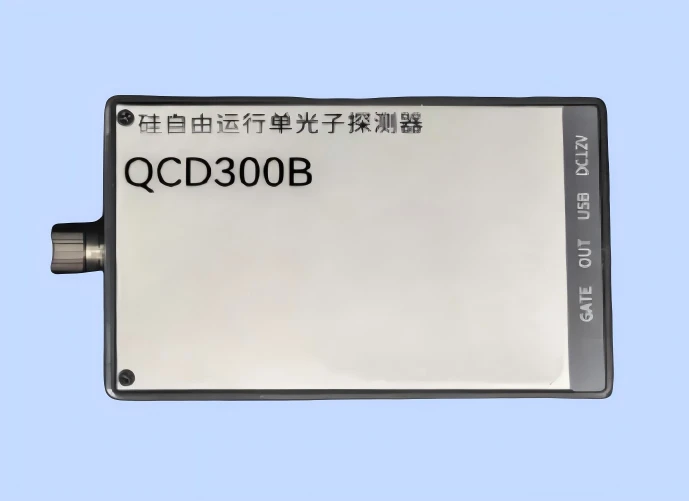
The R-QCD300B-S-3 is a compact, high-performance silicon free-running single photon detector engineered for demanding low-light and single-photon-level measurements in the 400–900 nm spectral range. Built around an integrated, cooled silicon single photon avalanche diode (SPAD), it delivers high detection efficiency at 850 nm (up to 65% maximum, 60% typical) while maintaining a very low dark count rate of ≤100 cps. This combination makes the R-QCD300B-S-3 well suited for applications such as quantum optics experiments, time-resolved fluorescence, precise optical metrology, and photon-counting based sensing systems where reliability, stability, and sensitivity are critical.
In contrast to many gated-mode SPAD modules used in similar wavelength ranges, the R-QCD300B-S-3 operates in true free-running mode. An integrated AQAR chip provides active quenching and active recovery, allowing the detector to automatically detect, quench, and reset after each avalanche event without external timing control. The adjustable dead time from 0 ns to 63 ns gives users precise control over count rate linearity and afterpulsing behavior, enabling optimization for either maximum throughput or minimal post-pulse probability (≤8% at 100 ns dead time). With a saturation count rate of ≥8 Mcps at 100 ns dead time and a minimum timing jitter of 350 ps (500 ps typical), the module offers both high dynamic range and robust temporal performance for time-correlated and high-speed photon-counting measurements.
From a system integration perspective, the R-QCD300B-S-3 is designed to be straightforward to incorporate into laboratory setups and OEM instruments. The detector includes an FC/UPC fiber optic input optimized for 62.5 μm / 105 μm multimode fiber, a standard SMA output for detector pulses, and an SMA input for an external gate control signal, giving users flexibility in how they trigger, synchronize, or monitor photon detection events. A USB 2.0 Type-C interface enables direct communication with a host computer for parameter configuration, status reporting, data handling, and firmware-level diagnostics. This digital control layer allows users to automate alignment checks, optimize operating conditions, log performance metrics, and integrate the detector into larger automated measurement platforms.
The physical design of the R-QCD300B-S-3 emphasizes robustness, thermal stability, and ease of deployment. The housing and cover plates are manufactured from 6061 aluminum alloy, a material commonly chosen in precision photonics instruments for its mechanical strength, dimensional stability, and excellent thermal conductivity. The enclosure surface is sandblasted and then anodized, with a silver-white top cover and black body and rear panel. This finish not only provides a clean, professional laboratory aesthetic but also offers improved resistance to wear and corrosion. A barcode label on the side encodes the full serial number along with production date and batch information, supporting traceability, documentation, and quality control in multi-unit deployments or long-term experiments.
Measuring approximately 110 mm in width, 35 mm in height, and 72 mm in depth, and with a net weight of about 300 g, the detector is compact enough for dense optical benches, portable setups, and multi-channel photon-counting assemblies. Power is supplied via a DC 12 V input (DC-005 connector) with no external power switch, simplifying installation in enclosures or racks. Internal active stabilization algorithms help maintain performance across different ambient temperatures by actively controlling the sensor’s operating conditions and integrated cooling stage. As a result, the R-QCD300B-S-3 maintains stable detection efficiency, dark count performance, and timing characteristics over a wide range of environments, addressing an important limitation seen in some non-cooled or passively stabilized silicon photon counters.
In comparison to many other silicon photon-counting modules on the market that target the 400–900 nm band, the R-QCD300B-S-3 brings together several attributes that are typically found only in higher-end instruments: free-running SPAD operation with integrated active quenching, high peak detection efficiency around 850 nm, flexible dead-time tuning, and an unusually low standard dark count level. Combined with USB-based digital control and real-time monitoring, it offers a balanced solution for researchers and system designers who need a detector that is both sensitive at the single-photon level and convenient to integrate into modern, software-driven optical measurement systems.
R-QCD300B-S-3 Silicon Free Running Single Photon Detector USB FC UPC
Specifications
| Diode Type: | Silicon (Si) |
|---|---|
| Wavelength Of Operation (Typical): | 650 nm |
| Spectral Range: | 400 – 900 nm |
| Peak Responsivity (Rmax): | Not Specified |
| Peak Quantum Efficiency: | 65 |
| Max Frequency Response: | Other / Not specified |
| Active Area: | Not Specified |
| Dark Current: | 0.016 fA/mm^2 |
| Package Type: | Custom Package |
| Built-In Amplifier: | Not Specified |
| Model: | R-QCD300B-S-3 |
| Detector Type: | Silicon free-running single photon detector |
| Core Device: | Integrated cooling type silicon SPAD with AQAR chip |
| Operation Mode: | Free-running |
| Communication Interface: | USB 2.0 Type-C |
| Power Interface: | DC-12V, DC-005 |
| Response Wavelength: | 400–900 nm |
| Number Of Channels: | Single channel |
| Coupling Method: | 62.5 µm / 105 µm multimode fiber @ UPC interface |
| Detection Efficiency @ 850 Nm: | Maximum 65%, typical 60% |
| Dark Count Rate: | ≤ 100 cps |
| Post-pulse Probability: | ≤ 8% @ 100 ns dead time |
| Time Jitter: | Minimum 350 ps, typical 500 ps |
| Dead Time Adjustment Range: | 0–63 ns |
| Saturation Count Rate: | ≥ 8 Mcps @ 100 ns dead time |
| Dimensions (W×H×D): | 110 mm × 35 mm × 72 mm |
| Weight: | ≈ 300 g |
| Supply Voltage: | DC 12 V |
| Housing Material: | Aluminum alloy 6061 |
Got questions about specs? Use the inquiry form to ask.
 Download Data Sheet

Features
- Silicon Free-Running Single-Photon Detector – Integrated cooling-type silicon SPAD (single-photon avalanche diode) with active quenching and active recovery (AQAR) circuitry for reliable free-running single-photon counting in demanding applications.
- Wide Spectral Response: 400–900 nm – Optimized for the visible and near-infrared band, covering common wavelengths from blue to NIR (e.g., 405, 532, 650, 780, 808, 850 nm), ideal for fluorescence detection, lidar, quantum optics, and time-resolved measurements.
- High Detection Efficiency up to 65% @ 850 nm – Maximum photon detection efficiency (PDE) of 65% (typical 60%) at 850 nm, comparable to leading free‑running Si single‑photon detectors on the market, enabling high sensitivity even at very low light levels.
- Very Low Dark Count Rate ≤ 100 cps – Ultra‑low dark count performance helps maximize signal‑to‑noise ratio in low‑light experiments, single‑photon imaging, and quantum communication tests.
- Low Afterpulsing Probability ≤ 8% @ 100 ns Dead Time – Integrated AQAR and optimized cooling/drive conditions effectively suppress afterpulsing, ensuring accurate photon counting and improved measurement linearity.
- Adjustable Electronic Dead Time: 0–63 ns – User‑configurable dead time for balancing maximum count rate versus afterpulsing and pile‑up effects, allowing optimization for different experimental regimes.
- High Saturation Count Rate ≥ 8 Mcps @ 100 ns Dead Time – Supports multi‑megacount per second (Mcps) operation, enabling use in high‑flux applications such as fast fluorescence lifetime measurements and high‑speed lidar.
- Fast Timing Response with Low Time Jitter – Timing jitter as low as 350 ps (typical 500 ps), suitable for many time‑correlated photon counting (TCSPC), time‑of‑flight, and timing‑critical experiments.
- Integrated Thermoelectric Cooling for Stability – Built‑in cooled Si-SPAD and active stabilization algorithms maintain stable performance (dark counts, gain, timing) across a range of ambient temperatures, improving repeatability and reliability.
- Free‑Running and Gate-Compatible Operation – Native free‑running mode with an external GATE SMA input for optional gating control, enabling background reduction and time‑selective detection in pulsed systems.
- Optical Fiber Coupled Input (FC/UPC) – Front-panel FC/UPC fiber flange optimized for 62.5 µm / 105 µm multimode fiber, ensuring robust, low‑loss coupling to common laboratory and OEM fiber setups.
- Clean Electrical Output Pulse via SMA – Dedicated DET SMA output for single‑photon detection pulses compatible with standard counting electronics, time-taggers, oscilloscopes, and TCSPC modules.
- USB 2.0 Type‑C Communication Interface – Modern Type‑C port for data communication with a host computer: parameter configuration, status monitoring, data acquisition, and firmware‑level diagnostics.
- Real‑Time Monitoring and Control – Supports real‑time reporting of operating status and parameters via USB, simplifying alignment, troubleshooting, long‑term monitoring, and automated measurement workflows.
- High System Reliability – Active stabilization algorithms and robust internal electronics maintain stable detection efficiency, timing characteristics, and noise performance over long operating periods.
- Compact and Lightweight Aluminum Alloy Housing – 6061 aluminum alloy chassis (sandblasted, colored, and oxidized) with silver‑white top cover and black body/back panel; approximately 110 mm (W) × 35 mm (H) × 72 mm (D), ~300 g net weight, ideal for benchtop or OEM integration.
- Industrial‑Grade Build and Traceability – Durable mechanical design with barcode label including serial number, production date, and batch number for reliable inventory management, support, and quality tracking.
- Simple DC Power Input (12 V) – Operates from a standard DC 12 V supply via DC‑005 connector, simplifying integration into lab setups and embedded systems (no mains‑voltage inside the module).
- Front‑Panel Status LEDs – Green operation LED indicates normal power‑on state; red fault LED provides immediate visual indication of malfunctions or abnormal operating conditions.
- Easy Integration into Experimental Setups – Standard FC/UPC, SMA, USB‑C, and 12 V interfaces, combined with compact size and free‑running capability, make the R‑QCD300B‑S‑3 well suited for spectroscopy, quantum optics, fluorescence lifetime, optical instrumentation, and OEM photon‑counting solutions.
Applications
- Quantum Optics Experiments
Ideal for detecting individual photons in fundamental quantum optics research, quantum interference studies, and tests of quantum foundations over the 400–900 nm spectral range. - Quantum Key Distribution (QKD)
Suitable for free‑running single‑photon detection in fiber‑based and free‑space QKD systems at 850 nm and other visible/near‑IR wavelengths, where low dark counts and high detection efficiency are critical. - Time‑Correlated Single Photon Counting (TCSPC)
Can be used in TCSPC setups for precise photon arrival time measurements, fluorescence lifetime analysis, and timing correlation studies, taking advantage of its sub‑nanosecond timing jitter. - Fluorescence Lifetime Imaging Microscopy (FLIM)
Applicable to FLIM systems that require sensitive detection of weak fluorescence signals in the visible range for biological imaging, cell diagnostics, and medical research. - Confocal and Multi‑Photon Microscopy Detection
Integrates as a high‑sensitivity detector in confocal and multi‑photon microscopy for low‑light imaging of fluorescent markers and nanoscale structures. - Single‑Molecule Spectroscopy and Biophysics
Supports single‑molecule fluorescence and FRET experiments, enabling counting and timing of individual photon events from single biomolecules or quantum emitters. - Optical Time‑Domain Reflectometry (OTDR)
Can serve as the receiver in short‑wavelength OTDR or photon‑counting OTDR systems, improving sensitivity for fault location and characterization in multimode fiber networks. - LIDAR and Time‑of‑Flight Measurements (Visible / NIR)
Suitable for short‑range, eye‑safe LIDAR, 3D ranging, and time‑of‑flight measurements in the 400–900 nm band where low‑power signals require single‑photon sensitivity. - Atmospheric and Remote Sensing
Used for photon‑counting detection in atmospheric lidar, aerosol and cloud profiling, and remote sensing of weak backscattered signals in the visible spectrum. - Biomedical and Chemiluminescence Detection
Applicable to assays and instruments that rely on ultra‑low‑light chemiluminescence or bioluminescence, such as DNA analysis, immunoassays, and clinical diagnostics. - Raman and Fluorescence Spectroscopy
Functions as a sensitive detector for weak Raman scattering and low‑intensity fluorescence signals, supporting analytical chemistry, material characterization, and environmental monitoring. - Optical Communication Research (Short‑Wavelength)
Suitable for experimental visible‑light or 850 nm optical communication links that employ photon‑counting receivers, BER testing, and channel characterization. - Quantum Random Number Generation (QRNG)
Can be used in QRNG systems where detection of individual photon events and precise timing statistics are required for generating high‑quality random numbers. - Single‑Photon Source Characterization
Enables characterization of quantum light sources (e.g., quantum dots, NV centers, heralded single‑photon sources) by measuring g(2) correlations, emission statistics, and timing properties. - Optical Metrology and Calibration
Useful as a reference detector in low‑light optical metrology for calibrating optical power at the single‑photon level, validating attenuators, and testing optical components at 400–900 nm. - Laboratory Education and Training
Well suited for university and research‑institute teaching labs to demonstrate single‑photon phenomena, photon statistics, and basic quantum communication principles. - Low‑Light Imaging and Night‑Vision Research
Supports prototype development of photon‑counting imaging systems and night‑vision technologies that operate in the visible and near‑infrared spectrum. - Optical Sensor and Detector Development
Used as a benchmark detector in R&D for new optical sensors, filters, and front‑end electronics, allowing precise evaluation of detection efficiency, dark count rates, and timing jitter. - Industrial Inspection and Quality Control
Applicable to high‑sensitivity optical inspection systems, such as defect detection on wafers, optical storage media, or precision components where scattered light levels are extremely low. - Security and Surveillance Systems (Research Stage)
Suitable for research and prototyping of photon‑counting based security, intrusion detection, and covert surveillance systems operating at low light levels.
Frequently Asked Questions
What is the R-QCD300B-S-3 silicon free-running single photon detector and what are its main applications?
What are the key technical specifications of the R-QCD300B-S-3 single photon detector?
How do I connect and operate the R-QCD300B-S-3 detector in free‑running and gated modes?
How does the dark count rate and timing jitter of the R-QCD300B-S-3 compare to similar silicon single photon detectors?
What type of optical fiber and connector does the R-QCD300B-S-3 support?
How is dead time configured on the R-QCD300B-S-3 and why is it important?
What interfaces and indicators does the R-QCD300B-S-3 provide for integration and monitoring?
Got more questions? Use the inquiry form to ask the supplier directly.
Similar Products


Your inquiry has been received.
Create an account by adding a password
Why create an account?
- Auto-complete inquiry forms
- View and manage all your past messages
- Save products to your favorites
- Close your account anytime — no hassle