
Description
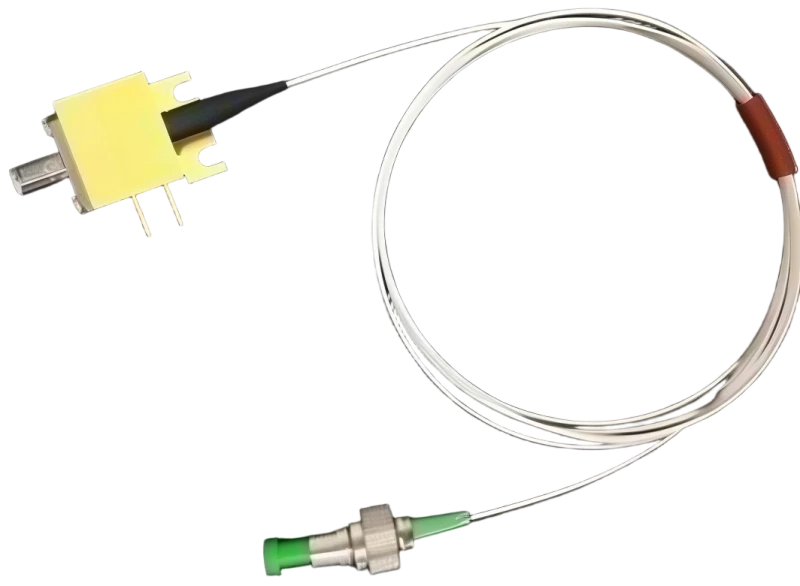
The ROF-PD-70 is an advanced ultra-wideband PIN photodetector designed for demanding high‑speed optical and microwave photonics applications. Engineered with a built‑in bias‑T and 50 Ω impedance matching at the RF port, this device delivers a typical 3 dB bandwidth of 67 GHz and an effective bandwidth of ≥70 GHz, placing it among the highest performance photodetectors in its class. With a responsivity of ≥0.6 A/W at 1550 nm and extremely low dark current, it provides a clean, high‑fidelity electrical output that is well suited to precision test, measurement, and communication systems.
Optimized for operation in the 1260–1570 nm wavelength window, the ROF-PD-70 is ideal for C‑band and L‑band fiber‑optic systems, including high‑speed optical links, coherent communication test setups, and broadband microwave photonic links. Its ultra‑high bandwidth enables faithful detection of modulation formats well beyond 40 Gb/s, and supports applications such as ultra‑wideband signal analysis, eye‑diagram and jitter measurements, optical sampling, and broadband RF over fiber. The combination of high responsivity, low dark current (typically in the tens of nanoamps), and low port standing wave (good RF return loss across 10 MHz–67 GHz) helps maintain excellent signal integrity over a very wide frequency range.
In comparison with common 40 GHz and 50 GHz photodetectors widely used in telecom and lab environments, the ROF-PD-70 extends the usable frequency range to ≥70 GHz, making it suitable for next‑generation coherent systems, ultra‑fast modulation format research, and mm‑wave / sub‑THz photonic experiments. The integrated bias‑T simplifies system integration by removing the need for external bias‑tee components, minimizing parasitics and cabling complexity. Its RF interface uses a precision 1.85 mm connector, ensuring consistent high‑frequency performance when mated with compatible test equipment such as real‑time oscilloscopes, vector network analyzers, and spectrum analyzers.
The optical interface is available with single‑mode fiber (SMF) or polarization‑maintaining fiber (PMF) pigtails terminated in FC/APC connectors, making it easy to integrate into standard fiber‑optic setups while keeping back‑reflections low. The device supports input optical powers up to 10 dBm absolute maximum, with a recommended operating range up to about 7 dBm to avoid saturation while maintaining a high signal‑to‑noise ratio. A positive bias voltage of +1 V to +3 V (typically +2 V) is applied to the BIAS pin, while the GND pin is used for grounding. This configuration helps achieve the specified bandwidth and linearity while keeping dark current low.
The ROF-PD-70 is designed for reliable performance over a wide operating temperature range from −40 °C to +70 °C, with storage down to −55 °C and up to +85 °C, making it suitable for both laboratory and field‑deployed systems. Careful attention to RF matching and packaging results in low reflection loss (S22 typically better than −8 dB across 10 MHz–67 GHz), which reduces ripple in the detected signal and simplifies calibration in metrology‑grade applications. These characteristics make the ROF-PD-70 a strong choice for users who require a high‑bandwidth, low‑noise photodetector for leading‑edge research, high‑speed instrumentation, and advanced microwave photonics experiments.
Typical use cases include high‑speed digital communications testing, optical arbitrary waveform generation and analysis, analog RF photonic links, radar and electronic warfare prototyping, and characterization of high‑bandwidth modulators and optical transmitters. With its balance of ultra‑wide bandwidth, high responsivity, integrated bias‑T, and robust fiber and RF interfaces, the ROF-PD-70 allows system designers and researchers to push their measurement and transmission capabilities further into the mm‑wave and ultra‑fast signal regime.
ROF-PD-70 Ultrawideband 70GHz PIN Photodetector 1550nm Fiber
Specifications
| Diode Type: | Indium Gallium Arsenide (InGaAs) |
|---|---|
| Wavelength Of Operation (Typical): | 1550 nm |
| Spectral Range: | 1260 – 1570 nm |
| Peak Responsivity (Rmax): | 0.6 A/W |
| Peak Quantum Efficiency: | Not Specified |
| Max Frequency Response: | DC - 70 GHz |
| Active Area: | Not Specified |
| Dark Current: | Not Specified |
| Package Type: | Custom Package |
| Built-In Amplifier: | Not Specified |
| Model: | ROF-PD-70 |
| Photodetector Type: | PIN-based ultrawideband photodetector |
| Built-in Bias-T: | Yes |
| Impedance: | 50 Ω |
| 3 DB Bandwidth (typical): | 67 GHz |
| Effective Bandwidth: | ≥70 GHz |
| Responsivity (typ.): | 0.6 A/W @ P=0 dBm, Vr=+2 V, λ=1550 nm |
| Dark Current (min): | 20 nA @ Vr=+2 V |
| Dark Current (max): | 60 nA @ Vr=+2 V |
| Operating Wavelength (min): | 1260 nm |
| Operating Wavelength (typ.): | 1550 nm |
| Operating Wavelength (max): | 1570 nm |
| Maximum Optical Power (absolute Rating): | 10 dBm |
| Maximum Positive Bias Voltage (absolute Rating): | 5 V |
| Operating Temperature Range: | -40 to +70 ℃ |
| Storage Temperature Range: | -55 to +85 ℃ |
| Test Temperature (unless Specified): | 25 ℃ |
| 3 DB Bandwidth (min): | 60 GHz @ P=0 dBm, Vr=+2 V, λ=1550 nm |
| 3 DB Bandwidth (typ.): | 67 GHz @ P=0 dBm, Vr=+2 V, λ=1550 nm |
| RF Reflection Loss S22 (min): | -10 dB, 10 MHz–67 GHz, Plight=0 dBm, Vr=+2 V |
| RF Reflection Loss S22 (max): | -8 dB, 10 MHz–67 GHz, Plight=0 dBm, Vr=+2 V |
| Saturated Optical Power: | 7 dBm @ Vr=+2 V, λ=1550 nm |
| Bias Voltage (recommended): | +2 V (range +1 to +3 V) |
| Fiber Type Options: | SMF or PMF |
| Fiber Connector: | FC/APC |
| Input Optical Power At Fiber Pin (max): | ≤10 dBm |
| Input Optical Power At Fiber Pin (recommended): | 0–7 dBm |
| RF Interface: | 1.85 mm, female |
Got questions about specs? Use the inquiry form to ask.
 Download Data Sheet

Features
- Ultra-Wideband 70 GHz Photodetector – PIN-based design with a typical 3 dB bandwidth of 67 GHz and an effective bandwidth ≥70 GHz, ideal for next‑generation ultra‑high‑speed optical and RF systems.
- High Responsivity at 1550 nm – Typical responsivity ≥0.6 A/W at 1550 nm (Popt=0 dBm, Vr=+2 V), providing strong photoelectric conversion efficiency for C‑band applications.
- Low Dark Current for Superior Signal Integrity – Dark current as low as 20–60 nA (at Vr=+2 V) helps achieve high signal‑to‑noise ratio in demanding measurement and communication environments.
- Optimized for 1260–1570 nm Operating Range – Broad wavelength coverage from 1260 nm to 1570 nm supports O‑, E‑, S‑, and C‑band systems used in optical communication, microwave photonics, and test & measurement.
- Integrated Bias‑T and 50 Ω Impedance Matching – Built‑in bias‑T and 50 Ω RF port matching provide excellent compatibility with high‑frequency instruments, VNAs, oscilloscopes, and modulators without external matching networks.
- Low RF Reflection Loss – RF S22 reflection loss of approximately −10 to −8 dB from 10 MHz to 67 GHz improves power transfer, reduces standing waves, and ensures clean high‑frequency performance.
- High Saturation Optical Power Handling – Saturated optical power up to 7 dBm (Vr=+2 V, 1550 nm) and maximum input optical power of 10 dBm provide generous headroom for high‑power or multi‑channel systems.
- Compact, High‑Frequency RF Interface – Equipped with a precision 1.85 mm (V‑connector) female RF port, supporting measurements and links up to 67 GHz with low loss and excellent repeatability.
- SMF or PMF Fiber Options – Available with single‑mode fiber (SMF) or polarization‑maintaining fiber (PMF) pigtails and standard FC/APC connector for easy integration into existing optical setups.
- Low VSWR / Port Standing Wave – Carefully engineered RF design and 50 Ω matching help minimize port standing waves, improving flatness and fidelity across the full ultra‑wideband range.
- Stable Reverse Bias Operation – Recommended operating bias of +1–3 V (typically +2 V) via BIAS pin delivers stable, repeatable performance with simple drive electronics.
- Wide Operating Temperature Range – Operates reliably from −40 °C to +70 °C (storage −55 °C to +85 °C), suitable for both laboratory environments and more demanding field or system‑level deployments.
- Low Noise for High‑Speed Instrumentation – Combined low dark current, high responsivity, and optimized RF design make the ROF‑PD‑70 ideally suited for high‑speed sampling oscilloscopes, BERTs, and optical test instruments.
- Designed for Microwave Photonic Links – Ultra‑wideband and low‑distortion performance enable use in analog microwave photonic links, RF‑over‑fiber, antenna remoting, and radar/5G/mmWave front‑haul systems.
- Rugged, ESD‑Aware Construction – Requires standard ESD protection measures and careful fiber handling; built for dependable long‑term operation when used with proper device protection and connector cleanliness.
- Flexible Ordering Configuration – Model code structure (ROF‑PD‑70‑M‑XX) allows selection of effective bandwidth and fiber type (SM or PM), simplifying configuration for diverse application requirements.
Applications
Applications of ROF-PD-70 Ultra-Wideband Photodetector
- High‑Speed Optical Communication Testing
Used as a front‑end receiver in 40G/100G/400G and beyond optical transceiver and coherent system testing, enabling analysis of eye diagrams, jitter, and bit error rates over the 1260–1570 nm wavelength range. - Microwave Photonics Links
Ideal for photonic generation, transport, and detection of RF and millimeter‑wave signals in analog optical links, including radio‑over‑fiber (RoF), phased array feeds, and fiber‑distributed antenna systems up to and beyond 67 GHz. - Millimeter‑Wave and 5G/6G RF Over Fiber
Suitable for converting modulated optical carriers back to electrical signals in 24–71 GHz and E‑band front‑haul/back‑haul links, testbeds, and prototyping platforms for 5G/6G and beyond wireless research. - High‑Frequency Network and Spectrum Analysis
Used with vector network analyzers (VNA) and microwave spectrum analyzers as an optical‑to‑RF interface, enabling S‑parameter characterization, phase noise, and linearity measurements of optoelectronic components up to 67 GHz. - Optical Sampling and High‑Speed Oscilloscope Front‑Ends
Acts as an ultra‑wideband optical input for real‑time oscilloscopes and sampling scopes in telecom and datacom labs, providing faithful reproduction of sub‑10 ps optical pulses and fast modulated waveforms. - Coherent Optical System Development
Deployed in coherent receiver setups as a high‑bandwidth detection element for advanced modulation formats (QPSK, 16QAM, 64QAM) and digital coherent test systems operating around 1550 nm. - Ultrafast Pulse and Mode‑Locked Laser Diagnostics
Used to monitor and characterize mode‑locked fiber lasers, frequency combs, and femtosecond or picosecond sources via RF spectrum analysis of repetition rates and harmonics up to Ku‑, K‑ and Ka‑bands. - Optical Time‑Domain and Frequency‑Domain Measurements
Applied in high‑resolution optical time‑domain reflectometry (OTDR), optical sampling, and optical frequency‑domain analysis where fast response and low dark current improve detection sensitivity and timing accuracy. - Analog Photonic Signal Processing
Enables implementation and testing of analog photonic subsystems such as true‑time delay lines, microwave photonic filters, frequency up/down‑conversion, and arbitrary waveform generation that require flat response to tens of GHz. - Optical Arbitrary Waveform and Pulse‑Shaping Systems
Used as a high‑bandwidth readout device in optical arbitrary waveform generators and pulse shapers to verify amplitude/phase profiles and to provide electrical feedback signals for system optimization. - High‑Speed LIDAR and Ranging Experiments
Suitable for laboratory‑grade high‑frequency detection in time‑of‑flight and FMCW LIDAR prototypes operating near 1.3–1.55 µm, where wide electrical bandwidth improves range resolution and velocity discrimination. - Optical Metrology and Frequency Comb Readout
Supports optical frequency comb beat‑note detection, RF extraction from stabilized lasers, and precision metrology setups that require low‑noise, high‑bandwidth photoelectric conversion. - Research in Nonlinear and Ultrafast Optics
Widely used in university and R&D laboratories for experiments involving four‑wave mixing, supercontinuum generation, all‑optical switching, and other ultrafast phenomena requiring detection of fast optical intensity changes. - Secure Optical Communications and Quantum‑Oriented Testbeds
Utilized in high‑speed classical encryption links, quantum‑inspired communication experiments, and hybrid classical/quantum test setups as a fast intensity detector in the 1260–1570 nm window. - Component Characterization in Production and QA
Integrated into automated test stations for characterization of high‑speed modulators, optical switches, EMLs, and integrated photonic circuits, where its built‑in bias‑T and 50 Ω matching simplify RF fixturing. - Microwave Photonic Sensor Readout
Employed in systems that convert physical quantities (strain, temperature, vibration) to RF signals on optical carriers, enabling broadband detection for distributed fiber sensors and interferometric sensing platforms. - High‑Speed Optical Data Recording and Storage Research
Suitable for experimental optical interconnects and optical data storage readout schemes that demand ultra‑wideband photodetection to investigate next‑generation I/O and memory architectures.
Frequently Asked Questions
What is the ROF-PD-70 ultrawideband photodetector and what are its key features?
What is the operating wavelength range and responsivity of the ROF-PD-70?
What bandwidth and RF performance does the ROF-PD-70 provide?
How should I bias and connect the ROF-PD-70 in my test or microwave photonics setup?
What optical power levels can the ROF-PD-70 handle, including maximum and saturation power?
What fiber types and optical connectors are available for the ROF-PD-70?
What are the operating conditions and handling precautions for the ROF-PD-70 photodetector?
Got more questions? Use the inquiry form to ask the supplier directly.
Similar Products


Your inquiry has been received.
Create an account by adding a password
Why create an account?
- Auto-complete inquiry forms
- View and manage all your past messages
- Save products to your favorites
- Close your account anytime — no hassle