
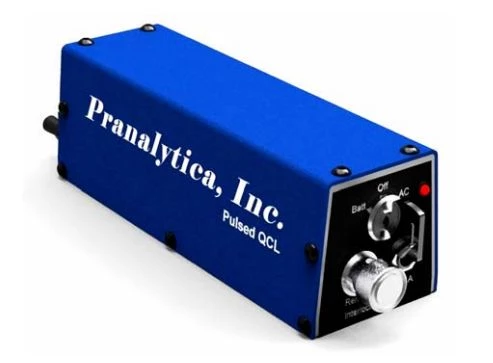
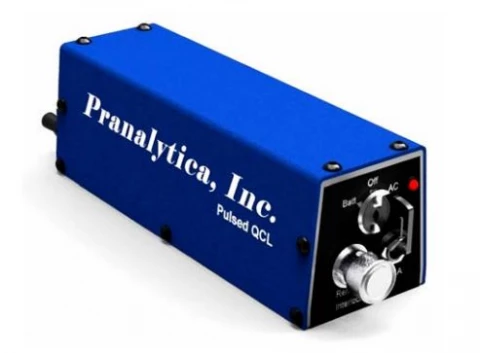
Description
Model 1101-XX-QCW-YYYY-MicroTT-EXT is a cutting-edge high power quasi-CW micro tabletop quantum cascade laser system, engineered to deliver exceptional performance in the realm of infrared radiation. This sophisticated system stands out with its ability to produce over 2 W of average power at a wavelength of 4.6 µm, while also offering versatility with available wavelengths ranging from 3.8 to 12 µm. Designed for bench top use, this laser system is passively cooled and virtually vibration-free, ensuring a stable and consistent output.
This self-contained unit is remarkably user-friendly, requiring only an external 20 VDC power source to operate. Inside, the system houses advanced pulse shaping and power conditioning electronics, along with a hermetically sealed package that includes the QCL and associated optics for collimating the laser beam. The system's design emphasizes long-term stability, making it ideal for operations in a stable temperature environment without the need for field adjustments.
For added convenience, the Model 1101-XX-QCW-YYYY-MicroTT-EXT offers an internal battery operation option. With four CR123A internal batteries, users can achieve a run time exceeding 30 minutes for a 2 W QCL, with potentially longer run times for lower power outputs. This feature enhances the system's portability and flexibility, making it suitable for a variety of applications where mobility is a key consideration.
High Power Quasi-CW Quantum Cascade Laser at 9.3um
Specifications
| Output Power (avg): | 2 W |
|---|---|
| Wavelength: | 9.3 um |
| Pulse Duration: | 200 – 500 ns |
| Tuning Range Around Center Wavelength: | Not Applicable |
| Wavelength Range: | um |
 Download Data Sheet

Features
- High Average Power Output: The Model 1101-XX-QCW-YYYY-MicroTT-EXT produces over 2 W of average power at a wavelength of 4.6 µm. Other wavelengths between 3.8 and 12 µm are available.
- Quasi-CW Operation: The system operates in a high duty cycle pulsed mode, factory-set for optimal performance.
- Pulse Specifications: Standard output includes pulses ranging from ~200 ns to 500 ns with a repetition rate of ~500 kHz to 2.0 MHz, achieving a ~50% duty cycle.
- Customizable Options: Optional features include variable duty cycle from 0.05% to 50%, variable pulse amplitude, and synchronization with external TTL pulse sequences.
- Wavelength Flexibility: Available wavelengths include ~3.8 µm, ~4.0 µm, 4.6 µm, 7.1 µm, 8.5 µm, and 9.3 µm. Custom wavelengths between 3.8 µm and 12 µm can be ordered.
- Beam Quality and Divergence: The system offers excellent beam quality with 5 mrad vertical and horizontal beam divergence.
- Collimated Output Beam: The nearly collimated output beam has a spot size of approximately 4 mm, facilitated by a lens within the hermetically sealed QCL package.
- Compact and Lightweight Design: The laser head measures 5.5” (L) x 1.8” (W) x 1.8” (H) and weighs only 11 oz, making it ideal for benchtop use.
- Power Supply Options: The system operates on an external 20 V DC power supply (included) and offers an optional internal battery operation using four CR123A batteries, providing over 30 minutes of runtime for a 2 W QCL.
- Reliable and Stable: The hermetically sealed QCL package ensures high reliability in all environments, requiring no field adjustments and maintaining stability over long periods in stable temperature conditions.
Applications
- Infrared Spectroscopy: Utilize the high average power and specific wavelengths for precise molecular analysis.
- Gas Sensing: Ideal for detecting and measuring gas concentrations due to its ability to operate at various infrared wavelengths.
- Environmental Monitoring: Monitor pollutants and greenhouse gases with high sensitivity and accuracy.
- Industrial Process Control: Use in manufacturing settings for real-time monitoring and control of processes involving infrared-active compounds.
- Medical Diagnostics: Apply in non-invasive diagnostics and imaging, leveraging its tunable wavelength capabilities.
- Scientific Research: Suitable for laboratory applications requiring stable and high-power infrared sources.
- Military and Defense: Use in secure communication systems and target designation due to its high power and reliability.
- Remote Sensing: Effective for atmospheric studies and remote detection of substances over large distances.
- Material Analysis: Perform detailed analysis of materials through their infrared absorption characteristics.
Frequently Asked Questions
What is a Quantum Cascade Laser (QCL)?
What is the average power output of the Model 1101-XX-QCW-YYYY-MicroTT-EXT quantum cascade laser system?
What is the mode of operation of the Model 1101-XX-QCW-YYYY-MicroTT-EXT quantum cascade laser system?
What is the beam divergence of the Model 1101-XX-QCW-YYYY-MicroTT-EXT quantum cascade laser system?
What is the power supply requirement for the Model 1101-XX-QCW-YYYY-MicroTT-EXT quantum cascade laser system?
Similar Products
Your inquiry has been received.
Create an account by adding a password
Why create an account?
- Auto-complete inquiry forms
- View and manage all your past messages
- Save products to your favorites
- Close your account anytime — no hassle