

Description
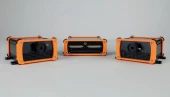
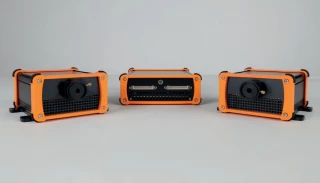
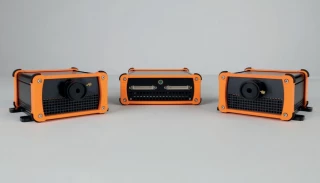
The PowerMir 4.6μm High-Power Quantum Cascade Laser Turnkey System is a versatile plug-and-play benchtop solution designed for lab development purposes. It comes with user-friendly Windows software that controls temperature and current to prevent laser damage. This system supports high-power lasers, can operate lasers with power exceeding 1W, and is capable of modulating down to 10 nanoseconds of pulse width.
Each laser head is air-cooled and includes a red beam laser for alignment purposes. With the ability to connect one or two laser heads to the same driver, regardless of wavelength or power, it offers flexibility for various projects. The system includes functionalities such as laser safety, laser driver control, temperature management, frequency modulation, duty cycle adjustment, and external TTL compatibility.
PW4600090HCNA: PowerMir 4.6um High Power Pulsed Quantum Turnkey System 100mW
Specifications
| Output Power (avg): | 0.1 W |
|---|---|
| Wavelength: | 4.6 um |
| Pulse Duration: | 10 – 300 ns |
| Tuning Range Around Center Wavelength: | Not Applicable |
| Physical Interface: | USB interface for PC connection; TTL trig IN connector for external TTL signal; TTL trig OUT connector for synchronization |
| Option: | Extra red laser beam for alignment assistance |
| Weight: | 925 g |
| Operating Temperature: | +10 to +30 °C |
| Cooling: | Air-cooled |
| Dimension (laser Head): | 20 x 15 x 6 cm |
| Dimension (driver): | 25 x 15 x 6 cm |
| Software: | A user friendly Windows software is supplied |
| Input Power: | 24V DC (an AC/DC power transformer is supplied) |
| Optional Power: | 450, 1000, 2000 mW |
Got questions about specs? Use the inquiry form to ask.
 Download Data Sheet

Features
Key Features of the 4.6µm QCW Quantum Cascade Laser System
- High-power mid-infrared QCL source: Fabry-Perot quantum cascade laser system emitting around 4.6µm, ideal for MIR spectroscopy, gas sensing, infrared countermeasure research, chemical detection, and industrial analysis.
- ITAR-free MIR laser technology: Designed and manufactured in France using proprietary mirSense QCL technology, offering an export-friendly alternative for high-performance mid-infrared laser integration.
- Quasi-CW pulsed operation: Operates in QCW high-duty-cycle pulsed mode to deliver high average optical power while improving wall-plug efficiency and reducing thermal dissipation.
- High average output power options: Available in configurations delivering >1 W average optical power or 450 mW to 500 mW average optical power, depending on application and export requirements.
- 4.6µm center wavelength: Central wavelength specified at 4.6µm ± 0.1µm, suitable for molecular absorption applications in the mid-infrared spectral region.
- High repetition rate pulsing: Supports pulse frequencies of >500 kHz, enabling fast modulation, high-speed measurements, and demanding spectroscopy applications.
- Excellent beam quality: Delivers a near-Gaussian TM00 beam with M² < 1.5, supporting efficient optical coupling, beam shaping, and long-distance propagation.
- Low-divergence standard beam: Typical beam divergence is 3 to 6 mrad horizontal and 2 to 4 mrad vertical, with a slightly elliptical beam profile.
- Convenient standard beam size: Window-output beam dimensions are typically 3 mm vertical x 2 mm horizontal, simplifying integration with MIR optics and laboratory setups.
- Highly polarized output: Provides linear vertical polarization >98%, beneficial for polarization-sensitive spectroscopy, optical systems, and beam delivery designs.
- Reliable laser platform: Designed for robust operation with demonstrated reliability of >3500 hours, supporting laboratory, OEM, and production use.
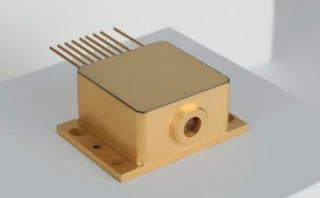
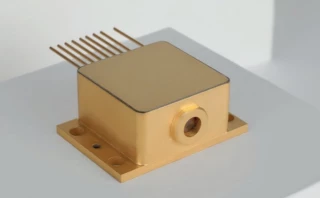
- Multiple system configurations: Available as a plug-and-play benchtop turnkey system, OEM driver + laser module, or HHL-packaged QCL for flexible integration.
- Turnkey benchtop system for R&D: Integrated laboratory system includes current control, temperature control, air cooling, laser safety functions, and user-friendly Windows control software.
- Dual laser head capability: Turnkey configuration can control two laser heads simultaneously, enabling multi-wavelength or expanded MIR experimental setups.
- External modulation support: Compatible with external TTL modulation, allowing synchronized pulsed operation and power modulation in advanced optical experiments.
- OEM-ready control options: OEM module can be controlled via Modbus or Windows software, making it suitable for integration into analytical instruments, sensing platforms, and industrial systems.
- Optional visible alignment aid: Turnkey systems can be fitted with red beam alignment lasers to simplify optical alignment of the invisible 4.6µm MIR beam.
- Efficient thermal management: QCW operation and regulated HHL base-plate temperature operation at +20°C help maintain stable optical performance and reduce heat load.
- Series-production consistency: Manufactured with reproducible specifications, making the platform suitable for repeatable OEM deployments and scalable product integration.
- Optimized for MIR applications: A strong choice for mid-infrared spectroscopy, environmental gas monitoring, defense and security sensing, process control, chemical analysis, and research-grade MIR photonics.
Applications
Applications for 4.6 µm QCW QCL Mid-Infrared Laser Systems
- Carbon monoxide gas sensing: High-sensitivity detection of CO using strong mid-infrared absorption bands near 4.6 µm.
- Industrial emissions monitoring: Measurement of CO and related combustion gases in stack emissions, flue gas, furnace exhaust, and process vents.
- Combustion diagnostics: Real-time analysis of combustion efficiency, flame chemistry, gas temperature, and exhaust composition in engines, turbines, burners, and industrial combustion systems.
- Environmental trace gas monitoring: Mid-IR detection of atmospheric pollutants and greenhouse-related gases with strong absorption features in the 4.5–4.7 µm spectral region.
- Process analytical technology: Inline and online gas analysis for chemical plants, petrochemical processing, refineries, steel production, cement plants, and power generation facilities.
- Photoacoustic spectroscopy: High-power pulsed MIR source for sensitive photoacoustic gas detection, including compact gas analyzers and laboratory spectroscopy platforms.
- Quartz-enhanced photoacoustic spectroscopy: Suitable laser source for QEPAS-based trace gas sensors requiring high optical power and fast pulsed operation.
- Infrared absorption spectroscopy: Mid-infrared laser source for molecular fingerprinting, laser absorption measurements, and spectroscopic analysis around 4.6 µm.
- Gas leak detection: Detection and localization of hazardous gas leaks in industrial plants, enclosed facilities, pipelines, and safety-critical environments.
- Engine and vehicle exhaust analysis: Measurement of CO concentration in automotive, diesel, marine, aviation, and heavy-duty engine exhaust streams.
- High-temperature gas diagnostics: Monitoring of hot gas flows in combustion chambers, furnaces, turbines, and high-enthalpy test facilities.
- Stand-off and open-path gas detection: Mid-IR illumination source for remote gas sensing, open-path absorption measurements, and long-path atmospheric monitoring.
- Defense and security sensing: ITAR-free mid-infrared laser source for hazardous gas detection, chemical detection research, target illumination, and infrared system testing.
- Infrared countermeasure and scene simulation testing: High-power MIR source for laboratory testing of IR sensors, detectors, cameras, seekers, and warning systems in the 4.6 µm band.
- MIR detector characterization: Optical source for testing, calibration, and performance evaluation of mid-infrared photodetectors, focal plane arrays, and imaging sensors.
- Thermal imaging and IR camera calibration: Mid-wave infrared source for alignment, calibration, and validation of MWIR imaging systems operating near 4.6 µm.
- Free-space optical communication research: High-power pulsed mid-infrared laser source for experimental MIR free-space links and atmospheric transmission studies.
- Mid-infrared illumination: Bright 4.6 µm source for active IR illumination, beam propagation studies, and optical system development.
- Laser-based chemical sensing: Molecular detection in the fingerprint region for laboratory instruments, OEM analyzers, and custom sensing platforms.
- Scientific research and spectroscopy: High-power quantum cascade laser source for universities, research laboratories, and R&D groups working in mid-infrared photonics.
- OEM gas analyzer integration: Compact HHL-packaged laser and driver module options for integration into commercial CO analyzers, emissions monitors, and industrial sensing instruments.
- Laboratory laser development: Turnkey benchtop configuration for rapid prototyping, optical alignment, spectroscopy experiments, and system validation.
- Non-dispersive infrared system development: High-brightness MIR source for advanced NDIR gas sensing architectures and sensor benchmarking.
- Materials and thin-film analysis: Mid-infrared source for studying absorption features, coatings, polymers, optical materials, and MIR-compatible components.
- Mid-IR photonics testing: Characterization of infrared optics, lenses, filters, waveguides, fibers, beam delivery components, and MIR optical coatings.
Frequently Asked Questions
What is the 4.6 µm QCW QCL PowerMir quantum cascade laser?
What output power is available from the 4.6 µm QCW QCL?
What are the main advantages of quasi-CW operation in this MIR QCL?
What beam quality and divergence does the 4.6 µm quantum cascade laser provide?
Is the 4.6 µm QCW QCL ITAR free and suitable for export-sensitive applications?
What system configurations are available for the 4.6 µm QCW QCL?
What applications use a high-power 4.6 µm mid-infrared QCL laser?
Got more questions? Use the inquiry form to ask the supplier directly.
Similar Products


Your inquiry has been received.
Create an account by adding a password
Why create an account?
- Auto-complete inquiry forms
- View and manage all your past messages
- Save products to your favorites
- Close your account anytime — no hassle