

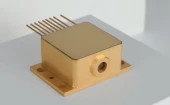
Description
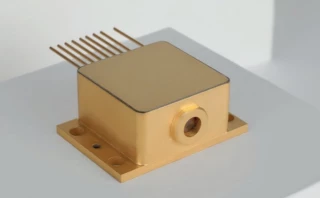
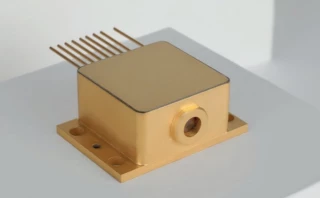
The PowerMir 9.4µm High-Power Pulsed Quantum Cascade Laser by mirSense represents cutting-edge technology tailored for demanding industrial and scientific applications. This versatile laser module is engineered to deliver exceptional performance, precision, and stability. Designed for seamless integration, it comes in a standalone packaged version, making it easy to incorporate into existing systems.
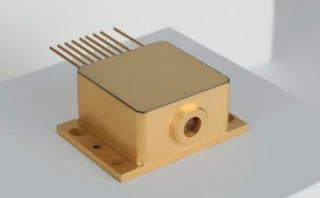
The HHL package features integrated temperature control mechanisms, including a Peltier TEC cooler and a thermistor, ensuring precise chip temperature regulation for consistent performance. Additionally, the laser is equipped with an integrated collimating lens, guaranteeing high beam quality with a Gaussian profile. Its hermetically sealed design, filled with dry N2 air, enhances long-term stability and reliability.
With optional customization available upon request, including different package configurations, the PowerMir 9.4µm laser offers flexibility to meet specific project requirements. Whether used for gas sensing, spectroscopy, environmental monitoring, or industrial process control, this laser module delivers unparalleled performance, making it an indispensable tool for researchers, engineers, and integrators alike.
PW940090HSNA: PowerMir 9.4um High-Power Pulsed Quantum Cascade Laser HHL Package 100mW
Specifications
| Output Power (avg): | 0.1 W |
|---|---|
| Wavelength: | 9.4 um |
| Tuning Range Around Center Wavelength: | Not Applicable |
| Package Type: | HHL (Hermetically-sealed package) |
| Temperature Control:: | Integrated Peltier TEC cooler and thermistor for precise chip temperature control |
| Beam Divergence: | Optional circular beam with 2.5mrad divergence |
| Beam Quality: | Enhanced by collimating lens inside the package |
| Manufacturing Process: | Burned-in during manufacturing to ensure long-term power and wavelength stability |
| Environmental Protection: | Hermetically sealed with dry N2 air inside |
| Pulse Frequenc: | > 500 kHz |
| Mode Of Operation: | Quasi-CW, high duty cycled pulsed |
| Polarizatio: | Linear vertically polarized (>98%) |
| Reliability: | > 3500 hours |
| Operational Temperature Range: | +10 to +30 °C |
Got questions about specs? Use the inquiry form to ask.
 Download Data Sheet

Features
Key Features – 9.4 µm QCW Mid-Infrared Quantum Cascade Laser System
- High-power 9.4 µm MIR QCL: Fabry-Perot quantum cascade laser emitting around 9.4 µm with a central wavelength tolerance of ±0.1 µm, ideal for mid-infrared spectroscopy, gas sensing, industrial analysis, and laboratory research.
- Up to 300 mW average optical power: Delivers high average output power in the mid-infrared range, with specified power measured at a regulated HHL base plate temperature of +20°C.
- Quasi-CW high-duty-cycle pulsed operation: QCW operation provides increased wall-plug efficiency and reduced thermal dissipation compared with conventional pulsed laser operation.
- High pulse repetition frequency: Supports pulse frequencies of >500 kHz, enabling demanding modulation, sensing, and spectroscopy applications.
- Excellent beam quality: Produces a TM00 Gaussian beam with M² < 1.5 for efficient optical coupling, beam delivery, and system integration.
- Low-divergence standard beam: Typical divergence is 3 to 6 mrad horizontal and 2 to 4 mrad vertical, supporting precise beam alignment and stable optical performance.
- Collimated output beam: Standard window-output beam dimensions are typically 3 mm vertical x 2 mm horizontal, with a slightly elliptical beam profile.
- Highly polarized emission: Provides >98% linear vertical polarization, suitable for polarization-sensitive MIR optical setups.
- ITAR-free laser technology: Manufactured in France using ITAR-free technology, simplifying international procurement and integration for qualified commercial, industrial, and research users.
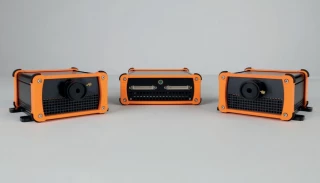
- Multiple system configurations: Available as a plug-and-play benchtop turnkey system, OEM driver + laser module, or HHL-packaged laser for flexible deployment from R&D to product integration.
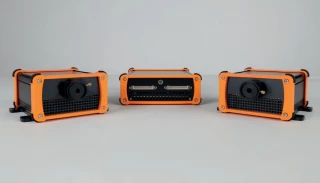
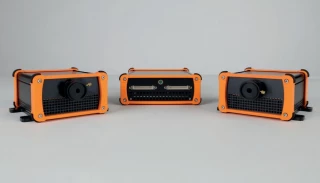
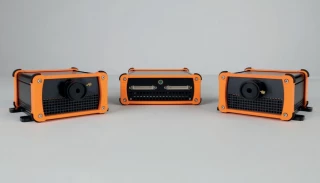
- Turnkey benchtop option: Complete laboratory-ready system includes temperature control, current control, air cooling, laser safety functions, and user-friendly Windows software for operation and power modulation.
- OEM integration ready: OEM configuration includes PCB driver electronics connected to an HHL-packaged QCL, with control via Modbus or Windows software for easy embedded-system integration.
- External modulation capability: Supports external TTL modulation as well as software-based modulation, enabling synchronization with measurement systems, detectors, lock-in amplifiers, and spectroscopy setups.
- HHL package with thermal control: HHL-packaged laser includes built-in TEC and thermistor for precise chip temperature regulation and stable wavelength/power performance.
- Integrated collimating optics: HHL laser option includes a collimating lens for simplified optical alignment and reduced integration time.
- Dual-head turnkey capability: Benchtop controller can operate two laser heads simultaneously, supporting multi-wavelength MIR experiments and expanded measurement flexibility.
- Optional red alignment laser: Turnkey systems can be fitted with red beam alignment lasers to simplify safe optical alignment in laboratory environments.
- Reliable operation for demanding use: Designed for reproducible series production with typical reliability greater than 3500 hours.
- Optimized for mid-infrared applications: Well suited for MIR spectroscopy, chemical detection, gas analysis, environmental monitoring, industrial process control, and scientific instrumentation.
- Manufactured by mirSense: Part of the PowerMir product line of high-power pulsed quantum cascade lasers based on proprietary high-performance QCL technology.
Applications
Applications for 9.4 µm QCW Quantum Cascade Laser Systems
- Mid-infrared gas sensing and molecular spectroscopy: High-power 9.4 µm QCW QCL sources are well suited for MIR absorption spectroscopy of gases with strong vibrational fingerprints in the 9–10 µm region.
- Ozone detection and monitoring: The 9.4 µm wavelength range is highly relevant for ozone absorption measurements, making this QCL suitable for atmospheric monitoring, environmental sensing, industrial emissions control, and laboratory ozone diagnostics.
- Trace gas analysis: Enables sensitive detection of trace gases and molecular species in industrial, environmental, defense, and research applications using infrared absorption techniques.
- Photoacoustic spectroscopy: The high average optical power and pulsed QCW operation make the laser an excellent source for photoacoustic gas detection systems requiring strong MIR excitation.
- Open-path and stand-off chemical detection: The high-power MIR output can be used in open-path spectroscopy and remote sensing systems for detecting gases, vapors, and chemical signatures over distance.
- Environmental monitoring: Ideal for monitoring atmospheric pollutants, greenhouse-related gases, ozone concentration, airborne contaminants, and industrial exhaust streams.
- Industrial process control: Suitable for real-time monitoring of chemical processes, combustion byproducts, emissions, gas purity, leak detection, and hazardous gas concentrations in manufacturing environments.
- Defense and security sensing: ITAR-free MIR QCL technology can be integrated into chemical detection, threat monitoring, perimeter sensing, and field-deployable spectroscopy systems.
- Hazardous vapor and chemical agent detection: The 9.4 µm spectral region can be used for identifying infrared-active chemical vapors and hazardous compounds based on their mid-infrared absorption fingerprints.
- Infrared countermeasure and target illumination research: High-power pulsed MIR laser emission can support laboratory and system-level testing of infrared sensors, detectors, and countermeasure technologies.
- MIR hyperspectral imaging and active infrared illumination: The laser can be used as an active illumination source for mid-infrared imaging systems, chemical imaging, and material identification.
- Non-destructive testing and material inspection: Useful for inspection of polymers, coatings, thin films, composites, and other materials with absorption features in the 9.4 µm mid-infrared region.
- Polymer and plastics analysis: The 9–10 µm spectral band overlaps with important vibrational absorption features in many organic and polymer materials, enabling identification, sorting, and process monitoring.
- Thin-film and coating characterization: Supports MIR reflectance, transmission, and absorption measurements for dielectric films, optical coatings, semiconductor layers, and specialty materials.
- Semiconductor and microelectronics process monitoring: Can be integrated into metrology tools for monitoring gases, films, etching processes, deposition processes, and contamination in semiconductor manufacturing.
- Laser-based metrology: Provides a stable mid-infrared source for measurement systems requiring narrow spectral output, high modulation capability, and reliable optical power around 9.4 µm.
- FTIR source replacement or enhancement: In selected applications, a high-brightness QCL can improve signal strength, measurement speed, and sensitivity compared with broadband thermal infrared sources.
- Infrared detector testing and calibration: Suitable for testing MIR photodetectors, thermal cameras, infrared focal plane arrays, pyroelectric detectors, MCT detectors, and QCL-compatible optical sensors.
- Optical system alignment and MIR instrument development: The turnkey configuration with optional red alignment lasers supports laboratory development of mid-infrared optical benches and sensing instruments.
- Scientific research and laboratory spectroscopy: A strong source for molecular physics, chemical physics, laser spectroscopy, plasma diagnostics, and fundamental mid-infrared light-matter interaction studies.
- Combustion diagnostics: Can be used for monitoring combustion-related molecular species, exhaust gases, and high-temperature gas-phase processes where MIR absorption spectroscopy is required.
- Plasma diagnostics: Useful for probing infrared-active species in plasma processing, gas discharge ex
Frequently Asked Questions
What is the mirSense PowerMir 9.4 µm QCW QCL laser system?
What output power does the 9.4 µm QCW QCL provide?
What does QCW operation mean for a quantum cascade laser?
What wavelength range does this mid-infrared QCL cover?
What beam quality and polarization does the 9.4 µm QCL offer?
Which system configurations are available for the 9.4 µm QCW QCL?
Can the 9.4 µm QCW QCL be modulated or integrated into OEM equipment?
Got more questions? Use the inquiry form to ask the supplier directly.
Similar Products


Your inquiry has been received.
Create an account by adding a password
Why create an account?
- Auto-complete inquiry forms
- View and manage all your past messages
- Save products to your favorites
- Close your account anytime — no hassle