


Description
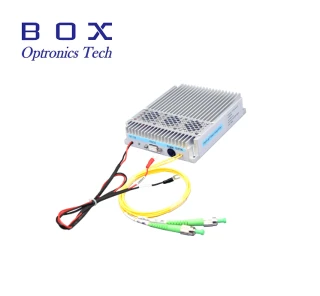
The OZ Optics Highly Stable Polarized Fiber Optic Source (HIPFOSS) is a precision light source engineered for demanding polarization-sensitive measurements in research, production, and metrology environments. Unlike conventional fiber-coupled laser modules, this source is optimized from the ground up for polarization performance, combining a temperature-stabilized emitter, integrated optical isolator, and carefully qualified internal optics to deliver outstanding power and wavelength stability. With polarization extinction ratios up to 40 dB and a broad range of operating wavelengths from approximately 400 nm to 2050 nm, the HIPFOSS provides the stable, well-defined polarization state required for accurate characterization of optical components and systems.
A key element that differentiates this source from many standard lab lasers and pigtailed diodes is its integrated rotatable polarizer. The HIPFOSS design allows the user to set the polarization axis to any desired angle relative to the fiber connector key, ensuring consistent alignment with polarization-maintaining fibers, test setups, and downstream instruments. In the motorized configuration (MHIPFOSS), the polarizer rotation is driven by a precision motorized stage with sub-degree (0.1°) angular resolution. This not only simplifies fine polarization alignment but also enables automated test sequences and repeatable polarization sweeps in PDL and extinction ratio measurements.
To achieve the high polarization extinction and long-term stability, the source incorporates a thermally controlled laser or super luminescent diode (SLD) together with an integrated isolator that suppresses back-reflections from connectors, components, and free-space optics in the system. Competitor products and similar precision polarized sources typically rely on temperature stabilization alone; the addition of the isolator in the HIPFOSS design significantly reduces feedback-induced noise and drift. Internal optics and fiber coupling are rigorously tested for wavefront quality and alignment, giving a low-noise, stable beam profile at the fiber output. This is particularly critical in applications such as interferometry, polarization-sensitive optical coherence tomography (OCT), and fiber-based sensing where small variations in polarization can translate into measurement errors.
The HIPFOSS platform supports both laser diodes and super luminescent diodes across its wavelength range. While laser diodes are often chosen for their narrower linewidth and higher coherence, use of an SLD can further improve the stability of polarization-dependent measurements by reducing coherence-induced interference effects and speckle. In comparison to standard benchtop laser sources, this flexibility allows users to select the emitter type that best matches their application—whether that be high-coherence interferometric setups or low-coherence, low-speckle environments where polarization stability still needs to be tightly controlled.
Another notable aspect of the design is the optional blocking-style optical attenuator that can be integrated into the source. Instead of adjusting the drive current electronically—which often alters the spectrum, linewidth, and polarization characteristics—this mechanical attenuation method regulates output power without disturbing the emission properties of the diode or SLD. This mirrors best practices seen in high-end metrology-grade sources worldwide and is particularly advantageous in precision test labs where consistency between measurements over long durations is essential. The result is a source whose spectral profile and polarization state remain essentially unchanged as you dial the power up or down for different devices under test.
The HIPFOSS family is offered with a variety of fiber connector receptacle styles, allowing straightforward integration into existing fiber networks, component test stations, and automated production lines. The polarization axis is carefully referenced to the keyway on the connector receptacle, so users can confidently align polarization-maintaining fibers or devices without repeated trial-and-error adjustments. When paired with accessories such as master reference patchcords and polarization extinction ratio meters, the system can form a complete, traceable reference for calibrating other sources, evaluating the extinction ratio of components, or verifying the polarization-dependent loss of assemblies and modules.
By combining long-term output stability, high polarization extinction ratio, motorized polarization control, and optional high-power configurations, this polarized fiber optic source serves as a robust solution for extinction ratio measurements, PDL characterization, interferometry, and quality control in both R&D and manufacturing environments.
Highly Stable Polarized Fiber Optic Source
Specifications
| Laser Type: | Continuous Wave (CW) |
|---|---|
| Fiber Type: | Single Mode |
| Wavelength: | 980 nm |
| Output Power: | 1 mW |
| Fiber Core Diamater: | 6 um |
| Fiber Cladding Diameter: | 125 um |
| Polarization Extinction Ratio: | up to 40 dB |
| Wavelength Range: | 400–2050 nm |
| Polarization Axis Adjustment Resolution (motorized Version): | 0.1 degree |
| Reference Ambient Temperature: | 23 °C |
| Warm-up Period: | 30 minutes |
Got questions about specs? Use the inquiry form to ask.
 Download Data Sheet

Features
- Ultra-High Polarization Extinction Ratio (up to >40 dB) – Delivers a highly pure, linearly polarized output, enabling precise extinction ratio and PDL measurements with minimal polarization crosstalk. Comparable or superior to leading fiber-coupled polarized sources on the market.
- Exceptional Power & Wavelength Stability – Thermally stabilized laser diode with integrated optical isolator minimizes drift due to temperature and back‑reflections, ensuring highly repeatable measurements over short and long time scales.
- Rotatable Polarizer with Precise Angle Control – Built‑in rotatable polarizer lets you set the polarization axis at any desired angle. The motorized HIPFOSS (MHIPFOSS) version offers 0.1° angular resolution with smooth, repeatable rotation for automated polarization sweeps and system alignment.
- Connector Keyway–Referenced Polarization Axis – Polarization axis is accurately referenced to the keyway of the connector receptacle, simplifying system setup and ensuring consistent, repeatable polarization alignment across test configurations.
- Wide Wavelength Coverage (≈400–2050 nm) – Available in a broad selection of wavelengths from the visible to the near‑IR and telecom bands, making the source suitable for R&D, production testing, and metrology across multiple applications.
- Laser Diode or Superluminescent Diode (SLD) Options – Choose between narrowband laser diodes for high coherence or SLDs for reduced coherence and improved polarization stability in sensitive measurement setups.
- High Stability, Long Lifetime Design – Carefully selected components, rigorous optical quality control, and integrated temperature control yield a highly reliable source with extended operating life and low maintenance requirements.
- Integrated Optical Isolator for Feedback Immunity – Built‑in isolator protects the laser against parasitic back‑reflections from connectors, fibers, or external optics, helping maintain both output power and polarization stability over time.
- Optional Blocking-Style Optical Attenuator – Manual output power control via an in‑line mechanical attenuator preserves the spectral and polarization characteristics of the source, unlike electronic drive current control methods.
- Optional High-Power Configurations – Higher power versions are available for applications requiring increased optical power budgets, longer fiber runs, or higher signal‑to‑noise ratios in polarization-sensitive measurements.
- Motorized Version with External Touch-Screen GUI – MHIPFOSS models provide motorized rotation controlled via an external touch screen with an intuitive Graphical User Interface (GUI) for fast setup, remote operation, and integration into automated test environments.
- Multiple Connector Receptacle Options – Supports a wide range of standard fiber connector receptacles (e.g., FC/PC, FC/APC, and others on request), simplifying integration with existing fiber optic infrastructures and test systems.
- Ideal for Precision Polarization Testing – Optimized for extinction ratio measurements, polarization dependent loss (PDL) testing, interferometry, and polarization‑sensitive component characterization in both laboratory and production environments.
- Accessories & System Verification Tools – Available master reference patchcords allow periodic verification of system performance. Optional power cords for different regions and compatible Polarization Extinction Ratio Meters simplify global deployment.
- Designed for Repeatable, Traceable Measurements – Stable output, well‑defined polarization axis, and non‑invasive power adjustment enable high repeatability and traceability in manufacturing QA/QC workflows and long‑term monitoring applications.
Applications
- Polarization extinction ratio (PER) measurements – Precise characterization of fiber components, connectors, and polarization-maintaining (PM) fibers where accurate PER up to 40 dB is required.
- Polarization Dependent Loss (PDL) testing – Measurement and qualification of passive fiber optic components such as couplers, WDMs, filters, isolators, VOAs, splitters, and PLC devices over 400–2050 nm.
- Interferometry and coherent sensing – Use as a highly stable polarized source in fiber interferometers (Mach–Zehnder, Michelson, Sagnac), optical coherence tomography (OCT) setups, and coherent detection systems.
- Fiber optic component manufacturing and quality control – Inline and end-of-line test source for production environments, validating polarization performance, insertion loss, and stability of components and modules.
- Characterization of polarization-maintaining fibers and connectors – Alignment and verification of PM fibers, PM pigtails, and keyed connectors using the precise polarization axis referenced to the connector key.
- Calibration of polarization-sensitive test equipment – Reference source for calibrating polarization analyzers, PER meters, PDL meters, optical spectrum analyzers (OSAs), and optical power meters.
- Research in polarization optics – Laboratory studies of birefringence, polarization mode coupling, polarization mode dispersion (PMD), and stress-induced polarization effects in fibers and integrated photonic circuits.
- Polarization-based fiber sensors – Excitation and interrogation of polarization-sensitive fiber sensors, including fiber Bragg gratings (FBGs), long-period gratings (LPGs), Sagnac loop sensors, and microbend sensors.
- Optical coherence and stability studies – Time-resolved investigations where high power and wavelength stability are essential for repeatable measurements over both short and long terms.
- Optical network component evaluation – Characterization of polarization behavior in amplifiers, transceivers, and tunable devices for telecom, datacom, and DWDM systems.
- Metrology and precision alignment – Use as a reference polarized beam for aligning polarization-dependent components (waveplates, polarizers, polarization controllers, PM couplers) and validating alignment angles to sub-degree precision.
- Development and testing of integrated photonic circuits – Evaluation of polarization-sensitive waveguides, on-chip interferometers, modulators, and photonic integrated circuits (PICs) requiring a well-defined input state of polarization.
- Biomedical optics and imaging – Polarization-sensitive imaging, polarimetric OCT, and tissue characterization experiments that rely on stable and well-controlled polarization.
- Non-destructive testing (NDT) and material analysis – Study of stress patterns, anisotropy, and birefringence in crystals, polymers, and composite materials using controlled polarized illumination.
- Education and training in photonics laboratories – Teaching tool in university and industrial labs for demonstrating polarization principles, extinction ratio measurements, PDL, and interferometry.
- Verification of polarization controllers and scramblers – Performance testing, characterization, and calibration of fiber-based and free-space polarization controllers, paddles, and polarization scramblers.
- System-level polarization optimization – Used as a diagnostic source in complex fiber optic systems to identify polarization-related penalties, optimize launch conditions, and minimize system-level PDL and PMD effects.
- High-precision optical attenuation and power stability tests – In combination with a blocking-style attenuator, provides a stable, polarization-controlled source for evaluating variable optical attenuators and other power-sensitive devices.
- Long-term stability and reliability testing – Continuous burn-in and reliability tests of components and subsystems, leveraging excellent wavelength and power stability for long-duration measurements.
- Custom and OEM system integration – Integration as a stable, polarized light engine in OEM test racks, automated characterization systems, and turnkey measurement platforms that require motorized polarization control and GUI-based operation.
Frequently Asked Questions
What is the OZ Optics Highly Stable Polarized Fiber Optic Source (HIPFOSS) and what makes it different from standard laser sources?
What polarization extinction ratio and stability can I expect from the HIPFOSS polarized light source?
Which wavelengths and fiber connector types are available for the HIPFOSS and MHIPFOSS sources?
How does the motorized rotatable polarizer in MHIPFOSS work and what alignment accuracy does it provide?
Can I adjust the output power of a HIPFOSS source without affecting its spectral or polarization properties?
What are the recommended accessories and how do they improve measurement accuracy with HIPFOSS?
What are the typical applications for HIPFOSS polarized fiber optic sources in lab and production environments?
Got more questions? Use the inquiry form to ask the supplier directly.
Similar Products




Your inquiry has been received.
Create an account by adding a password
Why create an account?
- Auto-complete inquiry forms
- View and manage all your past messages
- Save products to your favorites
- Close your account anytime — no hassle