


Description
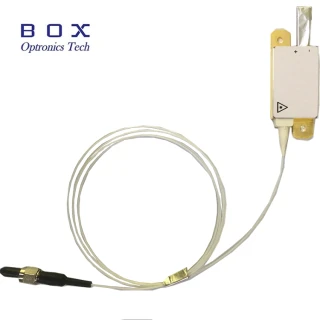
PhotonTec Berlin GmbH extends its 878.6nm wavelength-stabilized diode lasers to a higher power of 90W. This high-performance industrial laser diode is designed to meet the demanding needs of advanced applications.
The diode laser has a very narrow spectral linewidth of 0.5nm in FWHM and is equipped with a fiber receptacle for 200 µm core diameter, a numerical aperture of 0.22 and SMA905 connector. This configuration provides quick fiber exchange and integration flexibility. Designed for efficiency, the laser diode boasts a slope efficiency of 9.0 W/A and a power conversion efficiency of 50%. It operates within a voltage range of 7.19 to 7.25 volts, with an operating current up to 12.5 A, making it a powerful yet energy-efficient choice for industrial applications. The device's threshold current is a mere 9.0 A, underscoring its efficiency and performance capabilities.
878.6nm 90 W Wavelength-Stabilized Fiber Coupled Diode Laser
Specifications
| Laser Type: | Continuous Wave (CW) |
|---|---|
| Fiber Type: | Multi-Mode |
| Wavelength: | 878.6 nm |
| Output Power: | 90000 mW |
| Fiber Core Diamater: | 200 um |
| Wavelength: | 878.6 nm |
| Fiber Core Diameter: | 200 µm |
| Numerical Aperture: | 0.22 |
| Fiber Connector: | SMA905 |
| Spectral Linewidth (FWHM): | 0.5 nm |
| Threshold Current: | 1.4 A |
| Operating Current: | 12.0 A |
| Operating Voltage: | 16.0 V |
| Slope Efficiency: | 9.0 W/A |
| Power Conversion Efficiency: | 50% |
| Operating Temperature (baseplate): | 20 - 30°C |
Got questions about specs? Use the inquiry form to ask.
 Download Data Sheet

Features
- High-Power 878.6 nm Laser Diode Module (90 W) – Delivers up to 90 W of optical output at a tightly specified central wavelength of 878.6 ± 0.5 nm, ideal for demanding industrial, pumping, and materials processing applications.
- Narrow Spectral Width (0.5 nm FWHM) – Optimized emission spectrum with 0.5 nm full-width at half-maximum for efficient coupling into wavelength-sensitive systems such as solid-state laser pumping and precision heating.
- High Power Conversion Efficiency (Up to 50%) – Typical electrical-to-optical efficiency of 48–50% reduces power consumption and thermal load, minimizing cooling requirements and operating costs.
- Excellent Electro-Optical Performance – Low threshold current of 1.4 A and high slope efficiency of 9 W/A enable stable power scaling and efficient operation across the specified current range (up to 12.5 A).
- 200 µm / 0.22 NA Fiber-Coupled Output – Robust multimode fiber delivery with 200 µm core diameter and 0.22 numerical aperture, terminated in a standard SMA905 connector for easy integration into existing fiber-based setups.
- Stable Wavelength vs. Temperature and Current – Controlled tuning behavior with a wavelength temperature coefficient of 0.02 nm/°C and current coefficient of 0.05 nm/A, supporting reliable wavelength management in thermally regulated systems.
- Industrial-Grade Operating Conditions – Designed for a baseplate operating temperature range of 20 – 30 °C and storage from -20 to +80 °C, suitable for OEM integration in industrial environments with humidity < 75%.
- Integrated Photodiode and Thermistor Interfaces – Electrical pinout includes laser diode anode/cathode, photodiode anode/cathode, and thermistor connections to support active power monitoring and temperature control in closed-loop driver systems.
- OEM-Ready Diode Module – Supplied as an OEM industrial laser diode subassembly intended for integration into higher-level equipment, giving system designers maximum flexibility in mechanical, optical, and safety design.
- Ideal for Pumping and Thermal Processing Applications – 878 nm band wavelength and high power output are well suited for Nd-doped laser pumping (e.g., Nd:YVO4, Nd:YAG), annealing, soldering, plastics welding, and other high-intensity near-IR applications.
- Compact, Fiber-Delivered Architecture – Fiber coupling with standardized SMA905 interface simplifies beam delivery over distance, facilitates routing in tight spaces, and supports modular system architectures.
- Compatible with Advanced Laser Drivers – Electrical characteristics (16 V operating voltage, up to 12.5 A drive current) match commercially available high-current diode laser drivers and TEC controllers for straightforward system integration.
Applications
- Fiber Laser Pumping (Near‑IR) – Primary pump source for Yb‑doped fiber lasers and amplifiers requiring high-brightness 878 nm to 980 nm pumping in industrial, medical, and scientific systems.
- Solid‑State Laser Pumping – Efficient pumping of Nd:YVO4, Nd:YAG, and other neodymium‑doped crystals tuned near 880 nm for quasi‑three‑level operation and improved efficiency.
- DPSS Laser Modules & OEM Laser Engines – Integration into diode‑pumped solid‑state (DPSS) laser heads for compact OEM modules used in instrumentation and material processing.
- Industrial Material Processing – Energy source for systems used in plastics welding, soldering, thin‑film processing, surface annealing, and sintering of functional materials where near‑IR absorption is high.
- Polymer and Plastic Welding Systems – Pump laser for 9xx‑nm industrial lasers used in through‑transmission welding (TTW) and contour welding of engineering plastics in automotive, consumer electronics, and medical disposables.
- Metal Marking & Micro‑Machining (Pump Stage) – Pump diode for high‑peak‑power pulsed fiber or DPSS lasers deployed in precision marking, engraving, and micro‑drilling of metals and alloys.
- Laser Additive Manufacturing (AM) – Integration into pump modules for fiber or DPSS lasers used in selective laser sintering (SLS), selective laser melting (SLM), and direct metal printing platforms.
- LiDAR and Ranging Pump Source – Pump laser for 9xx‑nm and eye‑safe 1 µm / 1.5 µm pulsed fiber or solid‑state lasers used in long‑range LiDAR, time‑of‑flight metrology, and 3D mapping.
- Optical Test and Measurement Equipment – High‑power near‑IR source for characterizing optical fibers, fiber components, isolators, combiners, and optical coatings in R&D and production testing.
- Spectroscopy and Pump–Probe Experiments – Excitation source or pump for near‑infrared absorption, fluorescence, and time‑resolved spectroscopy in physics, chemistry, and material science.
- Nonlinear Frequency Conversion (Pump) – Pump laser for generating visible or mid‑IR radiation via OPO, OPA, and other nonlinear conversion schemes using 1 µm class lasers.
- Medical and Aesthetic Laser Platforms (Pump Diode) – OEM pump diode for 1 µm class medical lasers used in photocoagulation, dermatology, surgical cutting, dentistry, and aesthetic treatments.
- Scientific Research Lasers – Integration into laboratory fiber or bulk lasers requiring a narrow‑band, stabilized 878 nm pump for quantum optics, atom cooling pump stages, and precision measurement setups.
- IR Illumination Modules (Indirect) – Pump source for high‑brightness near‑IR lasers used in illumination and active imaging for machine vision, security, and industrial inspection.
- High‑Power Fiber Delivery Systems – SMA905‑coupled 200 µm / 0.22 NA output enables easy integration into fiber‑delivered laser tools, robotic workstations, and end‑effectors for automated processing.
- OEM Laser Subassemblies – Building block for multi‑diode pump modules, laser racks, and custom OEM engines requiring robust, high‑efficiency operation in the 878 nm band.
- Burn‑In and Reliability Testing Rigs – Use as a representative high‑power pump source in reliability, lifetime, and environmental testing of optical components, fibers, and cooling concepts.
- Defense and Aerospace Laser Systems (Pump Stage) – Pump diode for ruggedized fiber and solid‑state lasers deployed in target designation, range‑finding, directed energy research, and countermeasure prototyping.
- Seed and Master Oscillator Power Amplifier (MOPA) Pumping – Pump stage for high‑gain fiber amplifiers in MOPA architectures requiring stable, high‑brightness 878 nm pumping.
- Thermo‑Optic and Thermal Management Research – Controlled high‑power near‑IR input for studying thermal lensing, heat loading, and cooling strategies in gain media and photonic devices.
Frequently Asked Questions
What is the PhotonTec Berlin M878.6±0.5-90-D200/22-C5-P 878 nm fiber‑coupled laser diode and what are its key specifications?
What are common applications of a 90 W, 878 nm fiber‑coupled laser with 200 µm SMA905 output?
How does the wavelength stability of this 878 nm laser diode depend on temperature and drive current?
What cooling and thermal management are required for reliable operation of the M878.6±0.5-90-D200/22-C5-P laser module?
How should the M878.6±0.5-90-D200/22-C5-P laser diode be driven and protected electrically?
Is the PhotonTec Berlin M878.6±0.5-90-D200/22-C5-P laser module IEC/CDRH certified, and can it be used as a stand‑alone laser source?
What fiber interface does this 878 nm laser module use and how does it compare to similar fiber‑coupled diode lasers?
Got more questions? Use the inquiry form to ask the supplier directly.
Similar Products



Your inquiry has been received.
Create an account by adding a password
Why create an account?
- Auto-complete inquiry forms
- View and manage all your past messages
- Save products to your favorites
- Close your account anytime — no hassle