


Description
The 1.0 µm single-mode continuous-wave (CW) fiber lasers of the VFLS-1064-B VENUS Series are advanced Yb-doped laser sources designed to deliver stable, high-brightness output for demanding laboratory and industrial environments. Built around an all-fiber architecture with double-clad fiber pumping technology, these lasers achieve output powers up to 20 W while maintaining near diffraction-limited beam quality (M² < 1.2). This combination of power, beam purity, and reliability makes them particularly suitable for precision experiments and high-resolution optical setups where beam quality is critical.
Operating in the 1.0 µm band with a center wavelength around 1064 nm, this laser platform offers a narrow spectral width and excellent signal-to-noise performance comparable to other high-end 1064 nm CW fiber lasers on the market. The single-mode output ensures a clean Gaussian beam profile that is ideal for tight focusing, efficient coupling into downstream optics, and consistent performance in interferometry or nonlinear optics. For applications requiring defined polarization states, a polarization-maintaining (PM) output option is available, supporting experiments that depend on stable polarization such as high-precision spectroscopy and polarization-sensitive measurements.
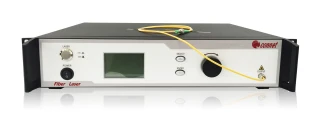
The VFLS-1064-B integrates a microprocessor-based control system for precise and repeatable operation. The front-panel LCD interface provides real-time readout of output power and internal temperature, helping users monitor the laser status at a glance. Built-in diagnostic and warning functions enhance operational safety and protect the laser from abnormal conditions. Power can be adjusted over a wide range (typically from 10% to 100% of rated output), enabling fine control of optical intensity for sensitive test and measurement tasks, photonics component characterization, and calibration routines.
Designed with long-term stability and low maintenance in mind, the laser exhibits excellent power stability over both short (15 minutes) and extended (8 hours) operating periods once thermal equilibrium is reached. This level of stability is comparable to other premium 1 µm CW fiber laser systems used in metrology and precision optics laboratories, minimizing drift and reducing the need for frequent recalibration. Integrated optical isolation and low return-loss tolerance further protect the internal cavity from back reflections, which can be especially important when the laser is coupled to external optics, fibers, or reflective samples.
The standard configuration is a benchtop unit with collimated free-space output, making it straightforward to integrate into optical tables and experimental setups. The output is delivered via a large mode area 10/125 µm gain fiber, with a typical output fiber length of at least 1 m to facilitate flexible routing in the lab. Alternative output options are available on request to match specific system architectures or coupling requirements. The compact housing, combined with universal AC input and robust thermal management, allows the system to operate reliably over a typical laboratory temperature range while maintaining consistent optical performance.
With its combination of high output power, excellent beam quality, and turnkey operation, the VFLS-1064-B 1.0 µm single-mode CW fiber laser is well suited to a broad spectrum of applications. These include test and measurement of photonic devices, scientific research in atomic and molecular physics, spectroscopy and absorption measurements, nonlinear frequency conversion experiments, optical trapping, and general-purpose laboratory use. Its performance parameters and user-friendly design place it in the same class as other state-of-the-art 1064 nm CW fiber lasers used in leading research institutions and advanced photonics laboratories worldwide.
1.0um Single-Mode CW Fiber Laser
Specifications
| Center Wavelength: | 1064 nm |
|---|---|
| Output Power: | 20 W |
| Beam Quality (M^2): | 1.2 |
| Spectral Linewidth: | 1 nm |
| Output Power Stability: | 0.4% ~ 0.5% |
| Output Fiber Type: | Other / Non-specified |
| Output Fiber Length: | 1 m |
| Interface: | Other / Not-specified |
| Electrical Requirements: | 220V - 50Hz |
| Part No.: | VFLS-1064-B |
| Center Wavelength: | 1060–1080 nm (typ. 1064 nm) |
| Output Power (min): | 1 W |
| Output Power (max): | 20 W |
| Output Power Adjustment Range: | 10–100 % |
| Spectral Width (FWHM): | < 1.2 nm |
| SMSR: | ≥ 35 dB |
| Beam Quality M² (typ): | ≤ 1.2 |
| Operation Mode: | CW |
| Output Polarization: | Random (PM optional) |
| Stability Of Output Power (15 Min): | ±0.5 % |
| Stability Of Output Power (8 H): | ±1 % |
| Output Isolation: | ≥ 35 dB |
| Return Loss: | ≥ 40 dB |
| Operating Temperature: | 0 to +40 °C |
| Storage Temperature: | -40 to +85 °C |
| Operating Voltage: | 170–260 VAC |
| Output Fiber Type: | LMA-GDF-10/125 |
| Length Of Output Fiber: | > 1 m |
| Output Mode: | Collimating output (other options available) |
| Dimension: | 420(L) × 485(W) × 105(H) mm |
| Typical Output Powers: | 1 W, 2 W, 5 W, 10 W, 20 W |
Got questions about specs? Use the inquiry form to ask.
 Download Data Sheet

Features
- High Output Power up to 20 W – Delivers continuous-wave (CW) output up to 20 W at 1.0 µm, ideal for demanding laboratory and industrial test environments.
- Single-Mode Beam with Near Diffraction-Limited Quality – True single-mode output (M² < 1.2) ensures excellent beam quality for precise focusing, high spatial resolution, and efficient coupling into optical systems.
- Stable 1064 nm Center Wavelength – Yb-doped fiber design provides a typical center wavelength of 1064 nm (1060–1080 nm range), widely used in spectroscopy, nonlinear optics, and general photonics research.
- All-Fiber, Highly Integrated Design – Integrated all-fiber architecture with double-clad fiber pumping for robust, alignment-free operation, high reliability, and reduced maintenance.
- Excellent Power Stability – Optimized control electronics and thermal management provide high stability over both short (15 min) and long (8 h) timescales, supporting accurate and repeatable measurements.
- Low Linewidth and Narrow Spectral Width (on request) – Spectral width < 1 nm (FWHM) typical; narrower linewidth options available for applications such as high-resolution spectroscopy and coherent experiments.
- Random or Polarization-Maintaining Output – Standard random polarization with optional PM fiber output for polarization-sensitive setups, interferometry, and nonlinear optics.
- High Optical Isolation and Low Back-Reflection Sensitivity – Integrated output isolation and high return loss improve stability and protect internal components from back-reflected light.
- Microprocessor-Based Intelligent Control – Embedded control system ensures long lifetime and reliable performance, monitoring key parameters and managing laser operation in real time.
- Front-Panel LCD Status Display – Clear LCD interface displays output power, temperature, and operating status, and provides warning messages for safe and intuitive operation.
- Adjustable Output Power (10–100%) – Wide output power adjustment range enables fine control of power levels for sensitive experiments or device characterization.
- Collimated Free-Space Output (Fiber-Coupled Options Available) – Standard collimated output for easy beam handling; other output configurations available upon request for system integration.
- LMA-GDF-10/125 Output Fiber – Large-mode-area, double-clad gain fiber supports high power handling with preserved single-mode beam quality.
- Compact Benchtop Form Factor – 420 (L) × 485 (W) × 105 (H) mm bench-top housing suitable for optical tables and lab environments.
- Modular / OEM Configurations Available – Optional modularized packages for integration into larger systems, instruments, and OEM platforms.
- Wide Operating Voltage and Temperature Range – Operates from standard AC mains with a broad operating temperature range, supporting continuous use in typical laboratory conditions.
- Maintenance-Free, Long-Lifetime Operation – Solid-state Yb-doped fiber architecture with no moving parts offers high reliability, low maintenance, and long service life compared with bulk solid-state lasers.
- Safe and User-Friendly Operation – Interlocks, status alarms, and clear front-panel controls support safe use by students, researchers, and engineers.
- Versatile Lab and R&D Applications – Well suited for test and measurement, scientific research, spectroscopy, device testing, nonlinear optics, laser seeding, and general-purpose laboratory experiments.
Applications
- Precision Test and Measurement
Ideal for use as a stable 1064 nm light source in optical test benches, component characterization, and performance verification of photonic devices such as isolators, couplers, wavelength division multiplexers, and optical amplifiers. - Scientific Research & Fundamental Physics
Widely used in university and institute laboratories for experiments in laser physics, nonlinear optics, quantum optics, atom trapping and cooling (near 1 µm transitions), and development of new fiber laser and amplifier architectures. - Spectroscopy & Metrology
Suited for high‑resolution spectroscopy, absorption and reflection measurements, optical frequency metrology, and characterization of materials and thin films at 1.0 µm. - Optical Pump Source
Serves as a pump laser for solid‑state and fiber lasers (e.g., OPOs, Raman lasers, mid‑IR conversion stages), as well as for optical parametric generation and frequency conversion systems. - Nonlinear Optics & Frequency Conversion
High‑brightness, near diffraction‑limited 1064 nm output is well suited for second‑harmonic generation (532 nm), sum‑/difference‑frequency generation, supercontinuum generation, and other nonlinear optical experiments. - Interferometry & Holography
Single‑mode, low‑noise CW output supports interferometric measurements, holographic recording, and precision alignment systems requiring high spatial coherence and stable power. - Optical Sensing & Fiber Sensing Systems
Used as a light source for fiber Bragg grating (FBG) interrogation, distributed sensing (DTS/DAS/DSS), and other fiber‑optic sensor systems that benefit from a stable, narrowband 1.0 µm laser. - Microscopy & Bio‑Photonics
Applicable as an excitation source for certain nonlinear and multiphoton microscopy schemes, optical trapping, and bio‑imaging techniques where 1.0 µm radiation is preferred for deeper penetration and reduced photodamage. - Material Characterization & Thin‑Film Studies
Enables precise evaluation of optical coatings, bulk materials, photonic crystals, and waveguides at 1.0 µm through transmission, reflection, and scattering measurements. - Laser Seeding & Injection Locking
Can be used as a master oscillator or seed laser for high‑power fiber or solid‑state amplifiers, improving beam quality and spectral characteristics in MOPA configurations. - Educational Laboratories & Training
Well suited for advanced teaching laboratories focusing on laser operation principles, fiber optics, optical communication fundamentals, and hands‑on training with high‑power CW fiber lasers. - Optical Communication Research
Supports experimentation in free‑space optical links, short‑reach fiber transmission, wavelength conversion, and evaluation of components and subsystems operating around the 1.0 µm band. - Prototype Development & System Integration
Thanks to its compact benchtop and modularized configurations, it is an excellent engine for OEM and custom systems requiring a robust, alignment‑free 1.0 µm CW source. - General Laboratory Illumination Source
Serves as a reliable, maintenance‑free CW illumination source for alignment, calibration, and general optical lab applications that require stable, single‑mode 1.0 µm radiation up to 20 W.
Frequently Asked Questions
What is the Connet VFLS-1064-B 1.0 µm single‑mode CW fiber laser and what are its key specifications?
What are the typical applications of a 1064 nm single‑mode CW fiber laser like the Connet VFLS-1064-B?
How is the output power controlled and how stable is the 1064 nm laser output?
What is the beam quality and polarization state of the VFLS-1064-B fiber laser?
What electrical, thermal, and environmental conditions are required to operate this 1064 nm CW fiber laser?
How do I choose the right output power and spectral width for my application?
How do I order and integrate the Connet 1.0 µm CW fiber laser into my lab setup?
Got more questions? Use the inquiry form to ask the supplier directly.
Similar Products



Your inquiry has been received.
Create an account by adding a password
Why create an account?
- Auto-complete inquiry forms
- View and manage all your past messages
- Save products to your favorites
- Close your account anytime — no hassle