
Description
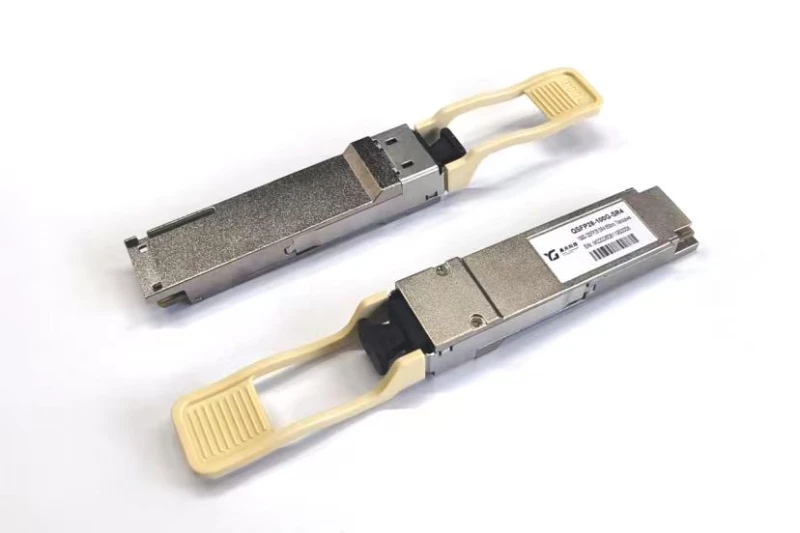
The OFQ212GD1C-F85 is a high‑performance 100G QSFP28 SR4 optical transceiver designed for short‑reach multimode fiber links inside modern data centers. Engineered around four parallel 25.78125 Gbps lanes over 850 nm VCSEL technology, it delivers an aggregate data rate of 100 Gbps in a compact, hot‑pluggable QSFP28 form factor. This module is fully compliant with the QSFP+ MSA specification and supports 100GBASE‑SR4 Ethernet applications, making it an ideal choice for top‑of‑rack, spine‑leaf, and aggregation switching environments where high density and low latency are critical.
Optimized for short‑range connectivity, the OFQ212GD1C-F85 supports link lengths of up to 70 m over OM3 multimode fiber and up to 100 m over OM4 multimode fiber. Each of its four transmit lanes operates in the 840–860 nm window with a typical center wavelength of 850 nm and narrow RMS spectral width for stable and predictable optical performance. The transmitter offers average launch power per lane from –8.4 dBm to 2.4 dBm and an extinction ratio of at least 3 dB, helping maintain clear signal separation and reliable operation in dense data center environments with parallel fiber infrastructures.
On the receive side, the module is designed to handle demanding 100G traffic profiles while maintaining robust link integrity. Each receive lane supports input average power from –10.3 dBm up to 2.4 dBm with a damage threshold of 3.4 dBm, providing headroom against potential over‑power conditions. Receiver sensitivity of –7.2 dBm (OMA) at a BER of 5 × 10⁻⁵ allows the transceiver to perform reliably within its specified reach budget. Optical return loss and receiver reflectance are tightly controlled, enhancing signal quality and minimizing penalty due to reflections in high‑density patching environments commonly found in large data centers.
The OFQ212GD1C-F85 is built to operate in real‑world data center conditions, with a recommended case temperature range of 0 °C to 70 °C and a supply voltage of 3.135 V to 3.465 V. Typical power consumption is kept to 3.5 W, which aligns with widely used QSFP28 SR4 modules and helps control rack‑level power budgets and cooling requirements. This efficient thermal and power profile makes it suitable for high‑port‑count switches and routers where careful power planning is essential for scalability.
Leveraging a standard 100 Ω differential CML electrical interface on each lane, the transceiver integrates seamlessly with current 100G switch and router ASICs. The module supports a two‑wire serial management interface (SCL/SDA) with LVTTL/LVCMOS logic, allowing access to digital diagnostics and configuration parameters through standard MSA‑defined registers. Functions such as module select, reset, and loss‑of‑signal (LOS) detection are implemented using familiar control and status pins, simplifying deployment, remote monitoring, and maintenance across large network fabrics.
Mechanically, the OFQ212GD1C-F85 conforms to the QSFP28 MSA outline, ensuring compatibility with standard QSFP28 cages and connectors used in switches, servers, and storage platforms. Hot‑pluggability enables quick installation, replacement, and upgrades without system downtime, while the robust design supports the environmental and reliability requirements of high‑availability data centers. With its combination of standards compliance, proven 850 nm VCSEL technology, and optimized short‑reach performance, this 100G QSFP28 SR4 transceiver is a dependable solution for upgrading 10G or 40G infrastructures to 100G and building high‑bandwidth, low‑latency spine and leaf architectures.
Typical use cases for the OFQ212GD1C-F85 include data center backbone links, high‑density 100G switch‑to‑switch interconnects, and server aggregation links over parallel multimode fiber trunks. By leveraging existing OM3/OM4 cabling up to 100 m, operators can achieve significant bandwidth scaling with minimal re‑cabling, reducing both deployment cost and complexity. This positions the module as a practical building block for scalable cloud, enterprise, and high‑performance computing networks that demand cost‑effective, short‑reach 100G connectivity.
100G QSFP28 100m SR4 Optical Transceiver Module
Specifications
| Signaling Rate Per Lane (Transmitter): | 25.78125 Gb/s |
|---|---|
| Signaling Rate Per Lane (Receiver): | 25.78125 Gb/s |
| Lane Center Wavelength: | 850 nm |
| Form Factor: | QSFP28 |
| Number Of Lanes: | 4 |
| Aggregate Data Rate: | 100 Gbps |
| Transmission Distance (OM3 MMF): | 70 m |
| Transmission Distance (OM4 MMF): | 100 m |
| Operating Temperature Range: | 0 °C to 70 °C |
| Storage Temperature Range: | -40 °C to +85 °C |
| Relative Humidity Range: | 0% to 85% |
| Power Supply Voltage: | 3.135 V to 3.465 V |
| Nominal Power Supply Voltage: | 3.3 V |
| Power Consumption: | 3.5 W |
| Supply Current: | 1050 mA |
| Supply Noise Rejection: | 100 mV |
| Receiver Differential Output Impedance: | 100 Ohm |
| Transmitter Center Wavelength: | 840 nm to 860 nm |
| Receiver Center Wavelength: | 840 nm to 860 nm |
| Nominal Center Wavelength: | 850 nm |
| RMS Spectral Width: | 0.6 nm |
| Average Launch Power Per Lane: | -8.4 dBm to 2.4 dBm |
| Transmitter OMA Per Lane: | -6.4 dBm to 3 dBm |
| Average Launch Power (OFF, Per Lane): | -30 dBm |
| Extinction Ratio: | 3 dB |
| Optical Return Loss Tolerance: | 12 dB |
| Receiver Damage Threshold: | 3.4 dBm |
| Average Receive Power Per Lane: | -10.3 dBm to 2.4 dBm |
| Receive Power Per Lane (OMA): | 3 dBm |
| Receiver Sensitivity (OMA): | -7.2 dBm |
| Receiver Sensitivity BER: | 5e-5 |
| Receiver Reflectance: | -12 dB |
| LOS Assert: | -30 dBm |
| LOS De-Assert: | -10.5 dBm |
| LOS Hysteresis: | 0.5 dB |
| Transmitter Type: | 850 nm VCSEL |
| Application Standard: | 100GBASE-SR4 |
| Receiver Supply Voltage (VccRx): | 3.3 V |
| Manufacturer Part Number (MPN): | LT-100G-Q28-SR4 |
| FindLight SKU: | FL-24863 |
Got questions about specs? Use the inquiry form to ask.
 Download Data Sheet

Features
- 100G QSFP28 SR4 Optical Transceiver – Hot‑pluggable 4‑lane QSFP28 module supporting 4x25G links for an aggregate data rate of 100 Gbps over multimode fiber.
- Standards‑Compliant 100GBASE‑SR4 – Fully compliant with QSFP+ MSA / QSFP28 specifications and IEEE 802.3bm 100GBASE‑SR4, ensuring broad interoperability with major switch and router OEMs.
- Short‑Reach Multimode Fiber Connectivity – Optimized for up to 100 m over OM4 MMF (and up to 70 m over OM3), ideal for top‑of‑rack (ToR), end‑of‑row (EoR), and data center aggregation links.
- 850 nm VCSEL‑Based Transmitters – Uses four high‑reliability 850 nm VCSEL laser channels at 25.78125 Gbps each for cost‑effective, low‑power multimode connectivity.
- High‑Density 4‑Lane Parallel Optics – 4x25G architecture on both transmit and receive paths, enabling efficient breakout to 4x25G interfaces or high‑bandwidth 100G point‑to‑point links.
- Low Power Consumption & Energy Efficient – Typical power consumption ≤ 3.5 W, reducing heat load and enabling higher port density in power‑constrained data center environments.
- Wide Operating Case Temperature Range – Designed for reliable operation from 0°C to +70°C case temperature, suitable for modern air‑cooled data center racks.
- High‑Performance Optical Parameters – Average launch power per lane from -8.4 to +2.4 dBm, receiver sensitivity (OMA) down to -7.2 dBm, and extinction ratio ≥ 3 dB for robust 100G links.
- Excellent Signal Integrity – 100 Ω differential CML electrical interfaces on all high‑speed lanes and supply noise rejection up to 100 mV help maintain low BER and clean eye diagrams.
- Integrated Digital Diagnostics Monitoring (DDM/DMI) – 2‑wire (I²C) serial interface (SCL/SDA) compatible with QSFP MSA for real‑time monitoring of transmit power, receive power, temperature, voltage, and module status.
- Reliable Link Management – Built‑in LOS (Loss of Signal) detection with assert/de‑assert thresholds and hysteresis for stable link monitoring in high‑density networks.
- Hot‑Pluggable QSFP28 Form Factor – Front‑panel hot insertion and removal for simplified maintenance and upgrades without impacting adjacent ports.
- Low Latency, High Throughput – Optimized for 25.78125 Gbps per lane NRZ signaling, providing wire‑speed 100G Ethernet throughput for latency‑sensitive workloads.
- Data Center & Enterprise Applications – Ideal for data center backbone, spine‑leaf architectures, 100G Ethernet aggregation, HPC clusters, and cloud infrastructure requiring short‑reach 100G connectivity.
- Industry‑Standard MPO/MTP Interface – Parallel optics interface via 12‑fiber MPO/MTP connector (MMF) for easy deployment with existing high‑density cabling systems.
- Robust Environmental & Storage Specs – Storage temperature range from -40°C to +85°C and relative humidity from 0 to 85% non‑condensing for safe handling and long‑term inventory.
- Simple Module Control & Reset – Supports Module Select (ModSelL) and hardware Reset (ResetL) pins for straightforward integration into network equipment control planes.
- Optimized for High‑Port‑Density Switches – Compact QSFP28 footprint and low power make this module suitable for high‑radix 100G switches, routers, and line cards.
Applications
- 100GBASE‑SR4 100G Ethernet Links – Short‑reach 100G Ethernet connectivity over multimode fiber (OM3/OM4) in top‑of‑rack (ToR), end‑of‑row (EoR), and aggregation switches.
- Data Center Spine‑Leaf Architectures – High‑density 4x25G lanes enabling low‑latency spine‑leaf interconnects within modern cloud and enterprise data centers.
- Server‑to‑Switch Interconnects – 100G uplinks from high‑performance servers or NICs to ToR/leaf switches within 70 m (OM3) or 100 m (OM4).
- Switch‑to‑Switch Aggregation – Short‑reach 100G links between core and aggregation switches inside a data hall for backbone and cross‑connect applications.
- High‑Bandwidth Storage Networks – 100G connections for NVMe‑oF, iSCSI, and Fibre‑Channel‑over‑Ethernet (FCoE) storage fabrics inside data centers.
- Hyper‑Converged and Cloud Infrastructure – East‑west traffic acceleration between compute and storage clusters in public, private, and hybrid cloud environments.
- High‑Performance Computing (HPC) Clusters – Low‑latency 4x25G optical links for tightly coupled HPC, AI, and machine learning clusters requiring high throughput.
- Virtualization and Large‑Scale VM Mobility – Backbone bandwidth for vMotion, container orchestration, and virtual desktop infrastructure (VDI) within a campus or single data center.
- Enterprise Campus Data Center Backbone – 100G core links between enterprise data center rooms or IDFs/MDFs using existing OM3/OM4 cabling plant.
- Short‑Reach Metro / POP Interconnect – Intra‑facility and intra‑building 100G links within colocation sites, carrier hotels, or central offices over multimode fiber.
- Telecom & Edge Computing Nodes – High‑density 100G ports in edge data centers, 5G/FTTx aggregation points, and micro‑data centers with controlled environments.
- Cloud Exchange & Colocation Cross‑Connects – Short‑distance 100G interconnects between tenants, peering routers, and cloud on‑ramps inside colocation facilities.
- Backplane Replacement with Fiber – Replacing high‑speed copper backplanes with short optical jumpers for improved signal integrity at 25G/lane.
- Breakout to 4x25G Applications – 100G QSFP28 port break‑out into four 25G Ethernet links using MPO‑to‑LC harnesses for server, access, or storage fan‑out.
- Migration from 40G to 100G – Direct upgrade path for networks using SR4/MPO cabling infrastructure, leveraging existing multimode fiber for higher port speeds.
- Test, Measurement, and Lab Environments – 100G reference links for traffic generators, protocol analyzers, and compliance test benches requiring standards‑compliant QSFP28 SR4 optics.
- Disaster Recovery and Backup Links (Intra‑Campus) – High‑speed replication between storage arrays or clusters located in separate rooms or buildings within 100 m.
- Media, Broadcast, and Video Transport – 100G optical connectivity for uncompressed or lightly compressed 4K/8K video and real‑time media workflows over short distances.
- Big Data Analytics Platforms – High‑throughput connectivity between data lakes, compute clusters, and database farms in analytics, AI, and machine learning environments.
- Open Networking and White‑Box Switches – QSFP28 SR4 optics for disaggregated switching platforms (NOS‑agnostic) in software‑defined data centers.
Export & Trade Information
| ECCN: | 5A991 |
|---|---|
| HTS Code: | 8517.62.0090 |
| Estimated US Tariff: | 7.5% |
Frequently Asked Questions
What is the OFQ212GD1C-F85 100G QSFP28 SR4 transceiver and what applications is it designed for?
What fiber type, connector and maximum distance does this 100GBASE‑SR4 QSFP28 module support?
Is the OFQ212GD1C-F85 compatible with QSFP28 ports on common switches and routers?
What are the key optical and electrical performance specs for this 100G QSFP28 SR4 module?
What is the operating temperature range and reliability environment for this QSFP28 SR4 transceiver?
How much power does the OFQ212GD1C-F85 consume and are there any power supply requirements?
What interface signals and management features are available on this QSFP28 SR4 transceiver?
Got more questions? Use the inquiry form to ask the supplier directly.
Similar Products


Your inquiry has been received.
Create an account by adding a password
Why create an account?
- Auto-complete inquiry forms
- View and manage all your past messages
- Save products to your favorites
- Close your account anytime — no hassle