
Description
Mini 10 MHz–3 GHz Analog Wideband Transceiver Module – High‑Linearity RF over Fiber Link
The Mini 10 MHz–3 GHz Analog Wideband Transceiver Module from the ROF Series is a compact, low‑cost, high‑performance RF over fiber solution designed for demanding broadband applications. Engineered for excellent linearity and low noise, this analog optical transceiver pair enables transparent RF‑to‑optical and optical‑to‑RF conversion across a wide frequency range. With support from 10 MHz up to 3 GHz, it is well suited for modern wireless infrastructure, satellite ground systems, distributed antenna systems (DAS), and other high‑dynamic‑range RF distribution scenarios where conventional coaxial transmission is limited by loss, interference, or distance.
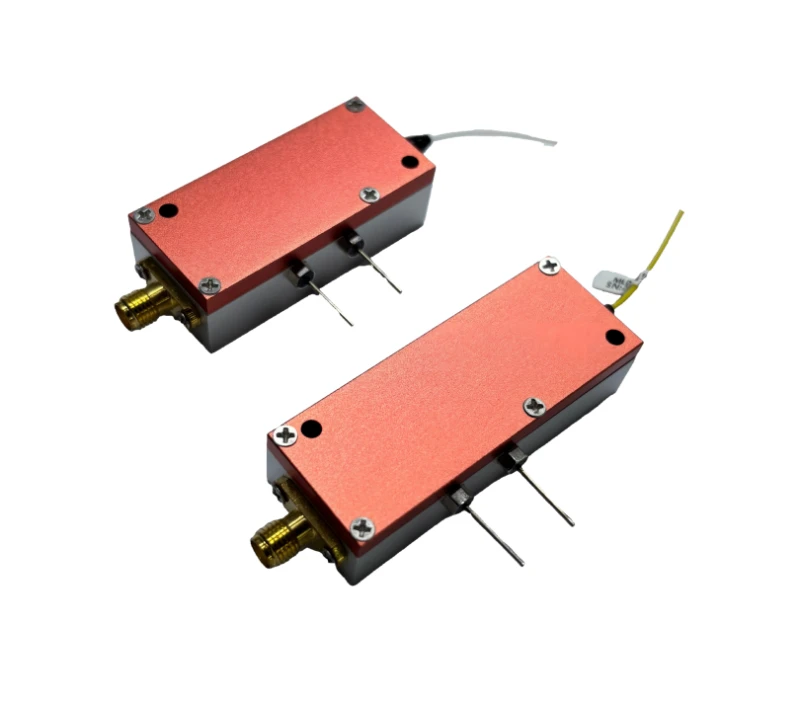
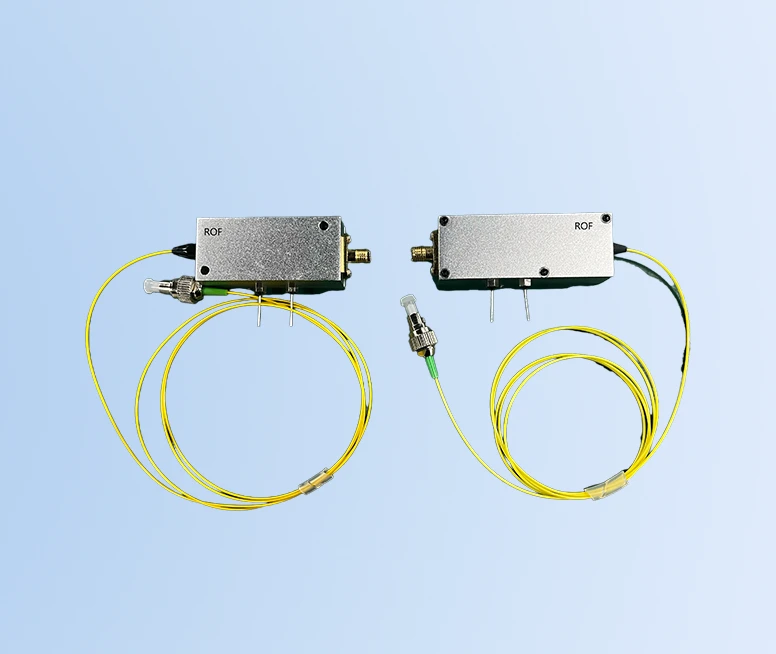
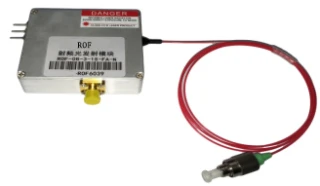
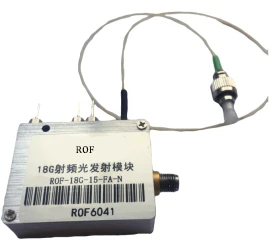
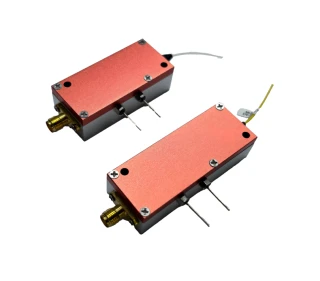
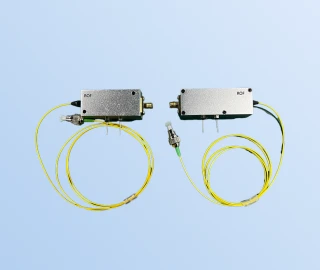
Each link consists of a compact transmitting module and a matching receiving module housed in tight cast metal enclosures that provide robust EMI shielding and mechanical stability. The RF interface uses standard 50 Ω SMA connectors for straightforward integration with existing RF systems, test equipment, and instrumentation. On the optical side, the modules are built around single‑mode fiber (9/125 µm) operation at 1310 nm or 1550 nm, with FC/APC connectors specified to minimize back reflection and maintain signal integrity. This architecture mirrors high‑end RF over fiber products used in professional telecom and satcom networks, while offering a smaller footprint and cost‑effective deployment.
The optical transmitter employs a linear, optically isolated FP or DFB laser, available at 1.3 µm and/or 1.5 µm, enabling flexible wavelength planning and compatibility with common telecom windows. At the receive end, a high‑performance InGaAs photodiode converts the optical signal back to RF with a flat frequency response from 10 MHz up to 3 GHz. Across this entire band, the module maintains a typical gain of 0–2 dB and a frequency flatness of approximately ±1.5 dB, which is comparable to other professional‑grade analog RF over fiber links on the market. The system is designed for a typical RF input range of −15 dBm to −5 dBm, with a 50 Ω impedance match and controlled VSWR to ensure minimal reflections and stable performance.
A key differentiator of this module is its high spurious‑free dynamic range (SFDR), supported by a 1 GHz input third‑order intercept point (IIP3) around 33 dBm. This high linearity allows the link to carry complex multi‑carrier, high‑crest‑factor signals such as those used in WiMAX, 4G LTE, and multi‑band repeaters without significant intermodulation distortion. As a result, the Mini 10 MHz–3 GHz module can be used in environments where clean analog transport is essential, including multi‑channel base station backhaul, satellite earth station IF distribution, and broadband RF monitoring systems. Temperature‑induced gain variation is tightly controlled, with typical gain drift of only about ±1.5 dB over the operating temperature range, helping maintain consistent link budgets in outdoor or industrial installations.
Designed with system integration in mind, the module operates from a single 5 V DC supply (4.5–5.5 V allowable range) and draws a modest total current of about 100 mA, making it suitable for space‑constrained or remote deployments where power is limited. The laser output power is typically 2–4 mW, and the receiver can safely handle up to 4 mW of optical input, simplifying optical power budgeting in point‑to‑point and short‑haul distribution networks. Environmental robustness is ensured with an operating temperature range from −25 °C to +65 °C and storage from −40 °C to +85 °C, aligning with conditions encountered in telecom shelters, shipborne systems, and outdoor RF enclosures.
The Mini 10 MHz–3 GHz Analog Wideband Transceiver Module is available in different configurations to match specific application requirements. Users can select FP or DFB laser types (with or without temperature control), 1310 nm or 1550 nm operating wavelengths, and two modulation bandwidth options: 10–1200 MHz for L‑band and sub‑GHz applications, or 10–3000 MHz for full broadband coverage. The module encapsulation is optimized for integration as a board‑level or enclosure‑mounted component, and the standard FC/APC optical connector can be replaced with user‑specified interfaces when required. These configuration options make the ROF Series a versatile platform comparable to other professional RF over fiber modules used in cellular, satellite, and defense communication systems.
Mini 10MHz to 3GHz Analog Wideband RF Fiber Optic Transceiver Module
Specifications
| Signaling Rate Per Lane (Transmitter): | Not Specified |
|---|---|
| Signaling Rate Per Lane (Receiver): | Not Specified |
| Lane Center Wavelength: | 1550 nm |
| Bandwidth: | 10 MHz to 1.2 GHz or 10 MHz to 3 GHz |
| Supply Voltage: | 4.5–5.5 V |
| Typical Supply Voltage: | 5 V |
| Supply Current (total): | 100 mA |
| Laser Output Power: | 2–4 mW |
| Transmitter Operating Wavelength: | 1310/1550 nm |
| Receiver Operating Wavelength: | 1310/1550 nm |
| High Frequency Cut-off (HFC): | 3000 MHz |
| Low Frequency Cutoff (LFC: | 10 MHz |
| Frequency Response (10 MHz–3 GHz): | ±1.5 to ±2 dB |
| Input RF Power: | -15 to -5 dBm |
| Input/Output Impedance (Z): | 50 Ohms |
| Input/Output VSWR (10–3000 MHz): | 2:1 to 2.5:1 |
| RF Link Gain: | 0–4 dB (typical 2 dB) |
| IIP3 @ 1 GHz: | 33 dBm |
| Gain Variation With Temperature: | ±1.5 dB |
| Storage Temperature (TS): | -40 to 85 ℃ |
| Operating Temperature (TO): | -25 to 65 ℃ |
| DC Supply Voltage (VDP): | 4.5–5.5 V |
| Maximum RF Input (Tx): | 15 dBm |
| Maximum Optical Input (Rx): | 4 mW |
| Optical Fiber Type: | 9/125 μm single-mode |
| Operating Wavelengths (general): | 1.3 μm or 1.5 μm |
| Optical Connector: | FC/APC |
| RF Connector: | 50 Ω SMA |
| Series/model Family: | ROF Series Mini analog broadband optical transceiver module |
| Modulation Bandwidth Option 01: | 10–1200 MHz |
| Modulation Bandwidth Option 02: | 10–3000 MHz |
Got questions about specs? Use the inquiry form to ask.
 Download Data Sheet

Features
- Ultra-Wideband RF Coverage (10 MHz – 3 GHz)
Supports broadband RF over fiber transmission from 10 MHz up to 3 GHz (or 10 MHz – 1.2 GHz option), ideal for multi-standard wireless, satellite, and RF distribution systems. - High Spurious-Free Dynamic Range (SFDR)
Engineered for low distortion and high linearity, delivering superior SFDR for clean, high-fidelity analog signal transport over fiber in demanding RF applications. - Flat Frequency Response
Typical frequency response of ±1.5 dB (max ±2 dB) from 10 MHz to 3 GHz ensures consistent gain and minimal amplitude ripple across the full operating band. - Compact Mini Transceiver Module
Miniature “ROF Series” module form factor allows easy integration into space-constrained headends, remote radio units, repeater systems, and test setups. - Robust Metal Housing
Tight cast metal case provides mechanical robustness, excellent shielding against EMI/RFI, and improved thermal stability for long-term reliable operation. - High-Performance Optical Components
Uses a high-sensitivity InGaAs photodiode in the receiver and a linear, optically isolated FP/DFB laser in the transmitter for low noise, high linearity RF-over-fiber links. - Dual Telecom-Grade Wavelength Options (1310 / 1550 nm)
Available at 1310 nm and 1550 nm operating wavelengths for compatibility with standard single-mode fiber infrastructure in indoor and outdoor deployments. - Single-Mode Fiber Operation
Optimized for 9/125 μm single-mode fiber, enabling long-distance, low-loss RF signal transport for centralized radio and distributed antenna systems. - Standard FC/APC Optical Interface
Uses FC/APC connectors as standard to minimize back reflection and ensure stable, low-noise optical coupling in precision RF applications. - 50 Ω SMA RF Interfaces
RF input and output via standard 50 Ω SMA connectors provide easy connection to radios, repeaters, analyzers, and other RF front-end equipment. - Optimized RF Input Power Range
Wide input RF power handling from -15 dBm to -5 dBm with a maximum RF input of 15 dBm (Tx), supporting a broad variety of signal levels without additional conditioning. - Balanced RF Link Gain
Typical RF link gain of 2 dB (0–4 dB range) helps compensate for path losses while maintaining excellent linearity and flatness across the band. - Excellent Linearity and IIP3 Performance
Input third-order intercept point (IIP3) of about 33 dBm at 1 GHz supports multi-carrier and high-density modulation formats with reduced intermodulation distortion. - Low VSWR for Better Matching
Input/output VSWR typically better than 2:1 (max 2.5:1 from 10 MHz to 3 GHz), minimizing reflections and standing waves in broadband RF chains. - Low Power Consumption, Single 5 V Supply
Operates from a 4.5 V to 5.5 V supply, with typical current of 100 mA, simplifying power design and integration into existing systems. - Wide Operating Temperature Range
Designed for -25 °C to +65 °C operating temperature and -40 °C to +85 °C storage, suitable for controlled indoor racks as well as harsher field environments. - Stable Gain over Temperature
Gain variation limited to approximately ±1.5 dB over the operating temperature range, ensuring predictable RF link performance in changing climates. - High Optical Power Handling (Rx)
Receiver input supports up to 4 mW optical power, providing margin for higher link budgets and longer fiber runs without performance degradation. - Laser Options with and without Temperature Control
Offered with TO (without TEC) or DFB (with temperature control) laser options to balance cost, performance, and temperature stability requirements. - Flexible Bandwidth Configurations
Configurable modulation bandwidth options, including 10–1200 MHz and 10–3000 MHz versions, to match specific system bandwidth and cost targets. - Multiple Connector & Packaging Choices
Available as module type (M) with standard FC/APC (FA) connectors or user-specified (SP) options to align with custom mechanical and interface needs. - Ideal for Wireless & RF-over-Fiber Systems
Suited for WiMAX, 4G LTE, 2G/3G repeaters, DAS, small cell backhaul, satellite earth stations, and shipborne RF distribution, replacing long lossy coax with low-loss fiber.
Applications
- Wireless Communication Infrastructure
Ideal for transporting RF signals over fiber in:- 4G LTE, 5G NR, and WiMAX RF-over-Fiber (RFoF) links
- 2G/3G macrocell and microcell repeater systems
- Distributed Antenna Systems (DAS) in buildings, tunnels, stadiums, and campuses
- Remote Radio Head (RRH) and Centralized/Cloud RAN (C‑RAN) fronthaul RF transport
- RF-over-Fiber for Satcom and Ground Stations
Suitable for low-loss, low-distortion RF transmission in:- Satellite earth station uplink and downlink RF distribution
- Gateway and teleport RF-to-fiber interface (L‑band, IF, and extended IF)
- VSAT hub and remote terminal RF transport
- GNSS/GPS repeater and distribution over optical fiber
- Shipborne and Marine RF Distribution
Designed for harsh and confined marine environments:- Shipborne radio frequency distribution networks
- Naval communication system RF extension via fiber
- Onboard radar, AIS, and VHF/UHF radio signal routing over long distances
- Offshore platform communication links and monitoring
- Remote Antenna and Repeater Systems
Enables flexible placement of RF equipment:- Remote antenna units (RAUs) for cellular and private wireless networks
- Analog repeater and booster systems for coverage extension
- Public safety, TETRA, and mission-critical communication coverage distribution
- Mountain, tunnel, and underground RF coverage extension
- Broadcast and Media Distribution
Supports high-fidelity analog RF transport for:- FM, DAB, and digital TV (DTV) transmitter feeding over fiber
- Studio-to-transmitter links (STL) in broadcast facilities
- RF signal routing in large venues, campuses, and media production centers
- IF and RF monitoring links in broadcast headends
- Test, Measurement, and Monitoring
Useful in laboratory, production, and field environments:- Remote RF signal monitoring and analysis via optical fiber
- Extension of RF test ports for spectrum analyzers and signal generators
- Anechoic chamber and EMC/EMI test range RF-over-fiber links
- Phase noise, intermodulation, and linearity testing requiring high SFDR
- Radar, EW, and Defense RF Links
High dynamic range and wide bandwidth support:- Remote radar receiver and transmitter front-end placement
- Electronic warfare (EW) signal collection and distribution
- Phased array antenna RF transport over fiber
- Secure, low-loss RF links between shelters and antenna farms
- Industrial, Scientific, and Medical (ISM) Applications
Covers common ISM and RF control bands:- 2.4 GHz and sub‑GHz ISM band RF-over-fiber links
- Particle accelerator and scientific instrumentation RF transport
- Medical imaging and RF-based diagnostic systems requiring remote electronics
- Industrial RF process monitoring and control over long distances
- Timing, Synchronization, and Reference Signal Distribution
Preserves signal integrity for:- 10 MHz reference signal distribution over fiber
- Clock and LO (local oscillator) distribution in large facilities
- Synchronization of base stations and remote RF equipment
- Phase-coherent RF link applications requiring stable amplitude and phase
- Building and Campus RF Networks
Simplifies RF infrastructure across large sites:- Campus-wide RF distribution for corporate, industrial, or educational facilities
- Hotels, airports, shopping malls, and hospitals in-building coverage
- Multi-building RF interconnects using existing fiber infrastructure
- Smart building and IoT gateway RF distribution via optical links
- Remote Sensing and Telemetry
Robust links for:- RF telemetry from remote sensors over long fiber runs
- Environmental, structural, and geophysical RF sensor networks
- Oil, gas, and energy sector monitoring sites with centralized processing
- Unmanned platform (UAV/UGV/USV) ground station RF transport
Frequently Asked Questions
What is the Mini 10MHz–3GHz Analog Wideband Transceiver Module and what does it do?
What are the key specifications and performance parameters of this RF over fiber module?
What are the operating and storage temperature ranges and environmental limits?
What fiber, optical connectors, and RF connectors does this module use?
How do I select the right model and interpret the ROF‑MINI ordering code?
What are common applications for this 10MHz–3GHz analog wideband transceiver compared to similar RF over fiber links?
How should I power and integrate the module into my RF system to avoid damage and ensure optimal performance?
Got more questions? Use the inquiry form to ask the supplier directly.
Similar Products


Your inquiry has been received.
Create an account by adding a password
Why create an account?
- Auto-complete inquiry forms
- View and manage all your past messages
- Save products to your favorites
- Close your account anytime — no hassle