


Description
Precision fiber optic coils are the core sensing element in modern fiber optic gyroscopes (FOGs), high‑precision delay lines, and interferometric sensors. By guiding two counter‑propagating light waves through a carefully engineered coil, these components exploit the Sagnac effect: a rotation‑induced phase difference that is directly proportional to the rotation rate experienced by the coil. The length of the fiber and the diameter of the coil are key design variables; increasing either parameter boosts the sensitivity and resolution of the gyroscope, making the coil design central to the overall performance of the inertial measurement unit or sensing platform.
These coils are typically manufactured from stress‑induced, high‑birefringence polarization‑maintaining (PM) single‑mode fiber to deliver superior stability and signal quality. In PM fiber, the optical power remains tightly aligned with one polarization axis, which dramatically reduces polarization fluctuations and signal fading compared with standard single‑mode coils. This is critical in FOGs and precision delay lines, where phase fidelity and low noise are essential. High coil symmetry and accurate layer‑to‑layer placement further enhance the repeatability and linearity of the sensor response, supporting tactical‑, navigation‑, and strategic‑grade performance levels found in advanced guidance, navigation, and timing systems.
A major limitation in high‑accuracy fiber coils is thermally induced bias drift, often referred to as the Shupe effect. This effect arises from time‑varying temperature gradients along the fiber length and can introduce long‑term bias errors if the coil is not properly engineered. To combat this, state‑of‑the‑art manufacturing relies on specialized precision winding machines and symmetrical winding patterns, such as quadrupole winding, which balance thermal and mechanical stresses across the coil. For even more demanding applications, higher‑order patterns like octupole or hexadecapole winding can be employed to suppress residual thermal asymmetries and further reduce bias drift, bringing the performance in line with the most advanced FOG coils available globally.
Modern high‑end fiber coils are available in a broad range of coil inner diameters, fiber lengths, and coating or jacket diameters to match customer system requirements. Typical coating sizes such as 100 µm, 135 µm, 165 µm, and 250 µm support compact, low‑mass coils for autonomous platforms as well as larger‑format coils for ultra‑sensitive navigation and geophysical instruments. Designers can choose between PM and standard single‑mode fibers, as well as “wet” or “dry” coil constructions, depending on the intended environment, integration method, and long‑term reliability targets. Wet coils employ carefully selected adhesives and potting compounds tailored to the fiber’s mechanical properties, maintaining low stress and stable performance over wide temperature and vibration ranges.
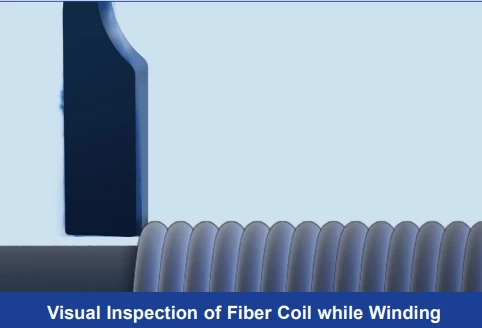
To meet the needs of diverse applications, from unmanned aerial and ground vehicles to naval platforms and industrial sensing, precision fiber coils are often supplied either in framed packages or as free‑standing coils ready for custom integration. Advanced winding equipment maintains accurate fiber placement under tightly controlled, low‑tension conditions, minimizing micro‑bending and residual stress, which in turn preserves low polarization crosstalk for PM coils and low insertion loss across the operating wavelength range. This level of process control aligns with leading solutions in the international marketplace and ensures high stability over the full lifetime of the device.
Beyond gyroscopes, these fiber coils are widely used as precise optical delay lines in coherent communication systems, radar and lidar test setups, and timing distribution networks where long, stable optical delays are required in a compact footprint. They also serve as the sensing element in fiber‑optic current sensors and other interferometric measurement systems that leverage phase or polarization changes induced by external fields. By combining customizable geometry, advanced winding techniques, and optimized material choices, precision fiber optic coils provide a robust platform for high‑accuracy rotation sensing, timing, and field measurement in both civilian and defense‑grade systems.
Fiber Optic Coils for Gyroscopes
Specifications
| Winding Length: | 10 – 5000 m |
|---|---|
| Fiber Type: | SMF-28, PM1550/980/780/etc. |
| Operating Wavelength: | 1650 nm |
| Coil Type: | Wet (W) or Dry (D) |
| Coil Inner Diameter: | ID (mm) |
| Fiber Type: | PM fiber (P) or SM fiber (S) |
| Fiber Coating/jacket Diameter: | 100 µm, 135 µm, 165 µm, 250 µm |
| Coil Package: | Framed (F) or Freestanding (N) |
| Fiber Coating Diameter Options: | 100 µm and 135 µm (mentioned for low-dimensional coils) |
Got questions about specs? Use the inquiry form to ask.
 Download Data Sheet

Features
- High‑Performance Fiber Coils for All FOG Grades – Engineered for tactical‑, navigation‑, and strategic‑grade fiber optic gyroscopes (FOGs), providing exceptional bias stability, low noise, and high sensitivity suitable for demanding defense, aerospace, and industrial navigation systems.
- Stress‑Induced High‑Birefringence PM & SM Fiber Options – Utilizes polarization‑maintaining (PM) single‑mode fiber with high birefringence to maintain polarization along the principal axis and minimize signal fading; single‑mode (SM) fiber options available for delay lines and sensing applications.
- Low Polarization Crosstalk (PM Fiber) – Optimized coil design and fiber selection result in very low polarization crosstalk, enabling higher interferometric contrast, improved scale factor stability, and reduced drift in precision FOG systems.
- Advanced Symmetrical Winding (Quadrupole, Octupole, Hexadecapole) – Coils are wound using high‑symmetry patterns such as quadrupole (standard), with optional octupole or hexadecapole winding for enhanced sensitivity and reduced error, matching or exceeding state‑of‑the‑art gyroscope coil designs used worldwide.
- Minimized Shupe Effect & Thermal Bias Errors – Symmetrical winding, carefully controlled tension, and optimized adhesives yield low temperature sensitivity and suppressed Shupe effect, reducing thermally induced bias drift for higher FOG accuracy over wide temperature ranges.
- Low‑Tension, High‑Accuracy Winding Process – Proprietary winding machines apply precise, low‑stress winding that minimizes microbending, residual stress, and geometric asymmetry, resulting in low vibration sensitivity and improved long‑term stability.
- Wide Range of Coil Lengths and Diameters – Coils can be manufactured in custom lengths and diameters to tune Sagnac sensitivity and bandwidth, from compact coils for autonomous platforms to larger coils for ultra‑high‑precision navigation.
- Multiple Fiber Coating and Jacket Diameters – Available with 100 µm, 135 µm, 165 µm, and 250 µm coating/jacket diameters, enabling low‑dimension, high‑density coils well suited to space‑ and weight‑constrained systems such as autonomous vehicles and UAVs.
- Wet and Dry Coil Types – Offered as wet (potted) coils for maximum mechanical robustness and environmental stability, or dry coils for applications requiring lower mass, reworkability, or specific thermal responses.
- Framed and Free‑Standing Package Options – Coil packages available as framed units for straightforward mechanical integration or free‑standing coils for customized system mounting and advanced FOG architectures.
- Optimized Adhesives for Different Fiber Types – Use of application‑specific adhesives matched to fiber coatings and coil mechanics helps to minimize stress, creep, and thermal mismatch, improving long‑term reliability and bias repeatability.
- High Symmetry for Superior Scale Factor Linearity – Coil geometry is carefully controlled to maintain high radial and axial symmetry, reducing nonreciprocal phase errors and improving scale factor linearity and repeatability comparable to leading global FOG coil solutions.
- Low Vibration and Shock Sensitivity – Mechanical design, potting options, and precise winding minimize susceptibility to vibration, acoustic noise, and shock, supporting mobile platforms, airborne systems, marine navigation, and rugged field instruments.
- Fully Customized Design & Co‑Engineering Service – OZ Optics can co‑design coils to customer specifications, including fiber type, coil length, diameter, winding scheme, package style, and interface requirements, ensuring an optimal match to your FOG, delay line, or sensor architecture.
- Design, Test, and Integration Support – Comprehensive design, testing, and integration services are available, including interferometric testing, insertion loss and polarization characterization, and mechanical integration guidance for faster time‑to‑market.
- Low Insertion Loss and High Reliability – Careful fiber handling and splicing deliver low optical loss and high return loss, while robust manufacturing and quality control ensure long service life in mission‑critical environments.<
Applications
- Fiber Optic Gyroscopes (FOGs) – Core sensing element for tactical, navigation, and strategic grade FOGs in aerospace, marine, land, and industrial platforms.
- Inertial Navigation Systems (INS) – High-stability rotation sensing for strapdown INS used in aircraft, spacecraft, submarines, unmanned systems, and guided munitions.
- Autonomous and Semi‑Autonomous Vehicles – Precision heading and attitude reference for self-driving cars, trucks, mining vehicles, construction equipment, agricultural robots, and warehouse AGVs.
- Robotics and Mobile Mapping – Stabilized motion feedback for SLAM systems, lidar mapping platforms, inspection robots, drones, and surveying equipment.
- Aircraft and UAV Attitude & Heading Reference – Integration into AHRS and IMU modules for fixed‑wing aircraft, helicopters, eVTOLs, and UAVs needing high-reliability inertial data.
- Marine and Subsea Navigation – FOG-based compasses and inertial units for ships, offshore platforms, ROVs, AUVs, and underwater survey systems.
- Spacecraft and Satellite Stabilization – Attitude control, platform stabilization, and pointing for satellites, launch vehicles, and space telescopes.
- Defense and Military Guidance – Ruggedized gyro coils for missile and torpedo guidance, stabilized weapon sights, fire-control systems, and target tracking platforms.
- Platform Stabilization and Gimbals – Precise motion sensing for stabilized camera systems, antenna pointing units, radar pedestals, and optical tracking mounts.
- Geophysical and Seismic Sensing – Rotation rate detection in seismic observatories, geophysical exploration tools, and structural monitoring systems.
- Precision Fiber Optic Delay Lines – Long, low-loss optical paths for timing control, signal synchronization, phase shifting, and buffering in photonic and RF-over-fiber systems.
- Microwave Photonics and RF Signal Processing – True-time-delay elements, phased-array beamforming, and coherent RF distribution using stable fiber delay coils.
- Optical Timing Distribution and Metrology – Ultra-stable delay references for time-transfer systems, frequency-comb distribution, and high-precision timing laboratories.
- Fiber Optic Current and Magnetic Field Sensors – Coils used in Faraday-effect current sensors for high-voltage substations, grid monitoring, and power electronics.
- Distributed and Multipoint Fiber Sensors – Coils integrated into interferometric or polarimetric setups for strain, pressure, acoustic, and temperature sensing.
- Vibration and Acoustic Detection – High-sensitivity interferometric coils for vibration, acoustic emission, intrusion detection, and structural health monitoring.
- Rotation and Motion Monitoring in Industrial Equipment – Long-term, maintenance‑free rotation sensing for turbines, generators, wind turbines, and heavy rotating machinery.
- Oil & Gas and Downhole Tools – High-temperature-compatible fiber coils for downhole gyroscopes, borehole imaging, and drilling tool orientation.
- Rail and Transportation Systems – FOG-based navigation and odometry support for trains, metros, and guided transport systems where GPS is intermittently unavailable.
- Navigation in GNSS-Denied Environments – Positioning and heading reference for underground mining, tunnels, urban canyons, and defense operations where GNSS/GPS is unreliable or jammed.
- Test, Calibration, and R&D Setups – Reference fiber coils for laboratory development of new FOG architectures, delay-line experiments, polarization studies, and sensor prototyping.
- Educational and Demonstration Systems – Demonstration of the Sagnac effect, interferometry, and polarization-maintaining fiber behavior in advanced physics and photonics courses.
Frequently Asked Questions
What are precision fiber optic coils for gyroscopes, delay lines, and sensors?
How do fiber optic coils improve fiber optic gyroscope (FOG) performance?
What winding patterns are available (quadrupole, octupole, hexadecapole), and why are they important?
What fiber types, coating diameters, and coil sizes can be provided?
What is the difference between wet and dry fiber coils, and when should each be used?
Which applications are best suited for these precision fiber coils?
What customization and integration support does OZ Optics offer for fiber optic gyroscope coils?
Got more questions? Use the inquiry form to ask the supplier directly.
Your inquiry has been received.
Create an account by adding a password
Why create an account?
- Auto-complete inquiry forms
- View and manage all your past messages
- Save products to your favorites
- Close your account anytime — no hassle