
Description
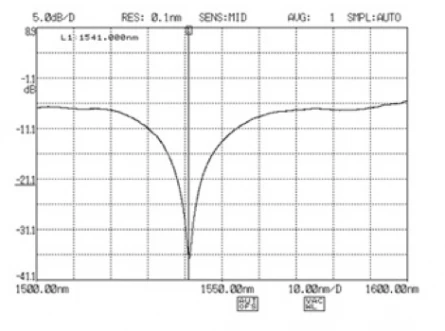
The Long Period Grating (LPG) from DK Photonics is a specialized optical fiber component designed to manipulate light propagation within fiber optic systems. Unlike traditional fiber Bragg gratings that reflect specific wavelengths, LPGs induce coupling between the core mode and forward-propagating cladding modes, resulting in wavelength-selective attenuation. This unique mechanism enables the LPG to act as a highly effective notch filter, providing precise spectral loss at designated wavelengths while maintaining low insertion loss for other wavelengths.
The structure of the Long Period Grating consists of periodic variations in the refractive index along the length of the optical fiber. These periodic modulations are engineered to satisfy phase-matching conditions for specific co-propagating modes, allowing for efficient energy transfer from the core to the cladding. The result is a customizable spectral response, making LPGs particularly valuable in applications such as gain flattening filters (GFF) for erbium-doped fiber amplifiers (EDFA), optical fiber sensing, and advanced telecommunication systems.
DK Photonics’ LPGs are compatible with standard single-mode fibers like SMF-28, ensuring seamless integration into existing fiber networks. The devices are available with various terminations, including bare fiber, FC/UPC, or FC/APC connectors, to accommodate diverse installation requirements. With a typical full width at half maximum (FWHM) ranging from 0.5 to 3 nm and a high attenuation at the center wavelength, these gratings deliver reliable, spectrally selective performance. Their robust design and customizable parameters make them suitable for both laboratory research and demanding field applications where precise wavelength control and low insertion loss are critical.
Long Period Grating Fiber Bragg Grating for Optical Sensing Filtering
Specifications
| Center Wavelength Range: | 1500 – 1600 nm |
|---|---|
| FBG Length: | Not Specified |
| Reflectivity: | >1% |
| Wavelength: | C+L |
| Insertion Loss: | >8.5 dB (+/-5nm @center wavelength) |
| FWHM: | 0.5~3 nm |
| Termination: | Bare Fiber, FC/UPC Or FC/APC (Customized) |
| Fiber Type: | SMF-28 Or Compatible |
Got questions about specs? Use the inquiry form to ask.
 Download Data Sheet

Features
- Wavelength Range: Supports C+L bands, ideal for advanced optical communication systems.
- No Reflection Type: Designed to minimize back-reflection, ensuring stable and reliable performance.
- Low Insertion Loss: Offers insertion loss greater than 8.5 dB (±5 nm @ center wavelength), optimizing signal integrity.
- Spectrally Selective Loss: Provides wavelength-dependent coupling for precise filtering and attenuation applications.
- Customizable Termination: Available with bare fiber, FC/UPC, or FC/APC connectors to suit various integration needs.
- Compatible Fiber Types: Works with SMF-28 or compatible single-mode fibers for broad compatibility.
- Flexible Bandwidth: Full Width at Half Maximum (FWHM) tunable from 0.5 to 3 nm for tailored filtering performance.
- High Stability and Reliability: Engineered for long-term operation in demanding environments.
- Versatile Applications: Perfect for use as a notch band filter, gain flattening filter (GFF) for EDFA, and optical fiber sensing.
- Compact and Robust Design: Suitable for integration into fiber optic networks and laboratory setups.
Applications
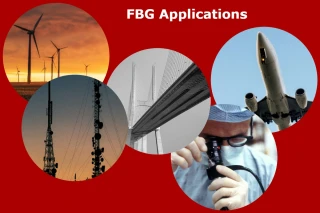
- Notch Band Filters: Used in optical communication systems to selectively block specific wavelength bands, improving signal quality and reducing noise.
- Gain Flattening Filters (GFF) for EDFA: Essential in Erbium-Doped Fiber Amplifiers (EDFA) to equalize the gain spectrum, ensuring uniform amplification across multiple channels in DWDM systems.
- Optical Fiber Sensing: Applied in distributed and point sensing for parameters such as temperature, strain, pressure, and refractive index in structural health monitoring, oil & gas, and environmental sensing.
- Wavelength Selective Loss Elements: Used to introduce controlled attenuation at specific wavelengths for channel equalization and spectral shaping in advanced optical networks.
- Mode Coupling Devices: Employed in research and development for mode conversion and mode filtering in specialty fiber applications.
- Dispersion Compensation: Utilized in optical transmission systems to manage chromatic dispersion, enhancing signal integrity over long distances.
- Laser Line Suppression: Integrated into laser systems to suppress unwanted emission lines, improving spectral purity for scientific and industrial applications.
- Biochemical and Environmental Sensing: Used as sensitive elements in sensors for detecting chemical, biological, or environmental changes due to their high sensitivity to refractive index variations.
- Wavelength Division Multiplexing (WDM) Systems: Applied for channel isolation, add/drop multiplexing, and spectral shaping in dense and coarse WDM networks.
- Optical Component Testing and Characterization: Utilized in laboratories for the calibration and testing of optical sources, detectors, and other fiber optic components.
Frequently Asked Questions
What is a Long Period Grating (LPG) in optical fibers?
What are the main features of DK Photonics' Long Period Grating?
What are the typical applications of Long Period Gratings?
What are the key specifications of DK Photonics' Long Period Grating?
How does a Long Period Grating work?
What fiber types are compatible with DK Photonics' Long Period Grating?
Can the termination of the Long Period Grating be customized?
Got more questions? Use the inquiry form to ask the supplier directly.
Similar Products
Your inquiry has been received.
Create an account by adding a password
Why create an account?
- Auto-complete inquiry forms
- View and manage all your past messages
- Save products to your favorites
- Close your account anytime — no hassle