

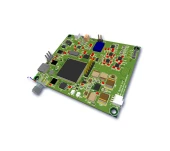
Description
The MBC-TUNABLE-SIL Modulator Bias Controller is a compact, full-function OEM solution for automatic bias control of Mach–Zehnder (MZ) modulators in demanding analog and high‑speed digital applications. Engineered to work seamlessly with lithium niobate (LN) modulators, thin-film lithium niobate (TFLN) devices, and silicon photonic modulators, it provides robust, long‑term stabilization of the modulator operating point. By continuously monitoring the optical output via an integrated or external photodetector and applying a precisely controlled bias voltage and current, the controller locks the modulator at any desired working point on the transfer curve, including Quad+, Quad−, Null, or Peak, even in environments subject to temperature drift, vibration, or long‑term aging.
In typical fiber‑optic systems, MZ modulators are highly sensitive to bias drifts that can degrade extinction ratio, linearity, and overall signal fidelity. The MBC-TUNABLE-SIL addresses these challenges with a tunable control architecture offering bias voltage adjustment from −12 V to +12 V and bias currents up to 250 mA (user‑configurable). This wide operating window makes it suitable for a broad range of integrated photonic platforms and modulator designs, including high‑Vπ discrete LN devices as well as lower‑voltage TFLN and silicon modulators. The controller maintains excellent extinction performance, enabling null mode extinction ratios up to approximately 40 dB, which is comparable to or better than many dedicated commercial bias controllers used in advanced coherent and analog optical links.
A key advantage of the MBC-TUNABLE-SIL is its flexible control strategy. It supports both calibration and locking modes: in calibration mode, the device characterizes the modulator transfer function and identifies the optimum operating point, while in locking mode it maintains this point over time by analyzing the detected optical signal. Users can select between positive or negative locking slopes and among Quad+, Quad−, Null, or Peak working points, allowing optimization for linear operation, maximum extinction, or maximum transmission as required by the application. The controller also provides tunable and fixed operating options, as well as auto and manual modes, giving system designers fine‑grained control over startup behavior, recalibration, and bias adjustment workflows.
The integrated pilot tone capability further enhances locking robustness. A small modulation tone, with a user‑adjustable amplitude in the range of approximately 20 mV to 250 mV and selectable frequencies around a few kilohertz, is superimposed on the bias. By analyzing the resulting modulation of the detected optical power, the controller can accurately determine the direction and magnitude of any drift from the setpoint and correct it in real time. For systems where rapid setup is critical, a calibration‑off mode supports quick configuration in locking mode without repeating the full characterization sequence, which is particularly useful in multi‑channel or field‑deployed platforms.
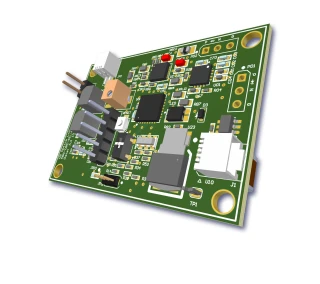
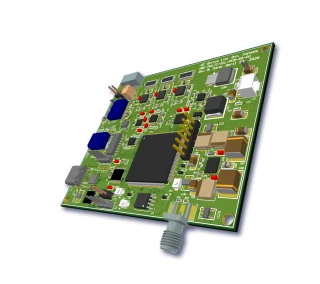
The MBC-TUNABLE-SIL is designed to integrate easily into OEM and research environments. The compact PCB form factor (approximately 2.5" × 3" × 0.65") and lightweight construction allow straightforward installation inside optical transceivers, analog transmission modules, test benches, or photonic evaluation boards. Users can choose between the standard configuration with an integrated pigtailed photodiode or a version designed for use with an external photodetector, enabling optimization for different optical power levels and layouts. The detector input power range from about −30 dBm to −10 dBm and operating wavelength coverage from roughly 1000 nm to 1650 nm make the controller suitable for a wide span of applications, from near‑infrared laboratory systems to telecom‑band fiber links.
For system control and monitoring, the MBC-TUNABLE-SIL includes a rich set of electrical and software interfaces. A USB Type‑C port provides the standard connection for a graphical user interface, enabling users to configure operating modes, working points, pilot tone settings, and bias parameters while also reading back all relevant status and diagnostic information. Optional RS232 interfaces (via DB9 or fly‑wires) support integration into existing control architectures and legacy instrumentation. All parameters are remotely controllable, which simplifies automation in multi‑channel test systems, production setups, and remote fiber‑optic links. The controller operates from symmetric DC supplies (around +15 V and −15 V) with modest current consumption, and is specified for operation over typical laboratory and industrial temperature ranges, making it a practical choice for both benchtop and embedded deployments.
Overall, the MBC-TUNABLE-SI
OZ Optics MBC TUNABLE SIL Modulator Bias Controller for LN and Silicon
Specifications
| Product Type: | MBC |
|---|---|
| Modulation Type: | Other |
| Detector Input Power: | -30 dBm |
| Locking Slope: | Positive, Negative |
| Locking Mode: | Quad+, Quad-, Null, Peak Positions |
| Photodetector Type: | External |
| Tunability: | Tunable |
| Part Number: | MBC-TUNABLE-SIL-PP-X |
| PCB Board Size: | 2.5 x 3 x 0.65 inch |
| Bias Port Voltage Range: | -12 V to +12 V |
| Bias Port Max Current: | 250 mA |
| Weight: | 0.2 lb |
| Dimensions: | 2.5 x 3 x 0.65 inch |
| Storage Temperature: | -40–85 °C |
| Operating Temperature: | 0–50 °C |
| DC Negative Power Current (typ): | 105 mA |
| DC Positive Power Current (typ): | 190 mA |
| DC Negative Power Voltage (typ): | -15 V |
| Locking Slope: | Positive or Negative |
| Detector Input Power Range \: | -30 dBm |
| Detector Input Power (max): | -10 dBm |
| Optical Wavelength: | 1000–1650 nm |
| Bias Voltage (min): | -12 V |
| Bias Voltage (max): | +12 V |
| Bias Current (max): | 250 mA |
| Null Mode Extinction Ratio (typ): | 36 dB |
| Null Mode Extinction Ratio (max): | 40 dB |
| DC Negative Power Voltage (max): | -14.5 V |
| Locking Mode: | Quad+/Quad- or Null/Peak |
| Pilot Tone Amplitude: | 20–250 mV |
| Pilot Tone Frequency: | 5 or 10 kHz |
| DC Positive Power Voltage (min): | 14.5 V |
| DC Positive Power Voltage (typ): | 15 V |
| DC Positive Power Voltage (max): | 15.5 V |
| DC Negative Power Voltage (min): | -15.5 V |
Got questions about specs? Use the inquiry form to ask.
 Download Data Sheet

Features
- Universal Compatibility with Leading Modulator Technologies
Optimized for single Lithium Niobate (LiNbO₃) Mach–Zehnder modulators, silicon photonic modulators, and thin-film lithium niobate (TFLN) modulators typically used in high‑performance analog, CATV, microwave photonics, and coherent communication systems. - Wide Bias Control Range: –12 V to +12 V
Integrated high‑compliance bias driver provides –12 V to +12 V output, accommodating a broad range of MZ modulator bias requirements including quadrature, peak, and null operating points. - High‑Current Bias Port up to 250 mA
Bias port can deliver up to 250 mA of current (user‑configurable limit), enabling reliable control of modulators and integrated photonic devices that demand higher drive currents. - Tunable Locking to Any Operating Point
Software‑selectable locking to Quad+, Quad–, Null, or Peak points on the modulator transfer function with positive or negative locking slope, ensuring optimal bias for linear operation, extinction, or maximum output power. - Advanced Bias Control Modes: Calibration & Locking
Two primary operation modes – Calibration Mode for initial setup and characterization, and Locking Mode for long‑term automatic bias stabilization, minimizing drift from temperature and aging. - Tunable/Fixed and Auto/Manual Operation
User can select between tunable or fixed bias settings, and choose automatic closed‑loop control or manual adjustment, offering flexibility for R&D labs, production test, and OEM integration. - High Extinction Ratio in Null Mode
Provides up to 36–40 dB null mode extinction ratio, supporting demanding applications that require deep suppression of the optical carrier for high dynamic range and low noise. - Integrated Pilot Tone Dithering with Adjustable Amplitude
Built‑in pilot tone for bias control with 20–250 mV amplitude adjustment and typical 5/10 kHz frequency options, allowing optimization of dither depth and minimizing interference with the RF signal band. - Pilot Tone Enable/Disable for System Flexibility
The pilot tone can be started or stopped on demand, and a Calibration Off function enables rapid system setup and fast transition to locking mode without disrupting data transmission. - Integrated and External Photodiode Options
Available with an integrated on‑board photodiode (PD) and optional pigtailed photodiode input for direct optical monitoring. An external photodetector access port is also provided to support custom monitoring configurations. - Broad Optical Wavelength Support: 1000–1650 nm
Compatible with key telecom and test wavelengths from 1000 nm to 1650 nm, including O‑, C‑, and L‑bands, suitable for both telecom/datacom and specialty photonics applications. - Robust Detector Input Power Range
Supports photodiode input levels from approximately –30 dBm to –10 dBm, enabling stable operation with a wide variety of optical link budgets and photonic setups. - Compact OEM Footprint for Easy Integration
Small PCB form factor of 2.5" × 3" × 0.65" and lightweight design (~0.2 lb) make it ideal for OEM integration in optical transceivers, evaluation boards, and compact test instruments. - Standard USB Type‑C Interface with GUI Control
Comes standard with a USB Type‑C interface and PC graphical user interface (GUI), enabling intuitive setup, monitoring, and control of all operating parameters without complex programming. - Optional RS‑232 Interfaces for System Integration
Supports optional RS232 DB9 or RS232 flywire interfaces, simplifying integration into embedded systems, legacy test racks, and automated manufacturing platforms. - Full Remote Control & Monitoring
All settings (bias mode, locking point, pilot tone, slopes, etc.) are remotely controllable via USB/RS232, and all parameters can be read back and displayed in the GUI for diagnostics and data logging. - Stable Performance over Wide Operating Temperatures
Designed for 0–50 °C operating temperature and –40–85 °C storage, providing reli
Applications
- Bias control for LiNbO₃ Mach–Zehnder (MZ) modulators in coherent optical communication systems
Maintain a stable operating point on the MZ transfer curve for applications such as QPSK, DP-QPSK, and higher-order QAM formats in long-haul and metro coherent links. - Silicon photonics modulator biasing in data center and short-reach interconnects
Actively stabilize silicon-based MZ or ring modulators in 100G/400G/800G optical transceivers to minimize drift due to temperature and process variations. - Thin-Film Lithium Niobate (TFLN) modulator control for high-speed analog links
Provide precise bias control for TFLN modulators used in broadband microwave photonic links, 5G/6G fronthaul/backhaul, and low-noise analog optical transmission. - Bias stabilization in RF-over-fiber and microwave-over-fiber systems
Lock the modulator at quadrature or null points to ensure linear transfer characteristics and low distortion for transporting RF, microwave, and millimeter-wave signals over fiber. - Linearized analog photonic links for radar, EW, and defense applications
Maintain quadrature bias for maximum linearity and dynamic range in analog optical links used in phased-array radar, electronic warfare receivers, and remote antenna remoting. - Test and measurement setups for high-speed optical components
Integrate into lab benches and automated test systems to provide stable bias control for characterizing LiNbO₃, silicon, and TFLN modulators, photonic integrated circuits, and optical transmitters. - Optical arbitrary waveform generation and photonic signal processing
Enable precise working-point control for modulators used in optical pulse shaping, arbitrary waveform generation, frequency comb manipulation, and phase/amplitude control in photonic processors. - Optical communication research and prototyping platforms
Provide a flexible, tunable bias control solution for university and R&D labs developing new modulation formats, DSP algorithms, and advanced transmitter architectures. - Bias control in coherent transmitter subsystems and integrated transceiver modules
Embed as an OEM controller board in coherent transmitters or optical engines to handle automatic bias tuning and long-term stability without manual adjustment. - Stabilization of null/peak operating points for extinction ratio optimization
Lock the modulator at null or peak to maximize extinction ratio in on-off keying (OOK), intensity-modulated direct-detect (IMDD) links, and optical switching circuits. - Automatic bias control in DWDM transmitters
Maintain consistent modulator performance across dense wavelength division multiplexing channels, ensuring stable output power and modulation depth over time and temperature. - Photonic microwave generation and optical frequency upconversion
Support stable biasing of modulators used in optical generation of RF and microwave signals, enabling low-phase-noise frequency synthesis and upconversion schemes. - Optical sensors and interferometric measurement systems
Control the operating point in interferometer-based sensing setups (e.g., fiber sensors, gyros, strain or temperature sensors) that use MZ modulators as phase or intensity actuators. - Quantum communications and quantum photonics experiments
Provide stable amplitude and phase modulation for quantum key distribution (QKD), entanglement distribution, and quantum state preparation using LiNbO₃ or integrated modulators. - Bias control in reconfigurable optical add-drop multiplexers and optical switches
Maintain consistent switching behavior in MZ-based optical switches and reconfigurable photonic circuits that rely on precise phase modulation. - Satellite and aerospace optical communication terminals
Use in harsh or thermally dynamic environments to automatically track the required working point, reducing the need for manual retuning of spaceborne or airborne optical transmitters. - Industrial and medical laser modulation systems
Enable repeatable intensity modulation for fiber lasers and solid-state lasers used in materials processing, imaging, and medical diagnostics where long-term bias stability is critical. - OEM integration into photonic integrated circuit (PIC) evaluation boards
Serve as a compact, full-function bias controller for PIC-based transmitters, facilitating evaluation, demo systems, and pilot production platforms. - Educational and training laboratories in photonics and optical communications
Provide students and trainees with a robust, u
Frequently Asked Questions
What is the MBC-TUNABLE-SIL Modulator Bias Controller and which modulators is it compatible with?
How does the MBC-TUNABLE-SIL lock the working point of a Mach-Zehnder or silicon modulator?
What are the key electrical and optical specifications of the MBC-TUNABLE-SIL?
Does the MBC-TUNABLE-SIL require an external photodiode, and how is the optical signal connected?
How is the MBC-TUNABLE-SIL controlled and what software or interfaces are available?
What power supplies and system connections do I need to use the MBC-TUNABLE-SIL in my setup?
What applications is the MBC-TUNABLE-SIL best suited for compared to other modulator bias controllers?
Got more questions? Use the inquiry form to ask the supplier directly.
Similar Products


Your inquiry has been received.
Create an account by adding a password
Why create an account?
- Auto-complete inquiry forms
- View and manage all your past messages
- Save products to your favorites
- Close your account anytime — no hassle