
Description
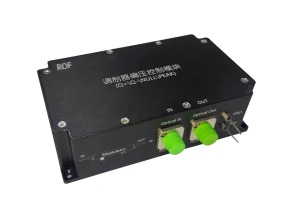
The ROF-ABC-MZ automatic bias point control module is an advanced solution designed specifically for stabilizing the operating point of lithium niobate Mach–Zehnder (M–Z) optical modulators. In demanding optical communication, microwave photonics, and pulsed laser systems, small thermal drifts or voltage fluctuations can significantly degrade modulation performance. This module continuously tracks and locks the desired bias point, ensuring that the modulator operates reliably at the quadrature point (linear region), the minimum transmission point, or the maximum transmission point depending on application needs. By maintaining an optimal operating point, the ROF-ABC-MZ helps achieve stable extinction ratio, linearity, and low distortion over long operating periods.
The ROF-ABC-MZ integrates an internal 1/99 optical coupler and detection circuitry, eliminating the need for external tap couplers or monitor photodiodes that are commonly required in manual bias control setups. This integrated design allows the module to sample a small portion of the optical signal and intelligently adjust the bias voltage between –10 V and +10 V in real time. With selectable lock modes such as Quad+ or Quad– for linear operation, and Min or Max for deep extinction or maximum throughput, the device matches the functionality found in high-end automatic bias controllers used in modern coherent and intensity-modulated links. Compared with manual bias control or simple temperature compensation schemes, it offers much higher long‑term stability and reduced maintenance effort.
Covering a very broad wavelength range from 780 nm up to 1650 nm, the ROF-ABC-MZ can be configured for common telecom and photonics bands such as 780 nm, 850 nm, 1064 nm, 1310 nm, and 1550 nm. Internal optical and electronic components are optimized for the specified wavelength at the time of ordering, enabling reliable bias control across a wide variety of LiNbO3 M–Z modulators. Users can select between single-mode or polarization-maintaining fiber pigtails and choose standard FC/APC or FC/UPC interfaces to match existing laboratory or system infrastructure. This flexibility makes the module compatible with many commercially available M–Z modulators and experimental setups.
The module supports serial communication for configuration, monitoring, and automated operation. Through the serial interface, users can switch between different bias operating modes, initiate automatic fine tuning, and lock the bias point without manual intervention. A dedicated manual adjustment mode is also available, giving researchers and developers the freedom to explore nonstandard bias conditions or to perform initial alignment before handing over control to the automatic locking algorithm. This dual operating paradigm—automatic closed-loop control combined with manual override—is particularly valuable in R&D environments where flexibility and repeatability are both crucial.
To achieve robust bias control, the ROF-ABC-MZ injects a low-depth pilot modulation signal and evaluates the response of the optical output. Typical modulation depth in quadrature mode is in the range of 1–2%, with a pilot frequency around 1 kHz for quadrature locking and around 2 kHz for null (minimum) locking. This low modulation depth is chosen to avoid disturbing the main data or analog signal while still providing sufficient sensitivity for accurate error detection and correction. The result is a stable lock with a high switching extinction ratio, which is influenced both by the controller and by the intrinsic performance of the connected modulator.
Featuring a compact module housing of approximately 120 × 70 × 34 mm, the ROF-ABC-MZ is well suited for both benchtop integration and system-level mounting. It operates from 0 °C to 70 °C, accommodating typical laboratory and controlled-environment conditions. An adapter power supply and standard electrical connectors simplify installation, and the enclosure provides mechanical protection for the internal optics and electronics. This design mirrors the form factor and usability of similar automatic bias controllers used in commercial optical transmitters and research platforms worldwide.
The ROF-ABC-MZ is particularly attractive for university laboratories, research institutes, and development teams building tabletop experiments in optical fiber communication, microwave photonics, or pulsed light applications. In these settings, long-term stability is essential when characterizing high‑speed modulation, measuring link performance, or exploring advanced modulation formats.
ROF ABC MZ Automatic Bias Control Module for Lithium Niobate Modulators
Specifications
| Product Type: | QPSK-DP/SP |
|---|---|
| Modulation Type: | PM |
| Detector Input Power: | 13 dBm |
| Locking Slope: | Positive, Negative |
| Locking Mode: | Quad+, Quad-, Null, Peak Positions |
| Photodetector Type: | Unspecified |
| Tunability: | Unspecified |
| Input Optical Power (min): | 0 dBm |
| Input Optical Power (max): | 13 dBm |
| Operating Wavelength (min): | 780 nm |
| Operating Wavelength (max): | 1650 nm |
| Optical Fiber Interface: | FC/APC |
| Bias Voltage (min): | -10 V |
| Bias Voltage (max): | 10 V |
| Switch Extinction Ratio (min): | 20 dB |
| Switch Extinction Ratio (typical): | 25 dB |
| Switch Extinction Ratio (max): | 50 dB |
| Mode-locked Region: | Positive or Negative |
| Lock Mode: | Quad+ (Quad-) or Min (Max) |
| Modulation Depth (QUAD, Min): | 1 % |
| Modulation Depth (QUAD, Max): | 2 % |
| Modulation Depth (Null): | 0.1 % |
| Pilot Frequency (QUAD): | 1 kHz |
| Pilot Frequency (NULL): | 2 kHz |
| Dimensions (L×W×T): | 120 × 70 × 34 mm |
| Operating Temperature: | 0–70 ℃ |
| Working Wavelength Option 1: | 1550 nm |
| Working Wavelength Option 2: | 1310 nm |
| Working Wavelength Option 3: | 1064 nm |
| Working Wavelength Option 4: | 850 nm |
| Working Wavelength Option 5: | 780 nm |
| Fiber Type Option 1: | Single-mode optical fiber |
| Fiber Type Option 2: | Polarization-maintaining fiber |
| Optical Fiber Interface Option 1: | FC/APC |
| Optical Fiber Interface Option 2: | FC/UPC |
Got questions about specs? Use the inquiry form to ask.
 Download Data Sheet

Features
- Automatic Bias Control for LiNbO₃ MZ Modulators
Precisely controls the bias point of lithium niobate Mach–Zehnder modulators at the minimum (Null), maximum, or quadrature (Quad) operating points (linear region) for stable, long‑term operation. - Multiple Bias Operating Modes
Supports comprehensive bias schemes including Quad+ ↔ Quad− and Min ↔ Max switching, allowing flexible optimization for different modulation formats and experiments. - Integrated 1/99 Optical Coupler
Built‑in 1/99 tap coupler for bias monitoring eliminates the need for an external coupler, simplifying optical setups and reducing insertion loss and system complexity. - Wide Wavelength Compatibility (780–1650 nm)
Internal optical components and detectors support a broad operating wavelength range from 780 nm to 1650 nm, making the module suitable for 780, 850, 1064, 1310, 1550 nm and other common wavelengths (optimized per order). - High Extinction Ratio Switching
Provides a typical switching extinction ratio of 25 dB (up to 50 dB max, depending on modulator), enabling clean transitions between operating points and high-contrast ON/OFF control. - Serial Communication and Remote Control
Features an external serial port interface for easy configuration, remote monitoring, bias point switching, and integration into automated test and control systems. - Automatic Fine Tuning and Bias Lock
Built‑in closed‑loop control performs automatic fine tuning and bias point locking to compensate for temperature drift, optical power variations, and device aging, ensuring long‑term stability. - Manual Adjustment Mode
In addition to automatic control, a manual adjustment mode allows users to fine‑tune and optimize bias settings by hand, ideal for research and development and educational labs. - Support for Diverse Modulator Types
Compatible with a wide range of LiNbO₃ MZ modulators across different wavelengths, extinction ratios, and fiber types (single‑mode or polarization‑maintaining), offering high flexibility in system design. - Quad and Null Pilot Modulation
Uses optimized pilot tones for bias control: ~1 kHz pilot for Quadrature mode and ~2 kHz pilot for Null mode, minimizing interference with data signals while maintaining robust lock. - Low Modulation Depth Pilot Signals
Very small pilot modulation depths (≈1–2% at Quad, ≈0.1% at Null) ensure that the bias control tones have negligible impact on the main optical signal quality. - Wide Bias Voltage Range
Supports a bias control voltage range of –10 V to +10 V, covering typical half‑wave voltages and operating requirements of most commercial LiNbO₃ MZ modulators. - Positive or Negative Mode-Locked Region
Capable of locking in either positive or negative mode‑locked regions, enhancing compatibility with different modulator transfer characteristics and application needs. - Broad Input Optical Power Range
Handles input optical powers from 0 to 13 dBm at the modulator maximum output, with options to adjust internal coupler and detector gain to accommodate special power requirements. - Optimized per Working Wavelength
When ordering, users specify the target wavelength (e.g., 780, 850, 1064, 1310, 1550 nm), and the internal optics and detection are factory‑optimized for maximum performance at that wavelength. - Fiber Interface Flexibility
Available with single‑mode (S) or polarization‑maintaining (P) fiber options and multiple connector types such as FC/APC (FA) and FC/UPC (FP) to match common laboratory and system setups. - Compact Module Package
Supplied as a self‑contained module with dimensions of approximately 120 × 70 × 34 mm, saving space in benchtop and rack‑mount systems while simplifying mechanical integration. - Adapter Power Supply Included
Delivered as a ready‑to‑use module with a compatible adapter power supply, enabling rapid deployment without additional power electronics design.
Applications
- High-Speed Optical Fiber Communication Links
Used to stabilize the operating point of LiNbO3 Mach-Zehnder modulators in high‑speed digital and analog optical communication systems (e.g., 10G/40G/100G and beyond), ensuring low bit‑error rate and long‑term transmission stability over 780–1650 nm. - Coherent Optical Communication and Advanced Modulation Formats
Enables precise bias control for coherent transmitters using QPSK, QAM, and other advanced modulation formats. Maintains quadrature (Quad+ / Quad−) bias for in‑phase and quadrature (I/Q) modulators in coherent detection systems used in metro, long‑haul, and data center interconnects. - Analog Optical Links and RF-over-Fiber Systems
Applied in linear analog intensity modulation links where high spurious‑free dynamic range (SFDR) is required. Stable biasing in the linear (orthogonal) region minimizes distortion for RF, microwave, and millimeter‑wave signal transport over fiber in radar, cable TV, satellite, and wireless fronthaul/backhaul systems. - Microwave Photonics Experiments
Serves as a key component in microwave photonic signal generation, filtering, and processing setups. Automatic bias control at Min/Max or Quad operating points supports low‑noise phase and intensity modulation for applications such as photonic frequency conversion, beamforming networks, and arbitrary waveform generation. - Pulsed Laser and Mode-Locked Laser Systems
Used to keep modulators at the required operating point in mode‑locked and pulsed laser systems, including pulse carving, pulse picking, and pulse shaping. The ability to operate from 780 to 1650 nm makes it suitable for fiber lasers and solid‑state lasers at 780 nm, 850 nm, 1064 nm, 1310 nm, and 1550 nm. - Optical Pulse Shaping and Temporal Modulation
Maintains a stable bias for precise temporal modulation of optical pulses in research and industrial systems. Suitable for creating custom pulse envelopes, amplitude modulation patterns, and time‑domain optical waveforms, improving repeatability in ultrafast optics experiments. - Quantum Optics and Quantum Communication Testbeds
Supports stable phase and intensity control in quantum key distribution (QKD), quantum state preparation, and entanglement experiments where LiNbO3 M‑Z modulators are used. The bias module improves stability of single‑photon level modulation and time‑bin/phase encoding over a wide wavelength range. - Photonic Research in University and Laboratory Environments
Ideal for educational and research laboratories building benchtop experiments involving LiNbO3 modulators. The serial communication interface and manual adjustment mode allow easy integration into experimental setups, enabling students and researchers to explore bias control, modulation transfer functions, and nonlinear effects. - Test and Measurement Systems for Modulators and Transmitters
Integrated into automated test benches and characterization systems for LiNbO3 M‑Z modulators, optical transmitters, and photonic integrated circuits. Automatic fine‑tuning and locking of the bias point support long‑term stability during extinction ratio, insertion loss, linearity, and chirp measurements. - Optical Sensing and Interferometric Measurement Systems
Provides stable operating conditions for interferometric sensors and fiber‑optic sensing schemes that rely on Mach‑Zehnder modulation. Helps maintain fixed operating points in interferometric measurement instruments used for strain, temperature, vibration, or refractive index sensing. - LiNbO3 Modulator Based Signal Generation
Used in optical generation of complex RF/microwave signals via intensity and phase modulation. Stable bias control is crucial for frequency multiplication, optical single‑sideband modulation, suppressing unwanted carrier or sidebands, and precise phase control in photonic signal synthesis. - Satellite, Avionics, and Defense Photonics Links
Supports harsh‑environment photonic links where long‑term bias drift cannot be tolerated. Automatic bias stabilization improves reliability in defense, avionics, and satellite RF‑over‑fiber or sensor‑over‑fiber systems employing LiNbO3 modulators. - Optical Switching and Intensity Control Modules
Employed in systems where LiNbO3 M‑Z devices function as fast optical switches or variable optical attenuators. Stable Min/Max bias control enhances extinction ratio performance and repeatability in high‑speed optical on/off switching and power control units.
Frequently Asked Questions
What is the ROF-ABC-MZ automatic bias control module and what does it do?
Which modulators and wavelengths are compatible with the ROF-ABC-MZ bias controller?
What bias operating modes does the ROF-ABC-MZ support (Quad+, Quad-, Min, Max)?
What optical power and extinction ratio conditions are required for stable bias control?
How does the ROF-ABC-MZ connect to my optical system and what fiber types are supported?
What are the electrical and environmental specifications (bias range, modulation depth, temperature)?
How do I order and customize an ROF-ABC-MZ module for my application?
Got more questions? Use the inquiry form to ask the supplier directly.
Similar Products


Your inquiry has been received.
Create an account by adding a password
Why create an account?
- Auto-complete inquiry forms
- View and manage all your past messages
- Save products to your favorites
- Close your account anytime — no hassle