


Description
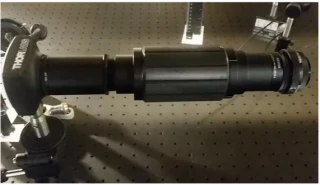
SID4 Cost-Effective High Resolution Wavefront Sensor
The SID4 wavefront sensor is an entry-level yet high-resolution optical metrology instrument designed for precise wavefront measurement across the visible and near-infrared spectrum. Covering a broad 400 nm to 1100 nm wavelength range, it is well suited for laboratories and industrial environments that require reliable phase, intensity, and beam characterization without the complexity or cost of higher-end wavefront sensing platforms.
Engineered for versatility, the SID4 provides accurate optical wavefront analysis for applications in the laser industry, high-intensity laser facilities, aerospace, and defense. Its compact design and robust measurement capability make it a practical solution for laser beam diagnostics, optical alignment, adaptive optics testing, lens and optical component inspection, and general wavefront metrology. With a 5.02 x 3.75 mm² aperture, it is optimized for precise measurements of small to medium beam profiles commonly encountered in advanced photonics and optical engineering setups.
The sensor delivers a fine 27.6 µm phase spatial resolution with 182 x 136 phase and intensity sampling, enabling detailed mapping of wavefront distortions and intensity distributions. With phase resolution below 2 nm RMS and absolute accuracy of 10 nm RMS, the SID4 supports demanding optical measurement tasks where sensitivity and repeatability are essential. Its ability to capture subtle phase variations makes it especially valuable for qualifying optical systems, analyzing laser beam quality, and validating precision optical assemblies.
For dynamic measurement environments, the SID4 offers an acquisition rate of 60 fps and real-time processing up to 10 fps at full resolution when used with compatible processing software. This makes it suitable for monitoring time-dependent optical behavior, optimizing alignment procedures, and supporting live diagnostic workflows. The Gigabit Ethernet interface provides dependable data transfer and straightforward integration into laboratory benches, production test stations, and automated measurement systems.
With compact dimensions of approximately 63 x 65 x 94 mm and a lightweight body of around 400 g, the SID4 is easy to integrate into space-constrained optical setups. Its combination of high resolution, broadband visible-to-NIR operation, compact footprint, and cost-effective positioning makes it a strong choice for users seeking a reliable high-resolution wavefront sensor for laser diagnostics, optical metrology, and advanced photonics research.
Phasics SID4 High Resolution Wavefront Sensor 400-1100 nm
Specifications
| Sensor Type: | CMOS |
|---|---|
| Measurable Sources: | CW, Pulsed |
| Wavelength Range: | 400 – 1100 nm |
| # Pixels (Width): | 182 |
| # Pixels (Height): | 136 |
| Pixel Size (Width): | 27.6 um |
| Pixel Size (Height): | 27.6 um |
| Max Full Frame Rate: | 60 Hz |
| ADC: | Unspecified |
| Wavelength Range: | 400 - 1100 nm |
| Aperture Dimensions: | 5.02 x 3.75 mm² |
| Phase Spatial Resolution: | 27.6 µm |
| Phase & Intensity Sampling: | 182 x 136 |
| Resolution (Phase): | < 2 nm RMS |
| Accuracy (Absolute): | 10 nm RMS |
| Acquisition Rate: | 60 fps |
| Real-time Processing Frequency: | 10 fps (full resolution) |
| Interface: | Giga Ethernet |
| Dimensions: | 63 x 65 x 94 mm |
| Weight: | ~ 400 g |
Got questions about specs? Use the inquiry form to ask.
 Download Data Sheet

Features
- Cost-effective high-resolution wavefront sensor designed for precise laser beam characterization, optical metrology, and wavefront analysis in visible and near-infrared applications.
- Broad 400–1100 nm wavelength range supports a wide variety of visible and NIR laser sources, making the SID4 a versatile choice for laboratories, production environments, and R&D systems.
- High phase measurement resolution with < 2 nm RMS phase resolution, enabling accurate detection of fine wavefront distortions and optical aberrations.
- Excellent absolute accuracy of 10 nm RMS for reliable quantitative wavefront measurements and repeatable optical system diagnostics.
- 5.02 x 3.75 mm² aperture provides practical coverage for compact laser beams, optical components, and metrology setups.
- 27.6 µm phase spatial resolution captures detailed wavefront information for high-resolution beam profiling and optical surface evaluation.
- 182 x 136 phase and intensity sampling enables simultaneous wavefront and intensity analysis for complete laser beam diagnostics.
- Fast 60 fps acquisition rate supports dynamic measurements, alignment tasks, and real-time monitoring of laser and optical systems.
- Real-time processing up to 10 fps at full resolution when used with PhaseStudio software, streamlining wavefront visualization, analysis, and reporting.
- Gigabit Ethernet interface ensures stable, high-speed data transfer and easy integration into industrial, laboratory, and automated optical test setups.
- Compact and lightweight design with approximate dimensions of 63 x 65 x 94 mm and a weight of about 400 g, ideal for benchtop systems and space-limited installations.
- Optimized for laser industry applications including beam quality analysis, laser alignment, collimation testing, and optical system calibration.
- Suitable for high-intensity laser facilities requiring accurate wavefront sensing for beamline diagnostics, adaptive optics support, and laser performance monitoring.
- Applicable to aerospace and defense optical metrology for testing precision optics, imaging systems, directed-energy components, and wavefront correction setups.
- Entry-level accessibility with professional-grade performance, offering a strong balance of affordability, sensitivity, speed, and measurement accuracy.
- Versatile visible-NIR wavefront sensor for research labs, OEM integration, quality control, optical alignment, adaptive optics, and advanced photonics applications.
Applications
- Laser Beam Characterization: Measure wavefront quality, beam profile, phase distortion, intensity distribution, beam divergence, and optical aberrations for visible and near-infrared laser systems from 400 to 1100 nm.
- Laser Alignment and Optimization: Support precise alignment of laser cavities, relay optics, focusing systems, beam expanders, collimators, and delivery optics in research, industrial, and laboratory environments.
- High-Power and High-Intensity Laser Diagnostics: Analyze wavefront distortions in high-energy laser chains, ultrafast laser facilities, amplifier systems, compressor stages, and beam transport lines.
- Adaptive Optics System Calibration: Provide high-resolution wavefront measurements for deformable mirror control, spatial light modulator calibration, closed-loop adaptive optics, and real-time optical correction systems.
- Optical Metrology and Wavefront Testing: Inspect lenses, mirrors, windows, prisms, filters, objectives, beam splitters, and custom optical assemblies for transmitted or reflected wavefront error.
- Visible and NIR Optical System Testing: Validate optical performance across the 400–1100 nm spectral range for imaging systems, laser optics, microscopy components, and photonics instruments.
- Lens and Objective Quality Control: Measure aberrations such as defocus, astigmatism, coma, spherical aberration, and higher-order wavefront errors in production and R&D environments.
- Collimated Beam Verification: Evaluate beam collimation, wavefront flatness, focus position, and optical alignment in laser modules, illumination systems, telescopes, and precision optical benches.
- Focal Spot and Beam Propagation Analysis: Characterize laser focusing performance, propagation quality, M²-related behavior, and wavefront-induced focal spot degradation.
- Aerospace Optical Testing: Support qualification and alignment of aerospace optics, free-space optical communication systems, star trackers, optical sensors, LiDAR transmitters, and imaging payloads.
- Defense and Directed Energy Applications: Measure and correct wavefront distortions in defense laser systems, target illumination optics, beam control systems, tracking optics, and high-performance electro-optical platforms.
- Free-Space Optical Communication: Test and optimize beam quality, wavefront stability, transmitter alignment, and optical path performance for laser communication links.
- LiDAR System Development: Characterize the wavefront and beam quality of pulsed and continuous-wave LiDAR sources used in autonomous systems, mapping, aerospace, defense, and industrial sensing.
- Semiconductor and Micro-Optics Inspection: Measure micro-lens arrays, wafer-level optics, diffractive optical elements, and compact imaging components requiring high spatial resolution wavefront sensing.
- Microscopy and Biomedical Optics: Evaluate and correct aberrations in microscope objectives, fluorescence imaging systems, ophthalmic instruments, endoscopy optics, and adaptive optics microscopy setups.
- Ophthalmic and Vision Science Research: Support measurement of optical aberrations, adaptive optics experiments, retinal imaging system alignment, and visible/NIR wavefront analysis in vision research platforms.
- Interferometry Support and Alternative Wavefront Measurement: Provide direct high-resolution phase measurement for optical testing setups where compact, vibration-tolerant, and fast wavefront sensing is preferred.
- Laser Manufacturing Quality Assurance: Integrate into production workflows for incoming inspection, final test, repeatability checks, and performance validation of laser sources and optical assemblies.
- Photonics Research and Development: Enable wavefront diagnostics for universities, national laboratories, laser research centers, photonics startups, and optical engineering teams developing advanced optical systems.
- Beamline Diagnostics in Research Facilities: Monitor wavefront stability, phase quality, optical aberrations, and beam transport performance in synchrotron, ultrafast laser, plasma physics, and high-intensity laser laboratories.
- Optical Component Alignment in Production: Assist with fast alignment and verification of compact optical modules, laser heads, fiber collimators, beam shaping systems, and NIR optical instruments.
- Wavefront Error Measurement for Precision Optics: Quantify low-level wavefront errors with high phase resolution for demanding applications requiring nanometer
Frequently Asked Questions
What is the SID4 wavefront sensor used for?
What wavelength range does the SID4 wavefront sensor cover?
What is the wavefront resolution and accuracy of the SID4?
How fast can the SID4 acquire and process wavefront data?
What are the aperture size and spatial sampling specifications of the SID4?
How does the SID4 compare with Shack-Hartmann wavefront sensors?
What interface, size, and weight does the SID4 wavefront sensor have?
Got more questions? Use the inquiry form to ask the supplier directly.
Similar Products


Your inquiry has been received.
Create an account by adding a password
Why create an account?
- Auto-complete inquiry forms
- View and manage all your past messages
- Save products to your favorites
- Close your account anytime — no hassle