


Description
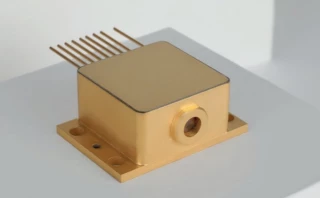
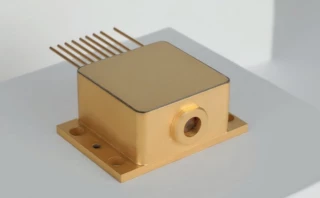
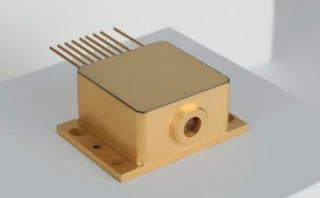
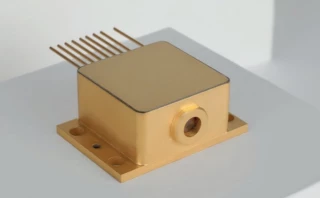
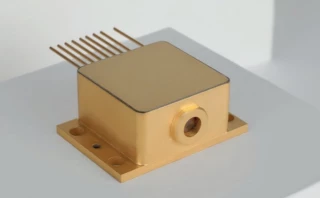
The PowerMir 4.0um High-Power Pulsed Quantum Cascade Laser is an advanced mid-infrared laser solution engineered for demanding applications. Encased in a robust High Heat Load (HHL) package, this laser boasts built-in thermoelectric cooling and collimated optics to ensure precise and stable performance even in harsh environments. With a hermetically sealed design and nitrogen gas fill, it offers exceptional reliability and longevity.
The integrated thermoelectric cooler (TEC) allows for efficient temperature control, while the built-in collimated lens enhances beam quality for accurate targeting and measurement. Operating at peak currents ranging from 1 to 4 Amps, and with a wall-plug efficiency of 5 to 10%, this laser delivers consistent and powerful performance. Whether used for gas sensing, environmental monitoring, or industrial processes, the PowerMir 4.0um laser offers unmatched versatility and reliability in mid-infrared laser technology.
PW4000090HSNA: PowerMir 4.0um High Power Pulsed Quantum Cascade Laser 100mW HHL Package Standard Beam
Specifications
| Output Power (avg): | 0.1 W |
|---|---|
| Wavelength: | 4 um |
| Pulse Duration: | 10 – 300 ns |
| Tuning Range Around Center Wavelength: | Not Applicable |
| Packaging: | Hermetically sealed HHL package with nitrogen gas fill |
| Thermoelectric Cooler (TEC): | Imax = 5.2A, Vmax = 17.5V |
| Collimated Lens: | Built-in |
| Wall-plug Efficiency: | 5 to 10 % |
| Temperature Sensor: | Built-in thermistor |
| Laser Peak Current: | Typically 1 - 4 A |
| Operational Temperature Range: | -20 to +30 °C |
| Laser Voltage: | 10-20 V |
| Weight: | 120 g |
Got questions about specs? Use the inquiry form to ask.
 Download Data Sheet

Features
- High-Power 4 µm MIR Quantum Cascade Laser System: PowerMir QCW QCL technology delivers high average optical power in the mid-infrared, with emission centered at 4 µm ± 0.1 µm across the 3.85 µm to 4.15 µm spectral band.
- ITAR-Free Mid-Infrared Laser Technology: Manufactured in France using proprietary mirSense technology, this ITAR-free QCL laser platform supports easier international procurement and integration compared with export-restricted MIR laser systems.
- Quasi-CW Operation for Higher Efficiency: Designed for QCW / high-duty-cycle pulsed operation, the laser provides increased wall-plug efficiency and reduced thermal dissipation versus comparable high-power continuous or heavily cooled MIR sources.
- Multiple Output Power Configurations: Available in power classes including >1 W, <500 mW, and <100 mW average optical power, enabling users to select the best configuration for laboratory, OEM, industrial, or export-sensitive applications.
- High Pulse Repetition Frequency: Supports pulse frequencies of >500 kHz, making it suitable for high-speed infrared spectroscopy, gas sensing, standoff detection, defense-free research applications, and industrial process monitoring.
- Excellent Mid-IR Beam Quality: Produces a TM00 Gaussian beam with low divergence, helping simplify optical alignment and improve coupling efficiency into downstream MIR optics, multipass cells, beam delivery systems, and measurement setups.
- Low-Divergence Standard Beam: Standard beam option provides full-angle far-field divergence of <6 mrad horizontal and <4 mrad vertical, with a typical window-output beam dimension of approximately 3 mm vertical x 2 mm horizontal.
- Optional Circular Beam Output: A circular beam option is available with a typical output beam diameter of <3 mm, reducing the need for external beam-shaping optics and improving system robustness for OEM integration.
- Linearly Polarized MIR Output: Delivers >98% vertically linear polarization, ideal for polarization-sensitive infrared optical systems, spectroscopy platforms, and advanced photonics instrumentation.
- Reliable HHL-Packaged Laser Design: HHL-packaged QCL lasers are available with specified output power at a regulated base plate temperature of +20°C, supporting stable operation and repeatable performance.
- Long Operating Lifetime: Designed for reliability with lifetime performance of >3500 hours, supporting demanding scientific, industrial, and OEM mid-infrared laser applications.
- Flexible System Configurations: Offered as a plug-and-play benchtop turnkey laser system, OEM driver + laser module, or HHL-packaged QCL laser, allowing easy selection for R&D, prototyping, and volume production.
- Reproducible Manufacturing for Series Production: Built for repeatable specifications and scalable production, making the platform well suited for OEM customers requiring consistent wavelength, power, and beam performance across multiple units.
- Optimized for Gas Sensing and MIR Spectroscopy: The 4 µm wavelength region is highly relevant for mid-infrared absorption spectroscopy, trace gas detection, chemical sensing, environmental monitoring, and industrial analytics.
- Reduced Thermal Load: QCW operation minimizes heat generation compared with equivalent high-power MIR sources, helping reduce cooling requirements and improving long-term system stability.
- High Wall-Plug Efficiency: Proprietary high-performance QCL technology provides strong optical output with improved electrical-to-optical efficiency, beneficial for compact MIR instruments and OEM laser systems.
- Export-Friendly Low-Power Options: The <500 mW configuration is designed for applications where lower maximum average power is preferred and may simplify export considerations compared with higher-power dual-use laser products.
- Robust Alternative to External Beam Shaping: The integrated circular beam option is produced at the chip level, offering a more durable and alignment-stable solution than add-on external optical beam circularization components.
- Ideal for OEM Integration: Compact module and HHL-package options make this 4 µm QCW QCL suitabl
Applications
Applications for 4 µm QCW Quantum Cascade Laser Systems
- Mid-Infrared Gas Sensing: High-power 4 µm QCL source for sensitive detection of gases with absorption features in the mid-infrared molecular fingerprint region.
- Trace Gas Analysis: Suitable for high-sensitivity measurement of low-concentration gas species in laboratory, industrial, environmental, and process-monitoring setups.
- Laser Absorption Spectroscopy: Ideal for tunable diode laser absorption spectroscopy, direct absorption spectroscopy, and wavelength-modulation spectroscopy in the MIR range.
- Photoacoustic Spectroscopy: High average optical power and QCW operation make the laser well suited for compact photoacoustic gas sensors and resonant photoacoustic detection systems.
- Cavity Ring-Down Spectroscopy: Useful for high-resolution, high-sensitivity spectroscopic measurements where stable mid-infrared pulsed laser power is required.
- Environmental Monitoring: Enables monitoring of atmospheric pollutants, greenhouse gases, industrial emissions, and hazardous gas leaks using mid-infrared absorption signatures.
- Industrial Process Control: Applicable to real-time inline gas monitoring in chemical plants, petrochemical facilities, semiconductor fabrication, combustion systems, and manufacturing environments.
- Combustion Diagnostics: Useful for studying combustion chemistry, exhaust composition, flame dynamics, and high-temperature gas-phase reactions in engines, turbines, furnaces, and research burners.
- Emission Monitoring: Can be integrated into continuous emissions monitoring systems for stack gas analysis, refinery monitoring, power-generation facilities, and environmental compliance applications.
- Leak Detection: Suitable for remote or point-sensing detection of gas leaks in pipelines, storage facilities, industrial plants, and enclosed process areas.
- Chemical Detection and Identification: Supports mid-infrared detection of chemical vapors and compounds for laboratory analysis, safety monitoring, and field-deployable sensing systems.
- Standoff Detection: High-power pulsed MIR output can be used in standoff detection architectures for remote sensing of chemical signatures at a distance.
- Defense and Security Sensing: ITAR-free MIR QCL technology is suitable for security screening, threat detection, target-signature analysis, and field-deployable infrared sensing platforms.
- Infrared Countermeasure Testing: Applicable as a 4 µm mid-wave infrared laser source for test and evaluation of infrared sensors, warning receivers, and electro-optical systems.
- MWIR Sensor Calibration: Can be used as a stable mid-infrared source for calibration, characterization, and performance testing of MWIR cameras, detectors, focal plane arrays, and imaging systems.
- Infrared Scene Projection and Simulation: Suitable for laboratory simulation of mid-infrared signatures used in electro-optical testing, sensor validation, and imaging system development.
- Free-Space Optical Experiments: The 4 µm wavelength range is useful for mid-infrared free-space propagation studies, atmospheric transmission testing, and optical communication research.
- Remote Sensing and LIDAR Research: High-power QCW operation supports mid-infrared LIDAR, differential absorption LIDAR, and remote chemical sensing research.
- Nonlinear Optics: Can serve as a pump or seed source for nonlinear frequency conversion, difference-frequency generation, optical parametric devices, and MIR photonics experiments.
- Mid-Infrared Photonics Development: Useful for testing MIR waveguides, fibers, photonic integrated circuits, optical coatings, filters, modulators, and specialty infrared components.
- Detector and Receiver Testing: Ideal for characterization of mercury cadmium telluride detectors, InAsSb detectors, type-II superlattice detectors, thermopiles, pyroelectric detectors, and MIR photodetectors.
- Optical Component Characterization: Suitable for measuring transmission, reflection, absorption, damage threshold, and alignment performance of mid-infrared lenses, windows, mirrors, and beam-shaping optics.
- FTIR and Spectroscopy System Enhancement: Can be used as a bright narrowband MIR source to complement or replace broadband thermal sources in targeted spectroscopy applications.
- Mid-Infrared Microscopy: Supports high-brightness illumination for infrared microscopy, chemical imaging, and sample a
Frequently Asked Questions
What is the 4 µm QCW QCL PowerMir quantum cascade laser used for?
What output power is available from this 4 µm quantum cascade laser?
What does QCW operation mean for a mid-infrared QCL?
Is the 4 µm QCW QCL ITAR free?
What wavelength range does this MIR quantum cascade laser cover?
What are the beam quality and divergence specifications of the 4 µm QCL?
What system configurations are available for integrating the 4 µm QCW QCL?
Got more questions? Use the inquiry form to ask the supplier directly.
Similar Products

Your inquiry has been received.
Create an account by adding a password
Why create an account?
- Auto-complete inquiry forms
- View and manage all your past messages
- Save products to your favorites
- Close your account anytime — no hassle