


Description
The 1.0 µm single‑mode CW fiber laser is a high‑performance, Yb‑doped fiber laser source designed for demanding scientific, industrial, and laboratory environments. Built around an all‑fiber architecture and double‑cladding pumping technology, this laser delivers continuous‑wave output powers from 0.2 W up to 20 W at a typical center wavelength of 1064 nm. The design targets applications that require excellent beam quality, high stability, and reliable long‑term operation, making it comparable to advanced laboratory‑grade fiber lasers used in precision test and measurement setups worldwide.
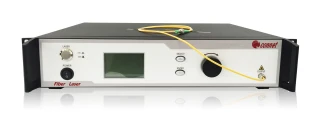
A microprocessor‑based control system provides precise and repeatable management of the laser’s operating conditions. In the benchtop configuration, a front‑panel LCD offers real‑time readouts of output power and internal temperature, along with intuitive status and warning messages. This allows users to monitor laser performance at a glance and respond quickly to any abnormal operating conditions. For OEM and system integration projects, a compact module package is also available, offering the same core optical performance in a footprint optimized for embedding into larger instruments and subsystems.
The laser’s output is engineered for near diffraction‑limited beam quality, with an M² value of less than 1.2, ensuring a clean, well‑defined spatial mode suitable for tight focusing, efficient coupling into optics, and high‑resolution measurements. The standard configuration provides single‑mode output with random polarization, while a linearly polarized, polarization‑maintaining option is available when polarization control is critical, such as in interferometry, Raman spectroscopy, and polarization‑sensitive nonlinear optics. Typical spectral width is under 1 nm (FWHM), and narrower linewidths can be specified on request to support applications that demand high spectral purity.
Output power can be continuously adjusted over a wide 10–100% range, enabling users to fine‑tune the laser level to match specific experimental conditions or detector dynamic ranges. High output stability is a key design parameter: short‑term power stability is typically within ±0.5% over 15 minutes, while long‑term stability is typically within ±1% over 8 hours under standard laboratory conditions after warm‑up. These stability metrics, combined with a side‑mode suppression ratio of at least 35 dB and integrated optical isolation, help maintain consistent results in sensitive measurements and reduce the impact of back‑reflections from downstream optics.
From an integration standpoint, the laser output is delivered through a large‑mode‑area (LMA) fiber with a standard length of more than 1 meter, terminated with an FC/APC connector or a free‑space collimator, with other connector options available as needed. Electrical compatibility is simplified: the module operates from a 12–24 V DC supply, while the benchtop version accepts a wide 100–240 V AC input range for global use. The laser is specified for operation across a broad temperature envelope, including 0 to 50 °C for benchtop units and −35 to 65 °C for modules, with storage temperatures down to −40 °C, supporting deployment in both standard laboratories and more challenging environments.
Typical applications for this 1.0 µm single‑mode CW fiber laser include precision test and measurement, scientific research, and spectroscopy analysis, as well as general laboratory use such as experimental teaching and device characterization. Its combination of high output power, excellent beam quality, and robust stability places it in the same performance class as many leading 1064 nm laboratory fiber lasers used for pump sources, nonlinear optics experiments, optical component testing, and materials studies. With optional polarization‑ maintaining output, multiple power configurations (0.2 W, 1 W, 5 W, 10 W, 20 W and custom), and flexible packaging, this laser serves as a versatile, long‑lifetime, and maintenance‑free platform for building advanced optical systems.
Connet 1.0um Single-mode CW Fiber Laser 0.2-20W
Specifications
| Center Wavelength: | 1064 nm |
|---|---|
| Output Power: | 20 W |
| Output Mode: | Continuous Wave (CW) |
| Beam Quality (M^2): | 1.2 |
| Spectral Linewidth: | 1 nm |
| Output Power Stability: | 0.9% ~ 1.0% |
| Output Fiber Type: | Other / Non-specified |
| Output Fiber Length: | 1 m |
| Cooling: | Other |
| Electrical Requirements: | 240V - 50Hz |
| Output Power Adjustable Range: | 10-100 % |
| Side-mode Suppression Ratio (SMSR): | 35 dB |
| Polarization: | Random (Linear Polarization Optional) |
| Output Isolation: | 35 dB |
| Output Isolation: | 40 dB |
| Operating Temperature (Module): | -35 to +65 ℃ |
| Operating Temperature (Benchtop): | +0 to +50 ℃ |
| Storage Temperature: | -40 to +85 ℃ |
| Operating Voltage (Module): | 12-24 VDC |
| Dimension: | 200x135x60 mm |
Got questions about specs? Use the inquiry form to ask.
 Download Data Sheet

Features
- High-Power 1.0 µm Single-Mode CW Fiber Laser (0.2–20 W) – Continuously tunable output power from 0.2 W up to 20 W to cover a wide range of test, research, and integration needs.
- Excellent Beam Quality (M² < 1.2) – Near diffraction-limited output ensures a clean, well-defined spot for high precision measurements, spectroscopy, and scientific experimentation.
- Narrow Linewidth & High Spectral Purity – Typical spectral width < 1 nm (FWHM) with side-mode suppression ratio (SMSR) ≥ 35 dB, suitable for spectroscopy, coherent detection, and stable seeding applications.
- Exceptional Power Stability – Output power stability of ±0.5% (15 minutes) and ±1% (8 hours) at 25 °C after warm-up minimizes drift in long-term experiments and measurement setups.
- Single-Mode Output with PM Option – Standard random polarization single-mode fiber output, with optional polarization-maintaining (PM) fiber for polarization-sensitive experiments and interferometric setups.
- Integrated Yb-Doped All-Fiber Design – Robust all-fiber architecture with double-clad fiber pumping technology delivers high reliability, efficient power conversion, and excellent long-term stability.
- High Output Isolation & Low Return Loss – Integrated optical isolator (up to 35 dB) and return loss ≥ 40 dB protect the laser from back-reflections, enhancing lifespan and measurement repeatability.
- Benchtop or Modular Configuration – Available as a compact module (200 × 135 × 60 mm) for OEM/system integration or as a benchtop unit (430 × 450 × 105 mm) for laboratory use.
- User-Friendly Benchtop Interface – Front-panel LCD provides real-time display of output power, operating status, and temperature, along with on-screen warning messages for safe and simple operation.
- Wide Adjustable Power Range (10–100%) – Smooth electronic power tuning allows fine control of output for sensitivity studies, calibration tasks, and component characterization.
- Wide Operating Temperature Range – Module: −35 to 65 °C; Benchtop: 0 to 50 °C. Designed for stable performance in varied lab, industrial, and field environments.
- Flexible Output Interface – Standard FC/APC connector or free-space collimated output; other connector and collimator options available for easy integration into existing optical setups.
- Long Lifetime & Maintenance-Free Operation – Solid-state fiber laser design with no moving parts and no consumables, providing high uptime and low total cost of ownership.
- Global Power Compatibility – Benchtop version operates from 100–240 V AC; module from 12–24 V DC, simplifying use in laboratories and systems worldwide.
- Ideal for Advanced Photonics Applications – Optimized for test and measurement, spectroscopy analysis, scientific research, experimental teaching, and a wide range of other laboratory and OEM applications.
Applications
- Test and Measurement Systems
Used as a stable narrow-linewidth source in optical test benches, insertion loss and return loss testing, calibration of photodetectors and power meters, and evaluation of optical components such as splitters, wavelength division multiplexers (WDMs), and circulators. - Scientific Research and Fundamental Physics
Ideal for precision laboratory experiments in optics and photonics, including nonlinear optics studies, optical trapping and manipulation, cold atom experiments (e.g., Yb-related systems near 1 µm), and time-resolved spectroscopy setups requiring high beam quality. - Spectroscopy and Spectral Analysis
Employed in high-resolution absorption and transmission spectroscopy, pump-probe spectroscopy, Raman spectroscopy, fluorescence excitation, and material characterization where a stable 1064 nm single-mode source is needed. - Optical Pumping Source
Serves as a pump laser for optical parametric oscillators (OPOs), frequency-doubling/frequency-conversion stages (e.g., generating 532 nm via SHG), mid-IR sources, and as a pump for other fiber lasers and solid‑state lasers with absorption near 1.0 µm. - Nonlinear Optics and Supercontinuum Generation
Provides high-brightness single-mode input for nonlinear fibers to generate supercontinuum light, study self-phase modulation, four-wave mixing, soliton dynamics, and other nonlinear phenomena in specialty fibers and photonic crystal fibers. - Fiber Optic Component and Device Testing
Used in characterization of isolators, couplers, modulators, filters, photonic integrated circuits, and fiber Bragg gratings (FBGs), leveraging the high stability, single-mode beam, and optional PM output for polarization-dependent measurements. - Fiber Bragg Grating (FBG) and Optical Sensor Interrogation
Serves as a stable source for FBG-based strain, temperature, and pressure sensing systems, as well as other distributed fiber sensing technologies (e.g., Rayleigh, Brillouin, and Raman-based systems) operating around 1 µm. - Metrology and Precision Alignment
Applied in interferometry, profilometry, optical path length measurement, precision alignment of optical systems, calibration of interferometers, and reference beams in metrology setups requiring low M² and stable power. - Microscopy and Imaging Illumination
Provides a coherent illumination source for confocal microscopy, multiphoton or nonlinear microscopy pump stages (after frequency conversion), optical coherence tomography (OCT) subsystems, and other advanced imaging platforms. - Educational and Training Laboratories
Well-suited for university and R&D teaching labs in photonics and laser engineering, enabling experiments on laser safety, beam propagation, fiber coupling, polarization control, and basic to advanced optical system design. - Industrial and OEM System Integration
Integrated as a master oscillator in OEM systems for instrumentation, inspection, and precision processing, including marking, micro-drilling, and scribing of materials that respond at 1.0 µm when combined with downstream amplification or frequency-conversion stages. - Material Characterization and Surface Studies
Used in reflectometry, scattering studies, thin-film evaluation, and optical property measurements of glasses, crystals, semiconductors, and coatings at 1064 nm, where stable CW illumination and excellent beam quality are crucial. - Communication and Photonic Network Research
Supports experimental work in free-space optical links, short-reach fiber systems around 1 µm, component prototyping, and optical signal processing, including external modulation and coherent detection experiments. - Laser Seeding and Master Oscillator Applications
Acts as a master oscillator or seed for high‑power Yb‑doped fiber amplifiers (YDFA) and MOPA (Master Oscillator Power Amplifier) chains, enabling high-brightness, narrow-band, stabilized output for advanced industrial and scientific systems. - General Laboratory Light Source
Functions as a robust, maintenance-free workhorse source for general optical labs, providing reliable CW illumination for alignment, diagnostics, component inspection, and system verification where a 1.0 µm single-mode laser is required.
Frequently Asked Questions
What is the Connet 1.0 µm single‑mode CW fiber laser and what are its key features?
What are the typical applications of this 1064 nm CW fiber laser compared to similar lab lasers?
How stable is the output power and beam quality of the Connet 1.0 µm CW fiber laser?
What configuration and options are available (power levels, packages, connectors, polarization)?
How do I power and control the Connet VFLS‑1064‑B/M‑MP fiber laser in a lab or OEM setup?
What are the operating and storage temperature ranges and environmental requirements?
How do I specify and order the correct 1.0 µm CW fiber laser configuration?
Got more questions? Use the inquiry form to ask the supplier directly.
Similar Products



Your inquiry has been received.
Create an account by adding a password
Why create an account?
- Auto-complete inquiry forms
- View and manage all your past messages
- Save products to your favorites
- Close your account anytime — no hassle