
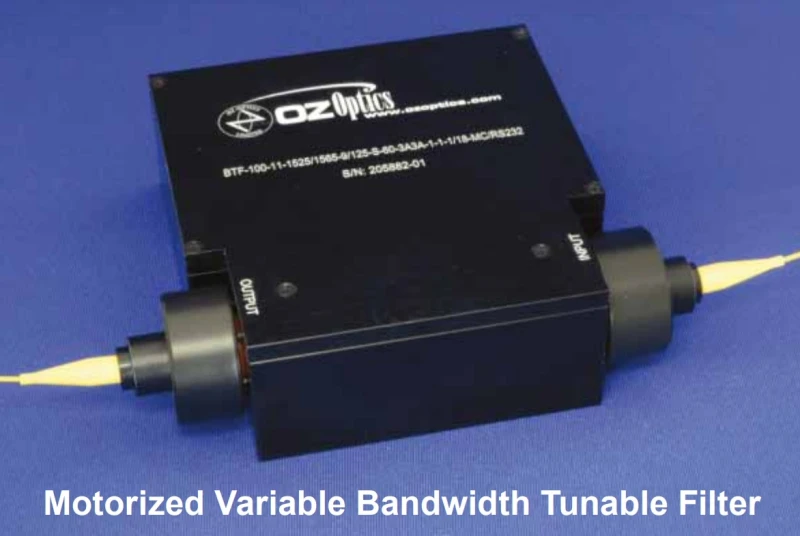
Description
The Motor Driven Adjustable Polarization Insensitive Variable Bandwidth Tunable Filter is a sophisticated optical filtering solution designed for advanced fiber optic applications. This device stands out for its ability to independently tune both the center wavelength and bandwidth, offering a high degree of flexibility and precision in optical signal management. With a tunable wavelength range of 45 nm and a continuously adjustable bandwidth from 1 to 18 nm, it is engineered to meet the demanding requirements of modern optical networks and research environments.
At the core of this filter are two multi-layer thin film bandpass filters arranged in series, each capable of independent adjustment. By varying the overlap between the two passbands, users can finely control the overall filter width and center frequency. The flat-top filter shape ensures minimal signal distortion and steep roll-off characteristics, which are crucial for applications requiring high selectivity and minimal crosstalk. The device’s motorized mechanism, combined with built-in microcontroller electronics, allows for precise and repeatable adjustments via standard electrical interfaces such as RS-232, IIC, or SPI.
A key advantage of this tunable filter is its polarization insensitivity, achieved through advanced design techniques that keep polarization-dependent loss (PDL) below 0.3 dB. This makes it exceptionally well-suited for Dense Wavelength Division Multiplexing (DWDM) systems and other polarization-sensitive applications. The filter is available in singlemode, polarization maintaining (PM), and multimode fiber configurations, supporting a wide operational wavelength range from 1100 nm to 1650 nm. Its robust construction ensures high out-of-band suppression and the ability to handle high input power, making it ideal for both laboratory and industrial environments.
Whether used for WDM channel filtering, high-speed transmission testing, laser pulse shaping, or spectral analysis, this motorized variable bandwidth tunable filter delivers reliable performance and adaptability. Its compatibility with various fiber types, including customer-supplied fibers, further enhances its versatility for integration into custom optical setups and automated testing systems.
Motor Driven Adjustable Polarization Insensitive Variable Bandwidth Tunable Filters
Specifications
| Operating Wavelength Range: | 1525 – 1565 nm |
|---|---|
| Bandwidth: | 0.002 GHz |
| Insertion Loss: | 3 dB |
| Input Power: | 200 mW |
| Wavelength Resolution: | 0.1 nm |
| Filter Edge Roll Off Slope: | 10 dB/nm |
| Insertion Loss: | 3 dB |
| Polarization Dependent Loss (PDL): | Typically less than 0.3 dB |
| Transmission Shape: | Transmission Shape |
| Wavelength/Temperature Sensitivity: | 0.002 nm/°C |
| Fiber Type: | SMF-28 (or SMF-28e) |
| Operating Temperature: | +10 to +40 °C |
| Storage Temperature: | -30 to +70 °C |
| Electrical Interface: | RS-232, IIC, or SPI |
| Supply Voltage: | 4-12.25 V |
| Operating Current: | TBD mA (dependent on operating voltage) |
| Input Voltage High: | VL - 0.4 VL V |
| VL - 0.4 VL V: | 0-0.15 V |
| Output Voltage Low: | 0-0.4 V |
| Output Voltage High: | 0.67 VL - VL V |
Got questions about specs? Use the inquiry form to ask.
 Download Data Sheet

Features
- Wide Tunable Wavelength Range: 45 nm tunable range, available for wavelengths from 1100 nm to 1650 nm, ideal for a variety of optical applications.
- Continuously Adjustable Bandwidth: Bandwidth can be precisely adjusted from 1 nm to 18 nm, allowing for flexible filtering requirements.
- Independent Wavelength and Bandwidth Control: Both center wavelength and bandwidth are independently tunable for maximum versatility.
- Flat-Top Filter Shape: Delivers a flat-top passband with steep roll-off for superior signal integrity and minimal distortion.
- Polarization Insensitive: Advanced design ensures polarization dependent loss (PDL) below 0.3 dB, making it suitable for DWDM and other polarization-sensitive applications.
- High Resolution Performance: Enables precise spectral selection and filtering for demanding optical systems.
- Multiple Fiber Options: Available in singlemode, polarization maintaining (PM), and multimode fiber versions, including PANDA fiber structure for PM options.
- High Out-of-Band Suppression: Effectively blocks unwanted wavelengths for clean signal transmission.
- High Input Power Handling: Designed to accommodate high optical power levels, supporting robust system integration.
- Integrated Microcontroller: Built-in microcontroller with RS-232, IIC, or SPI interface for easy remote control and automation.
- Motor-Driven Adjustment: Motorized mechanism allows for precise, repeatable, and automated tuning of filter parameters.
- Ideal for Advanced Applications: Perfect for WDM channel filtering, high-speed transmission testing, signal filtering, laser pulse shaping, ASE noise suppression, tunable light sources, spectral analysis, and more.
- Custom Fiber Options Available: Can be constructed using customer-supplied fibers or alternative fiber types upon request.
- Quality and Reliability: Engineered for use in fiber optic component manufacturing, quality control, product development, and automated testing environments.
Applications
- Wavelength Division Multiplexing (WDM) Channel Filtering: Precisely select and isolate specific channels in dense or coarse WDM systems for telecom and datacom applications.
- High-Speed Transmission Testing: Evaluate and optimize high-speed optical transmission systems by filtering and analyzing specific wavelength bands.
- Signal Filtering: Remove unwanted spectral components or noise from optical signals in research, development, and production environments.
- Laser Pulse Shaping: Tailor the spectral profile of laser pulses for advanced applications in ultrafast optics and photonics research.
- ASE (Amplified Spontaneous Emission) Noise Suppression: Suppress ASE noise in optical amplifiers and sources to improve signal-to-noise ratio and system performance.
- Tunable Light Sources: Create custom tunable light sources by filtering broadband or supercontinuum sources for spectroscopy, sensing, and metrology.
- Spectral Analysis: Perform high-resolution spectral analysis in laboratory, industrial, or field settings for material characterization and quality assurance.
- Fiber Optic Component Manufacturing: Integrate into automated production lines for testing, sorting, and characterizing fiber optic components such as multiplexers, demultiplexers, and filters.
- Quality Control and Measurement: Ensure product consistency and performance by filtering and measuring specific spectral bands during manufacturing processes.
- Product Development: Accelerate R&D cycles by enabling flexible, programmable filtering for prototyping and validating new optical devices and systems.
- Automated Testing: Incorporate into automated test setups for repeatable, high-throughput optical testing in both research and industrial environments.
- Optical Sensing: Enhance sensitivity and selectivity in fiber optic sensing systems by dynamically tuning filter parameters to match target analytes or environmental conditions.
- Biomedical Imaging and Diagnostics: Enable precise wavelength selection for advanced imaging modalities such as optical coherence tomography (OCT) and fluorescence imaging.
- Environmental Monitoring: Facilitate real-time spectral monitoring of environmental parameters, pollutants, or chemical species using tunable filtering techniques.
- Quantum Optics and Communications: Support quantum experiments and secure communications by filtering single photons or entangled photon pairs at specific wavelengths.
Frequently Asked Questions
What is a motor driven adjustable polarization insensitive variable bandwidth tunable filter?
What wavelength and bandwidth ranges does this tunable filter support?
How does the variable bandwidth tunable filter achieve polarization insensitivity?
What types of fiber configurations are available for this tunable filter?
What are the main applications of the motorized variable bandwidth tunable filter?
How is the filter controlled and what interfaces are supported?
What makes this tunable filter suitable for DWDM system applications?
Got more questions? Use the inquiry form to ask the supplier directly.
Similar Products

Your inquiry has been received.
Create an account by adding a password
Why create an account?
- Auto-complete inquiry forms
- View and manage all your past messages
- Save products to your favorites
- Close your account anytime — no hassle